Books like Monopolized by David Dayen


First publish date: 2020
Subjects: Economics, Monopolies, Monopoles
Authors: David Dayen
4.0 (1 community ratings)

Monopolized by David Dayen

How are these books recommended?

The books recommended for Monopolized by David Dayen are shaped by reader interaction. Votes on how closely books relate, user ratings, and community comments all help refine these recommendations and highlight books readers genuinely find similar in theme, ideas, and overall reading experience.


Have you read any of these books?
Your votes, ratings, and comments help improve recommendations and make it easier for other readers to discover books they’ll enjoy.

Books similar to Monopolized (11 similar books)
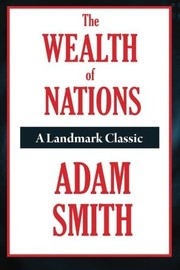
The Wealth of Nations

πŸ“˜ The Wealth of Nations
 by Adam Smith

Adam Smith's The Wealth of Nations was recognized as a landmark of human thought upon its publication in 1776. As the first scientific argument for the principles of political economy, it is the point of departure for all subsequent economic thought. Smith's theories of capital accumulation, growth, and secular change, among others, continue to be influential in modern economics. This reprint of Edwin Cannan's definitive 1904 edition of The Wealth of Nations includes Cannan's famous introduction, notes, and a full index, as well as a new preface written especially for this edition by the distinguished economist George J. Stigler. Mr. Stigler's preface will be of value for anyone wishing to see the contemporary relevance of Adam Smith's thought.

β˜…β˜…β˜…β˜…β˜…β˜…β˜…β˜…β˜…β˜… 4.1 (29 ratings)
Similar? ✓ Yes 0 ✗ No 0
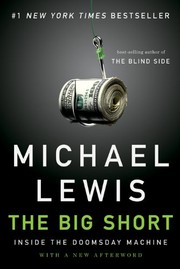
The big short

πŸ“˜ The big short

The #1 New York Times bestseller: "It is the work of our greatest financial journalist, at the top of his game. And it's essential reading."β€”Graydon Carter, Vanity Fair The real story of the crash began in bizarre feeder markets where the sun doesn't shine and the SEC doesn't dare, or bother, to tread: the bond and real estate derivative markets where geeks invent impenetrable securities to profit from the misery of lower- and middle-class Americans who can't pay their debts. The smart people who understood what was or might be happening were paralyzed by hope and fear; in any case, they weren't talking. Michael Lewis creates a fresh, character-driven narrative brimming with indignation and dark humor, a fitting sequel to his #1 bestseller Liar's Poker. Out of a handful of unlikely-really unlikely-heroes, Lewis fashions a story as compelling and unusual as any of his earlier bestsellers, proving yet again that he is the finest and funniest chronicler of our time.

β˜…β˜…β˜…β˜…β˜…β˜…β˜…β˜…β˜…β˜… 4.6 (18 ratings)
Similar? ✓ Yes 0 ✗ No 0
The Shock Doctrine

πŸ“˜ The Shock Doctrine

**The Shock Doctrine: The Rise of Disaster Capitalism** is a 2007 book by the Canadian author and social activist Naomi Klein. In the book, Klein argues that neoliberal free market policies (as advocated by the economist Milton Friedman) have risen to prominence in some developed countries because of a deliberate strategy of "shock therapy". This centers on the exploitation of national crises (disasters or upheavals) to establish controversial and questionable policies, while citizens are too distracted (emotionally and physically) to engage and develop an adequate response, and resist effectively. The book advances the idea that some man-made events, such as the Iraq War, were undertaken with the intention of pushing through such unpopular policies in their wake. Some reviewers criticized the book for making what they viewed as simplifications of political phenomena, while others lauded it as a compelling and important work. The book served as the main source of a 2009 documentary feature film with the same title directed by Michael Winterbottom. (Source: [Wikipedia](https://en.wikipedia.org/wiki/The_Shock_Doctrine))

β˜…β˜…β˜…β˜…β˜…β˜…β˜…β˜…β˜…β˜… 4.6 (18 ratings)
Similar? ✓ Yes 0 ✗ No 0
The Age of Surveillance Capitalism

πŸ“˜ The Age of Surveillance Capitalism

"Shoshana Zuboff, named "the true prophet of the information age" by the Financial Times, has always been ahead of her time. Her seminal book In the Age of the Smart Machine foresaw the consequences of a then-unfolding era of computer technology. Now, three decades later she asks why the once-celebrated miracle of digital is turning into a nightmare. Zuboff tackles the social, political, business, personal, and technological meaning of "surveillance capitalism" as an unprecedented new market form. It is not simply about tracking us and selling ads, it is the business model for an ominous new marketplace that aims at nothing less than predicting and modifying our everyday behavior--where we go, what we do, what we say, how we feel, who we're with. The consequences of surveillance capitalism for us as individuals and as a society vividly come to life in The Age of Surveillance Capitalism's pathbreaking analysis of power. The threat has shifted from a totalitarian "big brother" state to a universal global architecture of automatic sensors and smart capabilities: A "big other" that imposes a fundamentally new form of power and unprecedented concentrations of knowledge in private companies--free from democratic oversight and control"-- "In this masterwork of original thinking and research, Shoshana Zuboff provides startling insights into the phenomenon that she has named surveillance capitalism. The stakes could not be higher: a global architecture of behavior modification threatens human nature in the twenty-first century just as industrial capitalism disfigured the natural world in the twentieth. Zuboff vividly brings to life the consequences as surveillance capitalism advances from Silicon Valley into every economic sector. Vast wealth and power are accumulated in ominous new "behavioral futures markets," where predictions about our behavior are bought and sold, and the production of goods and services is subordinated to a new "means of behavioral modification." The threat has shifted from a totalitarian Big Brother state to a ubiquitous digital architecture: a "Big Other" operating in the interests of surveillance capital. Here is the crucible of an unprecedented form of power marked by extreme concentrations of knowledge and free from democratic oversight. Zuboff's comprehensive and moving analysis lays bare the threats to twenty-first century society: a controlled "hive" of total connection that seduces with promises of total certainty for maximum profit-at the expense of democracy, freedom, and our human future. With little resistance from law or society, surveillance capitalism is on the verge of dominating the social order and shaping the digital future--if we let it."--Dust jacket.

β˜…β˜…β˜…β˜…β˜…β˜…β˜…β˜…β˜…β˜… 3.9 (11 ratings)
Similar? ✓ Yes 0 ✗ No 0
Dark Money

πŸ“˜ Dark Money
 by Jane Mayer

Who are the immensely wealthy right-wing ideologues shaping the fate of America today? From the bestselling author of The Dark Side, an electrifying work of investigative journalism that uncovers the agenda of this powerful group. In her new preface, Jane Mayer discusses the results of the most recent election and Donald Trump's victory, and how, despite much discussion to the contrary, this was a huge victory for the billionaires who have been pouring money in the American political system. Why is America living in an age of profound and widening economic inequality? Why have even modest attempts to address climate change been defeated again and again? Why do hedge-fund billionaires pay a far lower tax rate than middle-class workers? In a riveting and indelible feat of reporting, Jane Mayer illuminates the history of an elite cadre of plutocratsβ€”headed by the Kochs, the Scaifes, the Olins, and the Bradleysβ€”who have bankrolled a systematic plan to fundamentally alter the American political system. Mayer traces a byzantine trail of billions of dollars spent by the network, revealing a staggering conglomeration of think tanks, academic institutions, media groups, courthouses, and government allies that have fallen under their sphere of influence. Drawing from hundreds of exclusive interviews, as well as extensive scrutiny of public records, private papers, and court proceedings, Mayer provides vivid portraits of the secretive figures behind the new American oligarchy and a searing look at the carefully concealed agendas steering the nation. Dark Money is an essential book for anyone who cares about the future of American democracy. ([source][1]) [1]: http://jane-mayer.com/

β˜…β˜…β˜…β˜…β˜…β˜…β˜…β˜…β˜…β˜… 4.3 (3 ratings)
Similar? ✓ Yes 0 ✗ No 0
The End of Alchemy

πŸ“˜ The End of Alchemy


β˜…β˜…β˜…β˜…β˜…β˜…β˜…β˜…β˜…β˜… 2.0 (1 rating)
Similar? ✓ Yes 0 ✗ No 0
Automating Inequality

πŸ“˜ Automating Inequality

A powerful investigative look at data-based discriminationβ€”and how technology affects civil and human rights and economic equity The State of Indiana denies one million applications for healthcare, foodstamps and cash benefits in three yearsβ€”because a new computer system interprets any mistake as β€œfailure to cooperate.” In Los Angeles, an algorithm calculates the comparative vulnerability of tens of thousands of homeless people in order to prioritize them for an inadequate pool of housing resources. In Pittsburgh, a child welfare agency uses a statistical model to try to predict which children might be future victims of abuse or neglect. Since the dawn of the digital age, decision-making in finance, employment, politics, health and human services has undergone revolutionary change. Today, automated systemsβ€”rather than humansβ€”control which neighborhoods get policed, which families attain needed resources, and who is investigated for fraud. While we all live under this new regime of data, the most invasive and punitive systems are aimed at the poor. In Automating Inequality, Virginia Eubanks systematically investigates the impacts of data mining, policy algorithms, and predictive risk models on poor and working-class people in America. The book is full of heart-wrenching and eye-opening stories, from a woman in Indiana whose benefits are literally cut off as she lays dying to a family in Pennsylvania in daily fear of losing their daughter because they fit a certain statistical profile. The U.S. has always used its most cutting-edge science and technology to contain, investigate, discipline and punish the destitute. Like the county poorhouse and scientific charity before them, digital tracking and automated decision-making hide poverty from the middle-class public and give the nation the ethical distance it needs to make inhumane choices: which families get food and which starve, who has housing and who remains homeless, and which families are broken up by the state. In the process, they weaken democracy and betray our most cherished national values. This deeply researched and passionate book could not be more timely.

β˜…β˜…β˜…β˜…β˜…β˜…β˜…β˜…β˜…β˜… 5.0 (1 rating)
Similar? ✓ Yes 0 ✗ No 0
A theory of incentives in procurement and regulation

πŸ“˜ A theory of incentives in procurement and regulation


β˜…β˜…β˜…β˜…β˜…β˜…β˜…β˜…β˜…β˜… 5.0 (1 rating)
Similar? ✓ Yes 0 ✗ No 0
Goliath

πŸ“˜ Goliath

A startling look at how concentrated financial power and consumerism transformed American politics, resulting in the emergence of populism and authoritarianism, the fall of the Democratic Partyβ€”while also providing the steps needed to create a new democracy. Americans once had a coherent and clear understanding of political tyranny, one crafted by Thomas Jefferson and updated for the industrial age by Louis Brandeis. A concentration of power, whether in the hands of a military dictator or a JP Morgan, was understood as autocratic and dangerous to individual liberty and democracy. This idea stretched back to the country’s founding. In the 1930s, people observed that the Great Depression was caused by financial concentration in the hands of a few whose misuse of their power induced a financial collapse. They drew on this tradition to craft the New Deal. In Goliath, Matt Stoller explains how authoritarianism and populism have returned to American politics for the first time in eighty years, as the outcome of the 2016 election shook our faith in democratic institutions. It has brought to the fore dangerous forces that many modern Americans never even knew existed. Today’s bitter recriminations and panic represent more than just fear of the future, they reflect a basic confusion about what is happening and the historical backstory that brought us to this moment. The true effects of populism, a shrinking middle class, and concentrated financial wealth are only just beginning to manifest themselves under the current administrations. The lessons of Stoller’s study will only grow more relevant as time passes. Building upon his viral article in The Atlantic, β€œHow the Democrats Killed Their Populist Soul,” Stoller illustrates in rich detail how we arrived at this tenuous moment, and the steps we must take to create a new democracy.

β˜…β˜…β˜…β˜…β˜…β˜…β˜…β˜…β˜…β˜… 0.0 (0 ratings)
Similar? ✓ Yes 0 ✗ No 0
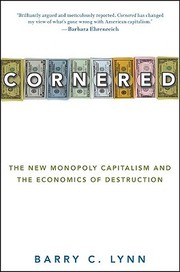
Cornered

πŸ“˜ Cornered

Journalist Barry C. Lynn paints an alarming picture: most of our public debates about globalization, competitiveness, creative destruction, and risky finance are nothing more than a cover for the widespread consolidation of power in nearly every sector of the American economy.

β˜…β˜…β˜…β˜…β˜…β˜…β˜…β˜…β˜…β˜… 0.0 (0 ratings)
Similar? ✓ Yes 0 ✗ No 0
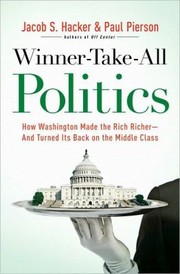
Winner-Take-All Politics

πŸ“˜ Winner-Take-All Politics


β˜…β˜…β˜…β˜…β˜…β˜…β˜…β˜…β˜…β˜… 0.0 (0 ratings)
Similar? ✓ Yes 0 ✗ No 0

Some Other Similar Books

Capital in the Twenty-First Century by Thomas Piketty
The Rise of Big Data Policing by Sarah Brayne

Have a similar book in mind? Let others know!

Please login to submit books!