Books like The myth of market share by Richard Miniter
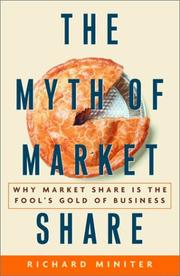

Richard Miniter skewers the sacred cow of market share and debunks the conventional wisdom that corporate profits rise as you grab more territory in the marketplace. Market share is the fool's gold of modern business. In reality, companies that maximize market share end up minimizing profits, while their smarter rivals earn higher returns. Three times out of four, on average, the most profitable firm is not the one with the largest slice of the market. Yet the myth of market share continues to hobble and kill great companies, while smaller competitors dig out real profits. Executives, entrepreneurs, investors, and regulators will learn why megamergers often fail, brand extensions wither, and stocks tumble. The Myth of Market Share also reveals a positive and proven strategy for transforming a company into a profit leader.Richard Miniter recounts many cautionary tales of great companies that refused to change--and outlines the practical plans of those that changed and flourished. Managers and investors will profit from knowing why Dell prospers by treating market share as a benchmark, not as a goal. Executives and entrepreneurs can retool their strategies by examining the case studies in this book, including Ryanair, an upstart Irish air carrier that transformed itself into the world's most profitable airline; International Paper, a manufacturing Goliath that tried to buy success; Boeing, the plane maker that pulled out of a steep dive by jettisoning its market share strategies; and DaimlerChrysler, the carmaker that stalled when it tried to be all things to all people.By providing a road map for persuading doubtful colleagues and leading a company to profit leadership, The Myth of Market Share is an entertaining, historical review and leadership tutorial, delivering proven strategies for generating long-term profits and sustainable growth during these uncertain times.
First publish date: 2002
Subjects: Management, Business, Nonfiction, Market share
Authors: Richard Miniter
0.0 (0 community ratings)

The myth of market share by Richard Miniter

How are these books recommended?

The books recommended for The myth of market share by Richard Miniter are shaped by reader interaction. Votes on how closely books relate, user ratings, and community comments all help refine these recommendations and highlight books readers genuinely find similar in theme, ideas, and overall reading experience.


Have you read any of these books?
Your votes, ratings, and comments help improve recommendations and make it easier for other readers to discover books they’ll enjoy.

Books similar to The myth of market share (13 similar books)

The Wealth of Nations by 8280760|Adam Smith book cover

πŸ“˜ The Wealth of Nations
 by Adam Smith

Adam Smith's The Wealth of Nations was recognized as a landmark of human thought upon its publication in 1776. As the first scientific argument for the principles of political economy, it is the point of departure for all subsequent economic thought. Smith's theories of capital accumulation, growth, and secular change, among others, continue to be influential in modern economics. This reprint of Edwin Cannan's definitive 1904 edition of The Wealth of Nations includes Cannan's famous introduction, notes, and a full index, as well as a new preface written especially for this edition by the distinguished economist George J. Stigler. Mr. Stigler's preface will be of value for anyone wishing to see the contemporary relevance of Adam Smith's thought.

β˜…β˜…β˜…β˜…β˜…β˜…β˜…β˜…β˜…β˜… 4.1 (29 ratings)
Similar? ✓ Yes 0 ✗ No 0
Good to Great by 6108069|Jim Collins book cover

πŸ“˜ Good to Great

The Challenge: Built to Last, the defining management study of the nineties, showed how great companies triumph over time and how long-term sustained performance can be engineered into the DNA of an enterprise from the verybeginning. But what about the company that is not born with great DNA? How can good companies, mediocre companies, even bad companies achieve enduring greatness? The Study: For years, this question preyed on the mind of Jim Collins. Are there companies that defy gravity and convert long-term mediocrity or worse into long-term superiority? And if so, what are the universal distinguishing characteristics that cause a company to go from good to great? The Standards: Using tough benchmarks, Collins and his research team identified a set of elite companies that made the leap to great results and sustained those results for at least fifteen years. How great? After the leap, the good-to-great companies generated cumulative stock returns that beat the general stock market by an average of seven times in fifteen years, better than twice the results delivered by a composite index of the world's greatest companies, including Coca-Cola, Intel, General Electric, and Merck. The Comparisons: The research team contrasted the good-to-great companies with a carefully selected set of comparison companies that failed to make the leap from good to great. What was different? Why did one set of companies become truly great performers while the other set remained only good? Over five years, the team analyzed the histories of all twenty-eight companies in the study. After sifting through mountains of data and thousands of pages of interviews, Collins and his crew discovered the key determinants of greatness -- why some companies make the leap and others don't. The Findings: The findings of the Good to Great study will surprise many readers and shed light on virtually every area of management strategy and practice. The findings include: Level 5 Leaders: The research team was shocked to discover the type of leadership required to achieve greatness. The Hedgehog Concept: (Simplicity within the Three Circles): To go from good to great requires transcending the curse of competence. A Culture of Discipline: When you combine a culture of discipline with an ethic of entrepreneurship, you get the magical alchemy of great results. Technology Accelerators: Good-to-great companies think differently about the role of technology. The Flywheel and the Doom Loop: Those who launch radical change programs and wrenching restructurings will almost certainly fail to make the leap. β€œSome of the key concepts discerned in the study,” comments Jim Collins, "fly in the face of our modern business culture and will, quite frankly, upset some people.” Perhaps, but who can afford to ignore these findings?

β˜…β˜…β˜…β˜…β˜…β˜…β˜…β˜…β˜…β˜… 3.8 (20 ratings)
Similar? ✓ Yes 0 ✗ No 0
The Innovator's Dilemma by 6744863|Clayton M. Christensen book cover

πŸ“˜ The Innovator's Dilemma

In his book, The Innovator's Dilemma [3], Professor Clayton Christensen of Harvard Business School describes a theory about how large, outstanding firms can fail "by doing everything right." The Innovator's Dilemma, according to Christensen, describes companies whose successes and capabilities can actually become obstacles in the face of changing markets and technologies. ([Source][1]) This book takes the radical position that great companies can fail precisely because they do everything right. It demonstrates why outstanding companies that had their competitive antennae up, listened astutely to customers, and invested aggressively in new technologies still lost their market leadership when confronted with disruptive changes in technology and market structure. And it tells how to avoid a similar fate. Using the lessons of successes and failures of leading companies, The Innovator's Dilemma presents a set of rules for capitalizing on the phenomenon of disruptive innovation. These principles will help managers determine when it is right not to listen to customers, when to invest in developing lower-performance products that promise lower margins, and when to pursue small markets at the expense of seemingly larger and more lucrative ones. - Jacket flap. [1]: http://web.mit.edu/6.933/www/Fall2000/teradyne/clay.html

β˜…β˜…β˜…β˜…β˜…β˜…β˜…β˜…β˜…β˜… 3.9 (16 ratings)
Similar? ✓ Yes 0 ✗ No 0
Barbarians at the gate by 6709482|Bryan Burrough book cover

πŸ“˜ Barbarians at the gate

Over six months on the New York Times bestseller list, Barbarians at the Gate is the definitive account of the largest takeover in Wall Street history. Bryan Burrough and John Helyar's gripping record of the frenzy that overtook Wall Street in October and November of 1988 is the story of deal makers and pulicity flaks, of strategy meetings and society dinners, of boardrooms and bedrooms, giving us not only an unprecedentedly detailed look at how financial operations at the highest levels are conducted but also a richly textured social history of wealth at the twilight of the Reagan era. As compelling as a novel, Barbarians at the Gate is must reading for everyone interested in the way today's world really works.

β˜…β˜…β˜…β˜…β˜…β˜…β˜…β˜…β˜…β˜… 4.1 (9 ratings)
Similar? ✓ Yes 0 ✗ No 0
The art of strategy by 8856099|Avinash K. Dixit book cover

πŸ“˜ The art of strategy


β˜…β˜…β˜…β˜…β˜…β˜…β˜…β˜…β˜…β˜… 3.8 (4 ratings)
Similar? ✓ Yes 0 ✗ No 0
Blue ocean strategy by 7424518|W. Chan Kim book cover

πŸ“˜ Blue ocean strategy

Blue Ocean Strategy is a book published in 2004 written by W. Chan Kim and RenΓ©e Mauborgne, professors at INSEAD,[1] and the name of the marketing theory detailed on the book. They assert that these strategic moves create a leap in value for the company, its buyers, and its employees while unlocking new demand and making the competition irrelevant. The book presents analytical frameworks and tools to foster an organization's ability to systematically create and capture "blue oceans"β€”unexplored new market areas.[2] An expanded edition of the book was published in 2015, while a sequel entitled Blue Ocean Shift was published in 2017.

β˜…β˜…β˜…β˜…β˜…β˜…β˜…β˜…β˜…β˜… 5.0 (2 ratings)
Similar? ✓ Yes 0 ✗ No 0
Competitive Strategy by 6518747|Michael E. Porter book cover

πŸ“˜ Competitive Strategy

ISBN: 9780029253601

β˜…β˜…β˜…β˜…β˜…β˜…β˜…β˜…β˜…β˜… 5.0 (2 ratings)
Similar? ✓ Yes 0 ✗ No 0
Organizational Culture and Leadership by 6614810|Schein, Edgar H. book cover

πŸ“˜ Organizational Culture and Leadership

In this third edition of his classic book, Edgar Schein shows how to transform the abstract concept of culture into a practical tool that managers and students can use to understand the dynamics of organizations and change. Organizational pioneer Schein updates his influential understanding of culture--what it is, how it is created, how it evolves, and how it can be changed. Focusing on today's business realities, Schein draws on a wide range of contemporary research to redefine culture, offers new information on the topic of occupational cultures, and demonstrates the crucial role leaders play in successfully applying the principles of culture to achieve organizational goals. He also tackles the complex question of how an existing culture can be changed--one of the toughest challenges of leadership. The result is a vital resource for understanding and practicing organizational effectiveness.

β˜…β˜…β˜…β˜…β˜…β˜…β˜…β˜…β˜…β˜… 5.0 (1 rating)
Similar? ✓ Yes 0 ✗ No 0
The Big Bing by 8329023|Stanley Bing book cover

πŸ“˜ The Big Bing

After two decades in the belly of the corporate beast, clawing his way to the top of one of the great multinational companies in the cosmos, Stanley Bing has seen it all. The Big Bing provides a mole's-eye view of the society in which we all live and work, in Bing's trademark funny, wise, and pleasantly mean-spirited style.A mandatory addition to the library of everyone who works for a living (or would like to).For twenty years, Stanley Bing has offered insight, wisdom, and advice from inside the belly of one of the great corporate beasts. In one essential volume, here is all you need to know to master your career, your life, and, when necessary, other weaker life forms. Bing knows whereof he speaks. He has lived the last two decades working inside a gigantic multinational corporation, kicking and screaming all the way up the ladder. During that time, he has seen it all -- mergers, acquisitions, layoffs, the death of the three-martini lunch -- and has himself been painfully reengineered a number of times. He has made a million friends and seen many of them prosper and grow, and sadly seen others sink into consultancy. He has eaten and drunk way too much, stayed in hotels far too good for him, waited for limousines in the pouring rain, and enjoyed it all. Sort of. Most important, Bing has seen management at its best and worst, and he has practiced both as he made the transition from an inexperienced player who hated pompous senior management to a polished strategist who kind of sees its point of view now and then. Bing's many fans from his days at Esquire and those who enjoy his current column in Fortune know that his take on the workplace is pure storytelling at its best -- sophisticated, amusing, and driven by the kind of insight that only a true insider can possess.The Big Bing provides a corporate mole's-eye view of the society in which we all live and toil, creating one of the most entertaining, thought-provoking, and just plain funny bodies of work in contemporary letters.

β˜…β˜…β˜…β˜…β˜…β˜…β˜…β˜…β˜…β˜… 2.0 (1 rating)
Similar? ✓ Yes 0 ✗ No 0
When cultures collide by 8850950|Richard D. Lewis book cover

πŸ“˜ When cultures collide

In this thoroughly updated and expanded 3rd edition of the groundbreaking book When Cultures Collide: Leading Across Cultures, Richard Lewis includes every major region of the world and more than sixty countries! Capturing the rising influence of culture and the seismic changes throughout many regions of the world, cross-cultural expert and international businessman Richard Lewis has significantly broadened the scope of his seminal work on global business and intercultural communication. Included are new chapters on more than a dozen countries. Within each country-specific chapter, Lewis provides invaluable insight into the beliefs, values, behaviors, mannerisms and prejudices of each culture, lending helpful advice on topics to discuss and those to avoid when communicating, guides to interpreting unique terminology, and modes of behavior that will contribute to successful communication and lasting relationships. Lewis advises on overarching guidelines for proper overseas manners, whether in a restaurant, at the home of a colleague or in the boardroom. Using dozens of scientific, yet highly accessible diagrams and building on his Linear-active, Multi-active and Reactive (LMR) culture type model, Lewis gives managers and leaders practical strategies to embrace differences and work successfully across an increasingly diverse business culture.

β˜…β˜…β˜…β˜…β˜…β˜…β˜…β˜…β˜…β˜… 0.0 (0 ratings)
Similar? ✓ Yes 0 ✗ No 0
The new gold standard by 8330005|Joseph A. Michelli book cover

πŸ“˜ The new gold standard

Discover the secrets of world-class leadership!When it comes to refined service and exquisite hospitality, one name stands high above the rest: The Ritz-Carlton Hotel Company. With ceaseless attention to every luxurious detail, the company has set the bar for creating memorable customer experiences in world-class settings. Now, for the first time, the leadership secrets behind the company's extraordinary success are revealed.The New Gold Standard takes you on an exclusive tour behind the scenes of The Ritz-Carlton Hotel Company. Granted unprecedented access to the company's executives, staff, and its award-winning Leadership Center training facilities, bestselling author Joseph Michelli explored every level of leadership within the organization. He emerged with the key principles leaders at any company can use to provide a customer experience unlike any other, such as:Understanding the ever-evolving needs of customersEmpowering employees by treating them with the utmost respectAnticipating customers' unexpressed needs and concernsDeveloping and conducting an unsurpassed training regimenSharing engaging stories from the company's employees--from the corporate office and hotels around the globe--Michelli describes the innovative methods the company uses to create peerless guest experiences and explains how it constantly hones and improves them.The New Gold Standard weaves practical how-to advice, proven leadership tools, and the wisdom of experts to help you create and embed superior customer-service principles, processes, and practices in your own organization.

β˜…β˜…β˜…β˜…β˜…β˜…β˜…β˜…β˜…β˜… 0.0 (0 ratings)
Similar? ✓ Yes 0 ✗ No 0
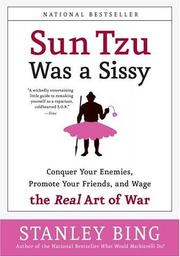
Sun Tzu Was a Sissy by 8329023|Stanley Bing book cover

πŸ“˜ Sun Tzu Was a Sissy

We live in a vicious, highly competitive workplace environment, and things aren't getting any better. Jobs are few and far between, and people aren't any nicer now than they were when Ghengis Khan ran around in big furs killing people in unfriendly acquisitions. For thousands of years, people have been reading the writings of the deeply wise, but also extremely dead Chinese philosopher Sun Tzu, who was perhaps the first to look on the waging of war as a strategic art that could be taught to people who wished to be warlords and other kinds of senior managers.In a nutshell, Sun Tzu taught that readiness is all, that knowledge of oneself and the enemy was the foundation of strength and that those who fight best are those who are prepared and wise enough not to fight at all. Unfortunately, in the current day, this approach is pretty much horse hockey, a fact that has not been recognized by the bloated, tree-hugging Sun Tzu industry, which churns out mushy-gushy pseudo-philosophy for business school types who want to make war and keep their hands clean.Sun Tzu was a Sissy will transcend all those efforts and teach the reader how to make war, win and enjoy the plunder in the real world, where those who do not kick, gouge and grab are left behind at the table to pay the tab. Students of Bing will be taught how to plan and execute battles that hurt other people a lot, and advance their flags and those of their friends, if possible. All military strategies will be explored, from mustering, equipping, organizing, plotting, scheming, rampaging, squashing and reaping spoils.Every other book on the Art of War bows low to Sun Tzu. We're going to tell him to get lost and inform our readers how real war is currently conducted on the battlefield of life.

β˜…β˜…β˜…β˜…β˜…β˜…β˜…β˜…β˜…β˜… 0.0 (0 ratings)
Similar? ✓ Yes 0 ✗ No 0
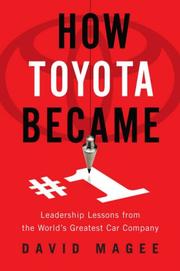
How Toyota Became #1 by 6061282|David Magee book cover

πŸ“˜ How Toyota Became #1

Everyone knows that Toyota has had an amazing twenty-five- year run, rising from a humble Japanese start-up to a thriving global giant. But how did it pass Ford and GM to become the world's largest auto manufacturer? And how does it continue to thrive while so many competitors are struggling and failing?Journalist David Magee dug deeply into Toyota's past and present, interviewing senior executives who rarely talk to the press, along with many other sources. The powerful lessons that he distills, especially about corporate culture, are valuable for managers in all industries.

β˜…β˜…β˜…β˜…β˜…β˜…β˜…β˜…β˜…β˜… 0.0 (0 ratings)
Similar? ✓ Yes 0 ✗ No 0

Some Other Similar Books

The Leverage Equation by Nicholas C. Bouchard
Understanding Michael Porter by JoΓ«l Bessis
The End of Competitive Advantage by Richard P. Rumelt

Have a similar book in mind? Let others know!

Please login to submit books!