Books like Glory and failure by Michael Lindgren


First publish date: 1987
Subjects: History, Histoire, Calculators, Computers, history, Calculatrices
Authors: Michael Lindgren
0.0 (0 community ratings)

Glory and failure by Michael Lindgren

How are these books recommended?

The books recommended for Glory and failure by Michael Lindgren are shaped by reader interaction. Votes on how closely books relate, user ratings, and community comments all help refine these recommendations and highlight books readers genuinely find similar in theme, ideas, and overall reading experience.


Have you read any of these books?
Your votes, ratings, and comments help improve recommendations and make it easier for other readers to discover books they’ll enjoy.

Books similar to Glory and failure (12 similar books)
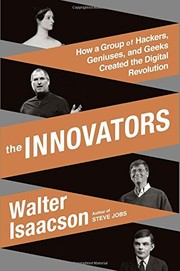
The Innovators by 12661862|Walter Isaacson book cover

πŸ“˜ The Innovators

Following his blockbuster biography of Steve Jobs, The Innovators is Walter Isaacson’s revealing story of the people who created the computer and the Internet. It is destined to be the standard history of the digital revolution and an indispensable guide to how innovation really happens. What were the talents that allowed certain inventors and entrepreneurs to turn their visionary ideas into disruptive realities? What led to their creative leaps? Why did some succeed and others fail? In his masterly saga, Isaacson begins with Ada Lovelace, Lord Byron’s daughter, who pioneered computer programming in the 1840s. He explores the fascinating personalities that created our current digital revolution, such as Vannevar Bush, Alan Turing, John von Neumann, J.C.R. Licklider, Doug Engelbart, Robert Noyce, Bill Gates, Steve Wozniak, Steve Jobs, Tim Berners-Lee, and Larry Page. This is the story of how their minds worked and what made them so inventive. It’s also a narrative of how their ability to collaborate and master the art of teamwork made them even more creative. For an era that seeks to foster innovation, creativity, and teamwork, The Innovators shows how they happen.

β˜…β˜…β˜…β˜…β˜…β˜…β˜…β˜…β˜…β˜… 3.9 (21 ratings)
Similar? ✓ Yes 0 ✗ No 0
The post-American world by 8320032|Fareed Zakaria book cover

πŸ“˜ The post-American world

"This is not a book about the decline of America, but rather about the rise of everyone else." So begins Fareed Zakaria's important new work on the era we are now entering. Following on the success of his best-selling The Future of Freedom, Zakaria describes with equal prescience a world in which the United States will no longer dominate the global economy, orchestrate geopolitics, or overwhelm cultures. He sees the "rise of the rest"β€”the growth of countries like China, India, Brazil, Russia, and many othersβ€”as the great story of our time, and one that will reshape the world. The tallest buildings, biggest dams, largest-selling movies, and most advanced cell phones are all being built outside the United States. This economic growth is producing political confidence, national pride, and potentially international problems. How should the United States understand and thrive in this rapidly changing international climate? What does it mean to live in a truly global era? Zakaria answers these questions with his customary lucidity, insight, and imagination.

β˜…β˜…β˜…β˜…β˜…β˜…β˜…β˜…β˜…β˜… 3.8 (4 ratings)
Similar? ✓ Yes 0 ✗ No 0
Destiny disrupted by 6552491|Mir Tamim Ansary book cover

πŸ“˜ Destiny disrupted

We in the west share a common narrative of world historyβ€”that runs from the Nile Valley and Mesopotomia, through Greece and Rome and the French Revolution, to the rise of the secular state and the triumph of democracy. But our story largely omits a whole civilization that until quite recently saw itself at the center of world history, and whose citizens shared an entirely different narrative for a thousand years. In Destiny Disrupted, Tamim Ansary tells the rich story of world history as the Islamic world saw it, from the time of Mohammed to the fall of the Ottoman Empire and beyond. He clarifies why our civilizations grew up oblivious to each other, what happened when they intersected, and how the Islamic world was affected by its slow recognition that Europeβ€”a place it long perceived as primitive and disorganizedβ€”had somehow hijacked destiny. Entertaining and enlightening, Destiny Disrupted also offers a vital perspective on current conflicts.

β˜…β˜…β˜…β˜…β˜…β˜…β˜…β˜…β˜…β˜… 4.7 (3 ratings)
Similar? ✓ Yes 0 ✗ No 0
Howard Aiken by 6712953|I. Bernard Cohen book cover

πŸ“˜ Howard Aiken

Howard Hathaway Aiken (1900-1973) was a major figure of the early digital era. He is best known for his first machine, the IBM Automatic Sequence Controlled Calculator or Harvard Mark I, conceived in 1937 and put into operation in 1944. But he also made significant contributions to the development of applications for the new machines and to the creation of a university curriculum for computer science. This biography of Aiken, by a major historian of science who was also a colleague of Aiken's at Harvard, offers a clear and often entertaining introduction to Aiken and his times.

β˜…β˜…β˜…β˜…β˜…β˜…β˜…β˜…β˜…β˜… 4.0 (2 ratings)
Similar? ✓ Yes 0 ✗ No 0
The limits of power by 10154313|Andrew J. Bacevich book cover

πŸ“˜ The limits of power

Bacevich traces how America's messianic exceptionalism coupled with the rise of the military from Truman on has lead to the current dismal relationship between America and the world.

β˜…β˜…β˜…β˜…β˜…β˜…β˜…β˜…β˜…β˜… 3.0 (1 rating)
Similar? ✓ Yes 0 ✗ No 0
Computing before computers by 10143379|William Aspray book cover

πŸ“˜ Computing before computers


β˜…β˜…β˜…β˜…β˜…β˜…β˜…β˜…β˜…β˜… 0.0 (0 ratings)
Similar? ✓ Yes 0 ✗ No 0
The Closed World by 8776870|Paul N. Edwards book cover

πŸ“˜ The Closed World

The Closed World offers a radical alternative to the canonical histories of computers and cognitive science. Arguing that we can make sense of computers as tools only when we simultaneously grasp their roles as metaphors and political icons, Paul Edwards shows how Cold War social and cultural contexts shaped emerging computer technology - and were transformed, in turn, by information machines. The Closed World explores three apparently disparate histories - the history of American global power, the history of computing machines, and the history of subjectivity in science and culture - through the lens of the American political imagination. In the process, it reveals intimate links among the military projects of the Cold War, the evolution of digital computers, and the origins of cybernetics, cognitive psychology, and artificial intelligence.

β˜…β˜…β˜…β˜…β˜…β˜…β˜…β˜…β˜…β˜… 0.0 (0 ratings)
Similar? ✓ Yes 0 ✗ No 0
A few good men from Univac by 8369538|David E. Lundstrom book cover

πŸ“˜ A few good men from Univac


β˜…β˜…β˜…β˜…β˜…β˜…β˜…β˜…β˜…β˜… 0.0 (0 ratings)
Similar? ✓ Yes 0 ✗ No 0
A history of computing technology by 9728949|Williams, Michael R. book cover

πŸ“˜ A history of computing technology

This second edition of the popular reference and textbook outlines the historical developments in computing technology. It describes historical aspects of calculation and concentrates on the physical devices used to aid people in their attempts at automating the process of arithmetic.

β˜…β˜…β˜…β˜…β˜…β˜…β˜…β˜…β˜…β˜… 0.0 (0 ratings)
Similar? ✓ Yes 0 ✗ No 0
Between Human and Machine by 7090448|David A. Mindell book cover

πŸ“˜ Between Human and Machine

Mindell ponders the orgin of cybernetics beyond Norbert Wiener's 1948 hypothesis. Mindell returns to the time between the World Wars, when four disparate computing research cultures thrived in the United States: the U.S. Navy, the Sperry Gyroscope Company, the Bell Telephone Laboratories, and Vannevar Bush's laboratory at MIT. In each culture, different technical problems, organizational imperatives, and working evironment existed, but they were all researching control, communications, and computing. When President Roosevelt synthesized the four engineering cultures into a representative government committee, they suffused engineering research with good principles and later made it possible for Norbert Wiener's 1948 formulation of cybernetics.

β˜…β˜…β˜…β˜…β˜…β˜…β˜…β˜…β˜…β˜… 0.0 (0 ratings)
Similar? ✓ Yes 0 ✗ No 0
Ada's algorithm by 11381419|James Essinger book cover

πŸ“˜ Ada's algorithm

Behind every great man, there's a great woman; no other adage more aptly describes the relationship between Charles Babbage, the man credited with thinking up the concept of the programmable computer, and mathematician Ada Lovelace, whose contributions, according to Essinger, proved indispensable to Babbage's invention. The Analytical Engine was a series of cogwheels, gear-shafts, camshafts, and power transmission rods controlled by a punch-card system based on the Jacquard loom. Lovelace, the only legitimate child of English poet Lord Byron, wrote extensive notes about the machine, including an algorithm to compute a long sequence of Bernoulli numbers, which some observers now consider to be the world's first computer program.

β˜…β˜…β˜…β˜…β˜…β˜…β˜…β˜…β˜…β˜… 0.0 (0 ratings)
Similar? ✓ Yes 0 ✗ No 0
Proud Glory by 6967051|Ann Forman Barron book cover

πŸ“˜ Proud Glory


β˜…β˜…β˜…β˜…β˜…β˜…β˜…β˜…β˜…β˜… 0.0 (0 ratings)
Similar? ✓ Yes 0 ✗ No 0

Some Other Similar Books

The Pursuit of Power by Robert Kagan
The Cold War and After by Joseph Nye
The Future of Power by Joseph Nye
The War That Made the Roman Empire by Barry Strauss
Power and Persuasion by Susan Carruthers
The American Way of War by Michael A. Elliott

Have a similar book in mind? Let others know!

Please login to submit books!