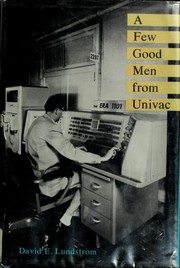
Books like A few good men from Univac by David E. Lundstrom

First publish date: 1987
Genre: Technology & Computing/Computer Science
Authors: David E. Lundstrom
★ ★ ★ ★ ★ 0.0 (0 community ratings)

A few good men from Univac by David E. Lundstrom

How are these books recommended?

The books recommended for A few good men from Univac by David E. Lundstrom are shaped by reader interaction. Votes on how closely books relate, user ratings, and community comments all help refine these recommendations and highlight books readers genuinely find similar in theme, ideas, and overall reading experience.


Have you read any of these books?
Your votes, ratings, and comments help improve recommendations and make it easier for other readers to discover books they’ll enjoy.

Books similar to A few good men from Univac (12 similar books)
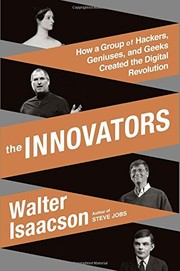
The Innovators by 12661862|Walter Isaacson book cover

πŸ“˜ The Innovators

Walter Isaacson chronicles the minds that forged the digital age, from Ada Lovelace to Larry Page, showing how vision, collaboration, and engineering transformed abstract ideas into the computers, Internet, and technology we use today.

β˜…β˜…β˜…β˜…β˜…β˜…β˜…β˜…β˜…β˜… 3.9 (21 ratings)
Similar? ✓ Yes 0 ✗ No 0
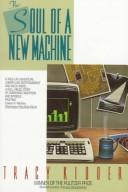
The Soul of a New Machine by 6337648|Tracy Kidder book cover

πŸ“˜ The Soul of a New Machine

A 1981 nonfiction work by Tracy Kidder that follows a computer‑engineering team building the Data General Eclipse MV/8000β€”a high‑speed minicomputerβ€”under intense deadline pressure.

β˜…β˜…β˜…β˜…β˜…β˜…β˜…β˜…β˜…β˜… 4.1 (15 ratings)
Similar? ✓ Yes 0 ✗ No 0
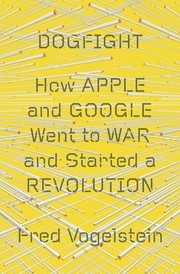
Dogfight by 11730122|Fred Vogelstein book cover

πŸ“˜ Dogfight

Apple and Google battle for dominance over the mobile and media markets, revealing how their rivalry reshapes technology, content and competition in Silicon Valley and beyond.

β˜…β˜…β˜…β˜…β˜…β˜…β˜…β˜…β˜…β˜… 2.7 (6 ratings)
Similar? ✓ Yes 0 ✗ No 0
Machines of loving grace by 8836719|John Markoff book cover

πŸ“˜ Machines of loving grace

John Markoff explores the rapid rise of robots and artificial intelligence, tracing their history and evaluating how they are reshaping work, society, and ethics in a world where technology grows faster than we can predict.

β˜…β˜…β˜…β˜…β˜…β˜…β˜…β˜…β˜…β˜… 3.5 (2 ratings)
Similar? ✓ Yes 0 ✗ No 0
Accidental empires by 9687053|Robert X. Cringely book cover

πŸ“˜ Accidental empires


β˜…β˜…β˜…β˜…β˜…β˜…β˜…β˜…β˜…β˜… 3.5 (2 ratings)
Similar? ✓ Yes 0 ✗ No 0
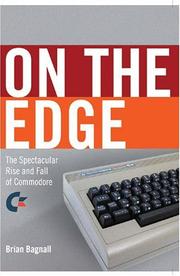
On the Edge by 14082769|Brian Bagnall book cover

πŸ“˜ On the Edge


β˜…β˜…β˜…β˜…β˜…β˜…β˜…β˜…β˜…β˜… 5.0 (1 rating)
Similar? ✓ Yes 0 ✗ No 0
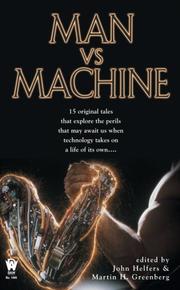
Man Vs Machine by 6061114|Martin H. Greenberg book cover

πŸ“˜ Man Vs Machine

Fifteen fresh science‑fiction tales explore how rising artificial intelligence and advanced technology might reshape society, raise ethical dilemmas, and challenge humanity’s control.

β˜…β˜…β˜…β˜…β˜…β˜…β˜…β˜…β˜…β˜… 4.0 (1 rating)
Similar? ✓ Yes 0 ✗ No 0
Computer by 9564750|Martin Campbell-Kelly book cover

πŸ“˜ Computer

Computer: A History of the Information Machine explores how business and government, rather than just scientists, drove the invention and evolution of computers, from mainframes to the PC revolution and the rise of companies like IBM, Apple, and Microsoft.

β˜…β˜…β˜…β˜…β˜…β˜…β˜…β˜…β˜…β˜… 0.0 (0 ratings)
Similar? ✓ Yes 0 ✗ No 0
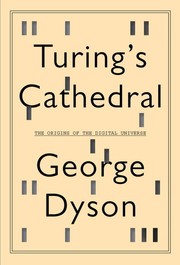
Turing's cathedral by 6805658|George Dyson book cover

πŸ“˜ Turing's cathedral

Legendary historian and philosopher of science George Dyson vividly re-creates the scenes of focused experimentation, incredible mathematical insight, and pure creative genius that gave us computers, digital television, modern genetics, models of stellar evolution--in other words, computer code. In the 1940s and '50s, a group of eccentric geniuses--led by John von Neumann--gathered at the newly created Institute for Advanced Study in Princeton, New Jersey. Their joint project was the realization of the theoretical universal machine, an idea that had been put forth by mathematician Alan Turing. This group of brilliant engineers worked in isolation, almost entirely independent from industry and the traditional academic community. But because they relied exclusively on government funding, the government wanted its share of the results: the computer that they built also led directly to the hydrogen bomb. George Dyson has uncovered a wealth of new material about this project, and in bringing the story of these men and women and their ideas to life, he shows how the crucial advancements that dominated twentieth-century technology emerged from one computer in one laboratory, where the digital universe as we know it was born.

β˜…β˜…β˜…β˜…β˜…β˜…β˜…β˜…β˜…β˜… 0.0 (0 ratings)
Similar? ✓ Yes 0 ✗ No 0
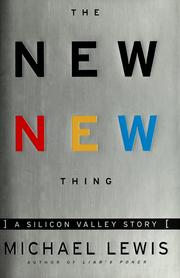
The New New Thing by 6940939|Michael Lewis book cover

πŸ“˜ The New New Thing

A groundbreaking book that explores a paradigm shift in American culture through the lens of a single entrepreneur's vision of the future of the Internet.

β˜…β˜…β˜…β˜…β˜…β˜…β˜…β˜…β˜…β˜… 0.0 (0 ratings)
Similar? ✓ Yes 0 ✗ No 0
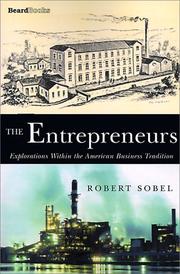
The entrepreneurs by 7745196|Robert Sobel book cover

πŸ“˜ The entrepreneurs

Thomas Edison -- King Gilette -- Adolph Zukor -- Mary Kay Ash -- Frederick Weyerhaeuser -- Frank Purdue -- John D. Rockefeller -- De Witt Clinton -- J.P. Morgan -- Alfred P. Sloan -- Samuel Colt -- Andrew Carnegie -- Henry Ford -- P.T. Barnum -- A.T. Stewart -- Montgomery Ward -- Samuel F.B. Morse -- David Sarnoff.

β˜…β˜…β˜…β˜…β˜…β˜…β˜…β˜…β˜…β˜… 0.0 (0 ratings)
Similar? ✓ Yes 0 ✗ No 0
Where Wizards Stay Up Late by 7829178|Katie Hefner book cover

πŸ“˜ Where Wizards Stay Up Late

A little more than twenty-five years ago, computer networks did not exist anywhere - except in the minds of a handful of computer scientists. In the late 1960s, the Defense Department's Advanced Research Projects Agency funded a project to create computer communication among its university-based researchers. The experiment was inspired by J. C. R. Licklider, a brilliant scientist from MIT. At a time when computers were generally regarded as nothing more than giant calculators, Licklider saw their potential as communications devices. Where Wizards Stay Up Late is the story of the small group of researchers and engineers whose invention, daring in its day, became the foundation for the Internet. With ARPA's backing, Licklider and others began the quest for a way to connect computers across the country. In 1969, ARPA awarded the contract to build the most integral piece of this network - a computerized switch called the Interface Message Processor, or IMP - to Bolt Beranek and Newman (BBN), a small Cambridge, Massachusetts, company. A half-dozen engineers at BBN, who called themselves the IMP Guys, knew it was possible to do what larger companies - including AT&T and IBM - had dismissed as impossible. But making computer networking possible required inventing new technologies. Working around the clock, the IMP Guys met a tight deadline, and the first IMP was installed at UCLA nine months after the contract award. A nationwide network called the ARPANET grew from four initial sites. Protocols were developed, and along the way a series of accidental discoveries were made, not the least of which was e-mail. Almost immediately, e-mail became the most popular feature of the Net and the "@" sign became lodged in the iconography of our times. The ARPANET continued to grow, then merged with other computer networks to become today's Internet. In 1990, the ARPANET itself was shut down, fully merged by then with the Internet it had spawned.

β˜…β˜…β˜…β˜…β˜…β˜…β˜…β˜…β˜…β˜… 0.0 (0 ratings)
Similar? ✓ Yes 0 ✗ No 0

Some Other Similar Books

The Computer Always Wins by John K. Thompson
Hackers: Heroes of the Computer Revolution by Steven Levy
Code: The Hidden Language of Computer Hardware and Software by Charles Petzold
The Mythical Man-Month by Frederick P. Brooks Jr.
Rebel Code: Linux and the Open Source Revolution by Glyn Moody

Have a similar book in mind? Let others know!

Please login to submit books!