Books like Pumping ions by Tom Wujec


First publish date: 1988
Subjects: Problems, exercises, Thought and thinking, Problèmes et exercices, Pensée
Authors: Tom Wujec
0.0 (0 community ratings)

Pumping ions by Tom Wujec

How are these books recommended?

The books recommended for Pumping ions by Tom Wujec are shaped by reader interaction. Votes on how closely books relate, user ratings, and community comments all help refine these recommendations and highlight books readers genuinely find similar in theme, ideas, and overall reading experience.


Have you read any of these books?
Your votes, ratings, and comments help improve recommendations and make it easier for other readers to discover books they’ll enjoy.

Books similar to Pumping ions (15 similar books)

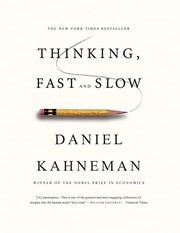
Thinking, fast and slow by 6390436|Daniel Kahneman book cover

πŸ“˜ Thinking, fast and slow

In his mega bestseller, Thinking, Fast and Slow, Daniel Kahneman, world-famous psychologist and winner of the Nobel Prize in Economics, takes us on a groundbreaking tour of the mind and explains the two systems that drive the way we think. System 1 is fast, intuitive, and emotional; System 2 is slower, more deliberative, and more logical. The impact of overconfidence on corporate strategies, the difficulties of predicting what will make us happy in the future, the profound effect of cognitive biases on everything from playing the stock market to planning our next vacation―each of these can be understood only by knowing how the two systems shape our judgments and decisions. Engaging the reader in a lively conversation about how we think, Kahneman reveals where we can and cannot trust our intuitions and how we can tap into the benefits of slow thinking. He offers practical and enlightening insights into how choices are made in both our business and our personal lives―and how we can use different techniques to guard against the mental glitches that often get us into trouble. Topping bestseller lists for almost ten years, Thinking, Fast and Slow is a contemporary classic, an essential book that has changed the lives of millions of readers.

β˜…β˜…β˜…β˜…β˜…β˜…β˜…β˜…β˜…β˜… 4.1 (189 ratings)
Similar? ✓ Yes 0 ✗ No 0
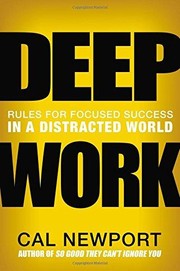
Deep Work by 7145896|Cal Newport book cover

πŸ“˜ Deep Work

One of the most valuable skills in our economy is becoming increasingly rare. If you master this skill, you'll achieve extraordinary results. Deep work is the ability to focus without distraction on a cognitively demanding task. It's a skill that allows you to quickly master complicated information and produce better results in less time. Deep work will make you better at what you do and provide the sense of true fulfillment that comes from craftsmanship. In short, deep work is like a super power in our increasingly competitive twenty-first century economy. And yet, most people have lost the ability to go deep-spending their days instead in a frantic blur of e-mail and social media, not even realizing there's a better way. In DEEP WORK, author and professor Cal Newport flips the narrative on impact in a connected age. Instead of arguing distraction is bad, he instead celebrates the power of its opposite. Dividing this book into two parts, he first makes the case that in almost any profession, cultivating a deep work ethic will produce massive benefits. He then presents a rigorous training regimen, presented as a series of four "rules," for transforming your mind and habits to support this skill. A mix of cultural criticism and actionable advice, DEEP WORK takes the reader on a journey through memorable stories -- from Carl Jung building a stone tower in the woods to focus his mind, to a social media pioneer buying a round-trip business class ticket to Tokyo to write a book free from distraction in the air -- and no-nonsense advice, such as the claim that most serious professionals should quit social media and that you should practice being bored. DEEP WORK is an indispensable guide to anyone seeking focused success in a distracted world.

β˜…β˜…β˜…β˜…β˜…β˜…β˜…β˜…β˜…β˜… 3.8 (150 ratings)
Similar? ✓ Yes 0 ✗ No 0
The Power of Habit by 11345987|Charles Duhigg book cover

πŸ“˜ The Power of Habit

A young woman walks into a laboratory. Over the past two years, she has transformed almost every aspect of her life. She has quit smoking, run a marathon, and been promoted at work. The patterns inside her brain, neurologists discover, have fundamentally changed. Marketers at Procter & Gamble study videos of people making their beds. They are desperately trying to figure out how to sell a new product called Febreze, on track to be one of the biggest flops in company history. Suddenly, one of them detects a nearly imperceptible pattern -- and with a slight shift in advertising, Febreze goes on to earn a billion dollars a year. An untested CEO takes over one of the largest companies in America. His first order of business is attacking a single pattern among his employees -- how they approach worker safety -- and soon the firm, Alcoa, becomes the top performer in the Dow Jones. What do all these people have in common? They achieved success by focusing on the patterns that shape every aspect of our lives. They succeeded by transforming habits. In The Power of Habit, award-winning New York Times business reporter Charles Duhigg takes us to the thrilling edge of scientific discoveries that explain why habits exist and how they can be changed. With penetrating intelligence and an ability to distill vast amounts of information into engrossing narratives, Duhigg brings to life a whole new understanding of human nature and its potential for transformation. Along the way we learn why some people and companies struggle to change, despite years of trying, while others seem to remake themselves overnight. We visit laboratories where neuroscientists explore how habits work and where, exactly, they reside in our brains. We discover how the right habits were crucial to the success of Olympic swimmer Michael Phelps, Starbucks CEO Howard Schultz, and civil-rights hero Martin Luther King, Jr. We go inside Procter & Gamble, Target superstores, Rick Warrens Saddleback Church, NFL locker rooms, and the nations largest hospitals and see how implementing so-called keystone habits can earn billions and mean the difference between failure and success, life and death. At its core, The Power of Habit contains an exhilarating argument: The key to exercising regularly, losing weight, raising exceptional children, becoming more productive, building revolutionary companies and social movements, and achieving success is understanding how habits work. Habits arent destiny. As Charles Duhigg shows, by harnessing this new science, we can transform our businesses, our communities, and our lives. - Publisher.

β˜…β˜…β˜…β˜…β˜…β˜…β˜…β˜…β˜…β˜… 4.0 (105 ratings)
Similar? ✓ Yes 0 ✗ No 0
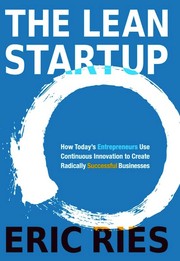
The Lean Startup by 7173148|Eric Ries book cover

πŸ“˜ The Lean Startup
 by Eric Ries

"Most startups are built to fail. But those failures, according to entrepreneur Eric Ries, are preventable. Startups don't fail because of bad execution, or missed deadlines, or blown budgets. They fail because they are building something nobody wants. Whether they arise from someone's garage or are created within a mature Fortune 500 organization, new ventures, by definition, are designed to create new products or services under conditions of extreme uncertainly. Their primary mission is to find out what customers ultimately will buy. One of the central premises of The Lean Startup movement is what Ries calls "validated learning" about the customer. It is a way of getting continuous feedback from customers so that the company can shift directions or alter its plans inch by inch, minute by minute. Rather than creating an elaborate business plan and a product-centric approach, Lean Startup prizes testing your vision continuously with your customers and making constant adjustments"--

β˜…β˜…β˜…β˜…β˜…β˜…β˜…β˜…β˜…β˜… 4.1 (60 ratings)
Similar? ✓ Yes 0 ✗ No 0
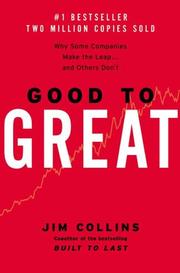
Good to Great by 6108069|Jim Collins book cover

πŸ“˜ Good to Great

The Challenge: Built to Last, the defining management study of the nineties, showed how great companies triumph over time and how long-term sustained performance can be engineered into the DNA of an enterprise from the verybeginning. But what about the company that is not born with great DNA? How can good companies, mediocre companies, even bad companies achieve enduring greatness? The Study: For years, this question preyed on the mind of Jim Collins. Are there companies that defy gravity and convert long-term mediocrity or worse into long-term superiority? And if so, what are the universal distinguishing characteristics that cause a company to go from good to great? The Standards: Using tough benchmarks, Collins and his research team identified a set of elite companies that made the leap to great results and sustained those results for at least fifteen years. How great? After the leap, the good-to-great companies generated cumulative stock returns that beat the general stock market by an average of seven times in fifteen years, better than twice the results delivered by a composite index of the world's greatest companies, including Coca-Cola, Intel, General Electric, and Merck. The Comparisons: The research team contrasted the good-to-great companies with a carefully selected set of comparison companies that failed to make the leap from good to great. What was different? Why did one set of companies become truly great performers while the other set remained only good? Over five years, the team analyzed the histories of all twenty-eight companies in the study. After sifting through mountains of data and thousands of pages of interviews, Collins and his crew discovered the key determinants of greatness -- why some companies make the leap and others don't. The Findings: The findings of the Good to Great study will surprise many readers and shed light on virtually every area of management strategy and practice. The findings include: Level 5 Leaders: The research team was shocked to discover the type of leadership required to achieve greatness. The Hedgehog Concept: (Simplicity within the Three Circles): To go from good to great requires transcending the curse of competence. A Culture of Discipline: When you combine a culture of discipline with an ethic of entrepreneurship, you get the magical alchemy of great results. Technology Accelerators: Good-to-great companies think differently about the role of technology. The Flywheel and the Doom Loop: Those who launch radical change programs and wrenching restructurings will almost certainly fail to make the leap. β€œSome of the key concepts discerned in the study,” comments Jim Collins, "fly in the face of our modern business culture and will, quite frankly, upset some people.” Perhaps, but who can afford to ignore these findings?

β˜…β˜…β˜…β˜…β˜…β˜…β˜…β˜…β˜…β˜… 3.8 (20 ratings)
Similar? ✓ Yes 0 ✗ No 0
Creativity, Inc. by 11623259|Ed Catmull book cover

πŸ“˜ Creativity, Inc.
 by Ed Catmull

Creativity, Inc. is a book for managers who want to lead their employees to new heights, a manual for anyone who strives for originality, and the first-ever, all-access trip into the nerve center of Pixar Animationβ€”into the meetings, postmortems, and β€œBraintrust” sessions where some of the most successful films in history are made. It is, at heart, a book about how to build a creative cultureβ€”but it is also, as Pixar co-founder and president Ed Catmull writes, β€œan expression of the ideas that I believe make the best in us possible.”

β˜…β˜…β˜…β˜…β˜…β˜…β˜…β˜…β˜…β˜… 4.5 (20 ratings)
Similar? ✓ Yes 0 ✗ No 0
The Innovator's Dilemma by 6744863|Clayton M. Christensen book cover

πŸ“˜ The Innovator's Dilemma

In his book, The Innovator's Dilemma [3], Professor Clayton Christensen of Harvard Business School describes a theory about how large, outstanding firms can fail "by doing everything right." The Innovator's Dilemma, according to Christensen, describes companies whose successes and capabilities can actually become obstacles in the face of changing markets and technologies. ([Source][1]) This book takes the radical position that great companies can fail precisely because they do everything right. It demonstrates why outstanding companies that had their competitive antennae up, listened astutely to customers, and invested aggressively in new technologies still lost their market leadership when confronted with disruptive changes in technology and market structure. And it tells how to avoid a similar fate. Using the lessons of successes and failures of leading companies, The Innovator's Dilemma presents a set of rules for capitalizing on the phenomenon of disruptive innovation. These principles will help managers determine when it is right not to listen to customers, when to invest in developing lower-performance products that promise lower margins, and when to pursue small markets at the expense of seemingly larger and more lucrative ones. - Jacket flap. [1]: http://web.mit.edu/6.933/www/Fall2000/teradyne/clay.html

β˜…β˜…β˜…β˜…β˜…β˜…β˜…β˜…β˜…β˜… 3.9 (16 ratings)
Similar? ✓ Yes 0 ✗ No 0

Mind performance hacks by 7017846|Ron Hale-Evans book cover

πŸ“˜ Mind performance hacks


β˜…β˜…β˜…β˜…β˜…β˜…β˜…β˜…β˜…β˜… 4.0 (1 rating)
Similar? ✓ Yes 0 ✗ No 0
Was heisst Denken? by 8298231|Martin Heidegger book cover

πŸ“˜ Was heisst Denken?


β˜…β˜…β˜…β˜…β˜…β˜…β˜…β˜…β˜…β˜… 5.0 (1 rating)
Similar? ✓ Yes 0 ✗ No 0
Originals by 7584134|Adam Grant book cover

πŸ“˜ Originals
 by Adam Grant


β˜…β˜…β˜…β˜…β˜…β˜…β˜…β˜…β˜…β˜… 0.0 (0 ratings)
Similar? ✓ Yes 0 ✗ No 0
REA's reasoning builder for admission & standardized tests by 9377934|Research and Education Association book cover

πŸ“˜ REA's reasoning builder for admission & standardized tests


β˜…β˜…β˜…β˜…β˜…β˜…β˜…β˜…β˜…β˜… 0.0 (0 ratings)
Similar? ✓ Yes 0 ✗ No 0
The art of argument by 7440371|Aaron Larsen book cover

πŸ“˜ The art of argument


β˜…β˜…β˜…β˜…β˜…β˜…β˜…β˜…β˜…β˜… 0.0 (0 ratings)
Similar? ✓ Yes 0 ✗ No 0
Gelassenheit by 8298231|Martin Heidegger book cover

πŸ“˜ Gelassenheit


β˜…β˜…β˜…β˜…β˜…β˜…β˜…β˜…β˜…β˜… 0.0 (0 ratings)
Similar? ✓ Yes 0 ✗ No 0
Range by 6833976|David Epstein book cover

πŸ“˜ Range


β˜…β˜…β˜…β˜…β˜…β˜…β˜…β˜…β˜…β˜… 0.0 (0 ratings)
Similar? ✓ Yes 0 ✗ No 0

Some Other Similar Books

Innovator's DNA by Jeff Dyer, Hal Gregersen, Clayton M. Christensen

Have a similar book in mind? Let others know!

Please login to submit books!