Books like The wandering mind by Michael C. Corballis


The Wandering Mind examines the everyday phenomenon of attention drift, arguing that what many consider a flaw—mind‑wandering—serves essential cognitive functions. Drawing on recent research in cognitive science and evolutionary biology, Michael C. Corballis shows how periods of free thinking release us from repetitive tasks and extend our imaginative capacities. By liberating imagination, morning mental flights fuel invention, narrative creation, and empathy, while the cyclical nature of wandering across our personal timelines helps maintain continuity in our self‑concept. The book presents a robust defense of inattention, re‑framing day‑dreaming as a vital, adaptive process rather than a productivity loss.
First publish date: 2014
Genre: Psychology/Cognitive Psychology
Authors: Michael C. Corballis
★ ★ ★ ★ ★ 0.0 (0 community ratings)

The wandering mind by Michael C. Corballis

How are these books recommended?

The books recommended for The wandering mind by Michael C. Corballis are shaped by reader interaction. Votes on how closely books relate, user ratings, and community comments all help refine these recommendations and highlight books readers genuinely find similar in theme, ideas, and overall reading experience.


Have you read any of these books?
Your votes, ratings, and comments help improve recommendations and make it easier for other readers to discover books they’ll enjoy.

Books similar to The wandering mind (14 similar books)

Thinking, fast and slow by 6390436|Daniel Kahneman book cover

📘 Thinking, fast and slow

Daniel Kahneman's "Thinking, Fast and Slow" explains how two distinct mental systems shape our judgments and decisions, offering insights into the biases that influence everyday choices.

★★★★★★★★★★ 4.1 (189 ratings)
Similar? ✓ Yes 0 ✗ No 0
The Power of Habit by 11345987|Charles Duhigg book cover

📘 The Power of Habit

The Power of Habit shows how tiny habits shape our lives and how they can be transformed to achieve personal and organizational success.

★★★★★★★★★★ 4.0 (105 ratings)
Similar? ✓ Yes 0 ✗ No 0
The art of thinking clearly by 9275146|Rolf Dobelli book cover

📘 The art of thinking clearly

Rolf Dobelli presents 99 concise chapters that explain everyday cognitive biases, showing how awareness can sharpen decision‑making at work and in life.

★★★★★★★★★★ 4.2 (18 ratings)
Similar? ✓ Yes 0 ✗ No 0
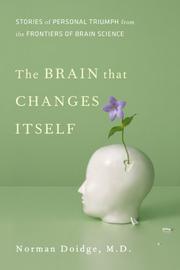
The Brain That Changes Itself by 7038154|Norman Doidge book cover

📘 The Brain That Changes Itself

Explores the groundbreaking science of neuroplasticity, showing how the brain can recover from injury, learn new skills, and even rewire itself to overcome long‑standing mental limits.

★★★★★★★★★★ 3.0 (9 ratings)
Similar? ✓ Yes 0 ✗ No 0
The Mind Map Book by 6676281|Tony Buzan book cover

📘 The Mind Map Book
 by Tony Buzan

Tony Buzan’s The Mind Map Book explains how to harness the brain’s pattern of perception and association to improve learning, memory, creativity, and note‑taking skills through mind mapping techniques.

★★★★★★★★★★ 4.2 (5 ratings)
Similar? ✓ Yes 0 ✗ No 0
The Mind's Eye by 6502167|Oliver Sacks book cover

📘 The Mind's Eye

Oliver Sacks weaves intimate case studies and personal anecdotes to explore how the brain perceives, interprets, and adapts to the world of sight, revealing the astonishing resilience of human cognition.

★★★★★★★★★★ 4.4 (5 ratings)
Similar? ✓ Yes 0 ✗ No 0
Beyond the Brain by 7060915|Louise Barrett book cover

📘 Beyond the Brain

Louise Barrett argues that intelligent animal behavior relies less on brain size and more on the interplay between body, environment, and evolution.

★★★★★★★★★★ 4.5 (2 ratings)
Similar? ✓ Yes 0 ✗ No 0
Brainstorm by 6747047|Daniel J. Siegel book cover

📘 Brainstorm

Between the ages of 12 and 24, the brain changes in important, and oftentimes maddening and challenging ways. In this book, the author, a psychiatrist busts a number of commonly held myths about adolescence. He shows that, if parents and teens can work together to form a deeper understanding of the brain science behind all the tumult, they will be able to turn conflict into connection and form a deeper understanding of one another. According to the author, during adolescence we learn important skills, such as how to leave home and enter the larger world, how to connect deeply with others, and how to safely experiment and take risks, thereby creating strategies for dealing with the world's increasingly complex problems. Here he presents an inside-out approach to focusing on how brain development affects our behavior and relationships. Drawing on important new research in the field of interpersonal neurobiology, he explores exciting ways in which understanding how the brain functions can improve the lives of adolescents, making their relationships more fulfilling and less lonely and distressing on both sides of the generational divide.

★★★★★★★★★★ 0.0 (0 ratings)
Similar? ✓ Yes 0 ✗ No 0
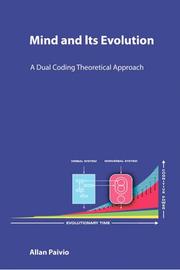
Mind and Its Evolution by 11035175|Allan Paivio book cover

📘 Mind and Its Evolution


★★★★★★★★★★ 0.0 (0 ratings)
Similar? ✓ Yes 0 ✗ No 0
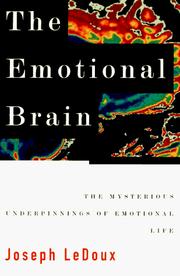
The Emotional Brain by 7052618|Joseph Ledoux book cover

📘 The Emotional Brain

What happens in our brains to make us feel fear, love, hate, anger, joy? do we control our emotions, or do they control us? Do animals have emotions? How can traumatic experiences in early childhood influence adult behavior, even though we have no conscious memory of them? In The Emotional Brain, Joseph LeDoux investigates the origins of human emotions and explains that many exist as part of complex neural systems that evolved to enable us to survive. Unlike conscious feelings, emotions originate in the brain at a much deeper level, says LeDoux, a leading authority in the field of neural science and one of the principal researchers profiled in Daniel Goleman's Emotional Intelligence. In this provocative book, LeDoux explores the underlying brain mechanisms responsible for our emotions, mechanisms that are only now being revealed. The Emotional Brain presents some fascinating findings about our familiar yet little understood emotions. For example, our brains can detect danger before we even experience the feeling of being afraid. The brain also begins to initiate physical responses (heart palpitations, sweaty palms, muscle tension) before we become aware of an associated feeling of fear. Conscious feelings, says LeDoux, are somewhat irrelevant to the way the emotional brain works. He points out that emotional responses are hard-wired into the brain's circuitry, but the things that make us emotional are learned through experience. And this may be the key to understanding, even changing, our emotional makeup. Many common psychiatric problems - such as phobias or posttraumatic stress disorder - involve malfunctions in the way emotion systems learn and remember. Understanding how these mechanisms normally work will have important consequences for how we view ourselves and how we treat emotional disorders.

★★★★★★★★★★ 0.0 (0 ratings)
Similar? ✓ Yes 0 ✗ No 0
Make the most of your mind by 6676281|Tony Buzan book cover

📘 Make the most of your mind
 by Tony Buzan

Tony Buzan explores how to unlock your mind’s full potential, offering techniques for learning, memory, creativity and personal success.

★★★★★★★★★★ 0.0 (0 ratings)
Similar? ✓ Yes 0 ✗ No 0
The philosophy of mind and cognition by 8875301|David Braddon-Mitchell book cover

📘 The philosophy of mind and cognition


★★★★★★★★★★ 0.0 (0 ratings)
Similar? ✓ Yes 0 ✗ No 0
Wandering Mind by 11988143|Jamie Kreiner book cover

📘 Wandering Mind


★★★★★★★★★★ 0.0 (0 ratings)
Similar? ✓ Yes 0 ✗ No 0
Mindwandering by 5899192|Moshe Bar book cover

📘 Mindwandering
 by Moshe Bar


★★★★★★★★★★ 0.0 (0 ratings)
Similar? ✓ Yes 0 ✗ No 0

Some Other Similar Books

Incognito: The Secret Lives of the Brain by David Eagleman
Quiet: The Power of Introverts in a World That Can't Stop Talking by Susan Cain
The Human Brain Book by Rex E. Jung
The Mind and the Brain by William H. Calvin

Have a similar book in mind? Let others know!

Please login to submit books!