Books like One Billion Americans by Matthew Yglesias


First publish date: 2020
Subjects: New York Times reviewed, Demography, United states, emigration and immigration, United states, economic conditions, 21st century, United states, population
Authors: Matthew Yglesias
5.0 (2 community ratings)

One Billion Americans by Matthew Yglesias

How are these books recommended?

The books recommended for One Billion Americans by Matthew Yglesias are shaped by reader interaction. Votes on how closely books relate, user ratings, and community comments all help refine these recommendations and highlight books readers genuinely find similar in theme, ideas, and overall reading experience.


Have you read any of these books?
Your votes, ratings, and comments help improve recommendations and make it easier for other readers to discover books they’ll enjoy.

Books similar to One Billion Americans (8 similar books)

The Wealth of Nations by 8280760|Adam Smith book cover

πŸ“˜ The Wealth of Nations
 by Adam Smith

Adam Smith's The Wealth of Nations was recognized as a landmark of human thought upon its publication in 1776. As the first scientific argument for the principles of political economy, it is the point of departure for all subsequent economic thought. Smith's theories of capital accumulation, growth, and secular change, among others, continue to be influential in modern economics. This reprint of Edwin Cannan's definitive 1904 edition of The Wealth of Nations includes Cannan's famous introduction, notes, and a full index, as well as a new preface written especially for this edition by the distinguished economist George J. Stigler. Mr. Stigler's preface will be of value for anyone wishing to see the contemporary relevance of Adam Smith's thought.

β˜…β˜…β˜…β˜…β˜…β˜…β˜…β˜…β˜…β˜… 4.1 (29 ratings)
Similar? ✓ Yes 0 ✗ No 0
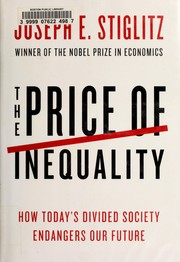
The price of inequality by 7311516|Joseph E. Stiglitz book cover

πŸ“˜ The price of inequality


β˜…β˜…β˜…β˜…β˜…β˜…β˜…β˜…β˜…β˜… 4.7 (3 ratings)
Similar? ✓ Yes 0 ✗ No 0
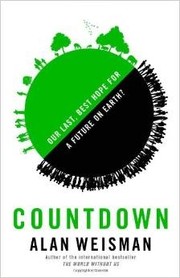
Countdown by 8370179|Alan Weisman book cover

πŸ“˜ Countdown

A powerful investigation into the chances for humanity's future from the author of the bestseller The World Without Us. In his bestselling book The World Without Us, Alan Weisman considered how the Earth could heal and even refill empty niches if relieved of humanity's constant pressures. Behind that groundbreaking thought experiment was his hope that we would be inspired to find a way to add humans back to this vision of a restored, healthy planet-only in harmony, not mortal combat, with the rest of nature. But with a million more of us every 4 1/2 days on a planet that's not getting any bigger, and with our exhaust overheating the atmosphere and altering the chemistry of the oceans, prospects for a sustainable human future seem ever more in doubt. For this long awaited follow-up book, Weisman traveled to more than 20 countries to ask what experts agreed were probably the most important questions on Earth--and also the hardest: How many humans can the planet hold without capsizing? How robust must the Earth's ecosystem be to assure our continued existence? Can we know which other species are essential to our survival? And, how might we actually arrive at a stable, optimum population, and design an economy to allow genuine prosperity without endless growth? Weisman visits an extraordinary range of the world's cultures, religions, nationalities, tribes, and political systems to learn what in their beliefs, histories, liturgies, or current circumstances might suggest that sometimes it's in their own best interest to limit their growth. The result is a landmark work of reporting: devastating, urgent, and, ultimately, deeply hopeful. By vividly detailing the burgeoning effects of our cumulative presence, Countdown reveals what may be the fastest, most acceptable, practical, and affordable way of returning our planet and our presence on it to balance. Weisman again shows that he is one of the most provocative journalists at work today, with a book whose message is so compelling that it will change how we see our lives and our destiny.

β˜…β˜…β˜…β˜…β˜…β˜…β˜…β˜…β˜…β˜… 5.0 (1 rating)
Similar? ✓ Yes 0 ✗ No 0
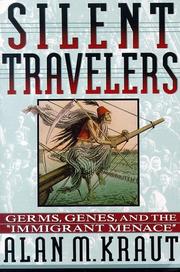
Silent travelers by 10200666|Alan M. Kraut book cover

πŸ“˜ Silent travelers

Epidemics and immigrants have suffered a lethal association in the public mind, from the Irish in New York wrongly blamed for the cholera epidemic of 1832 and Chinese in San Francisco vilified for causing the bubonic plague in 1900, to Haitians in Miami stigmatized as AIDS carriers in the 1980s. Silent Travelers vividly describes these and many other episodes of medicalized prejudice and analyzes their impact on public health policy and beyond. The book shows clearly how the equation of disease with outsiders and illness with genetic inferiority broadly affected not only immigration policy and health care but even the workplace and schools. The first synthesis of immigration history and the history of medicine, Silent Travelers is also a deeply human story, enriched by the voices of immigrants themselves. Irish, Italian, Jewish, Latino, Chinese, and Cambodian newcomers among others grapple in these pages with the mysteries of modern medicine and American prejudice. Anecdotes about famous and little-known figures in the annals of public health abound, from immigrant physicians such as Maurice Fishberg and Antonio Stella who struggled to mediate between the cherished Old World beliefs and practices of their patients and their own state-of-the-art medical science, to "Typhoid Mary" and the inspiring example of Mother Cabrini. Alan M. Kraut tells of the newcomers founding of hospitals to care for their own the "Halls of Great Peace" (actually little more than hovels where lepers could go to die) set up by Chinese immigrants; the establishment of St. Vincent's Hospital in New York as an institution sensitive to the needs of Catholic patients; and the creation of a tuberculosis sanitarium in Denver by Eastern European Jewish tradespeople who managed to scrape together $1.20 in contributions at their first meeting. Tapping into a rich array of sources - from turn-of-the-century government records to an advice book aimed at Italians financed by the DAR, from the photographs of Jacob Riis to the records of insurance companies and visiting nurse services, as well as poems, songs, stories, and letters of patients - this book evokes an intimate sense of the poignancy of the immigrant odyssey. Amid growing concern over using AIDS to exclude immigrants and ongoing debates about multi-culturalism, this look at how earlier generations struggled with such problems is especially valuable.

β˜…β˜…β˜…β˜…β˜…β˜…β˜…β˜…β˜…β˜… 4.0 (1 rating)
Similar? ✓ Yes 0 ✗ No 0
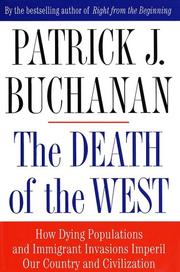
The Death of the West by 6954951|Patrick J. Buchanan book cover

πŸ“˜ The Death of the West

"The West is Dying. Collapsing birth rates in Europe and the United States, coupled with population explosions in Africa, Asia, and Latin America, are set to cause cataclysmic shifts in world power, as unchecked immigration swamps and polarizes every Western society and nation.". "Drawing on U.N. population projections, recent U.S. census figures, and expert policy studies, prominent conservative Pat Buchanan takes a cold, hard look at the future decay of Europe and America and the decline of Western culture. In The Death of the West, Buchanan contends that the United States now harbors a "nation within a nation," that Europe will be inundated by an Islamic-Arab-African invasion, and that most First World nations, including Japan, have begun slowly to vanish from the earth."--BOOK JACKET.

β˜…β˜…β˜…β˜…β˜…β˜…β˜…β˜…β˜…β˜… 4.0 (1 rating)
Similar? ✓ Yes 0 ✗ No 0
The Line Becomes a River by 11855370|Francisco Cantú book cover

πŸ“˜ The Line Becomes a River

A former US Border Patrol agent's haunting exploration of his time on the Mexican border and the politics, gatekeepers, and victims on both sides of the line.

β˜…β˜…β˜…β˜…β˜…β˜…β˜…β˜…β˜…β˜… 0.0 (0 ratings)
Similar? ✓ Yes 0 ✗ No 0
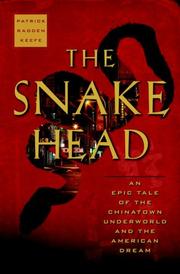
The snakehead by 10866020|Patrick Radden Keefe book cover

πŸ“˜ The snakehead

A mesmerizing narrative about the rise and fall of an unlikely international crime bossIn the 1980s, a wave of Chinese from Fujian province began arriving in America. Like other immigrant groups before them, they showed up with little money but with an intense work ethic and an unshakeable belief in the promise of the United States. Many of them lived in a world outside the law, working in a shadow economy overseen by the ruthless gangs that ruled the narrow streets of New York's Chinatown.The figure who came to dominate this Chinese underworld was a middle-aged grandmother known as Sister Ping. Her path to the American dream began with an unusual business run out of a tiny noodle store on Hester Street. From her perch above the shop, Sister Ping ran a full-service underground bank for illegal Chinese immigrants. But her real business-a business that earned an estimated $40 million-was smuggling people. As a "snakehead," she built a complex--and often vicious--global conglomerate, relying heavily on familial ties, and employing one of Chinatown's most violent gangs to protect her power and profits. Like an underworld CEO, Sister Ping created an intricate smuggling network that stretched from Fujian Province to Hong Kong to Burma to Thailand to Kenya to Guatemala to Mexico. Her ingenuity and drive were awe-inspiring both to the Chinatown community--where she was revered as a homegrown Don Corleone--and to the law enforcement officials who could never quite catch her. Indeed, Sister Ping's empire only came to light in 1993 when the Golden Venture, a ship loaded with 300 undocumented immigrants, ran aground off a Queens beach. It took New York's fabled "Jade Squad" and the FBI nearly ten years to untangle the criminal network and home in on its unusual mastermind.THE SNAKEHEAD is a panoramic tale of international intrigue and a dramatic portrait of the underground economy in which America's twelve million illegal immigrants live. Based on hundreds of interviews, Patrick Radden Keefe's sweeping narrative tells the story not only of Sister Ping, but of the gangland gunslingers who worked for her, the immigration and law enforcement officials who pursued her, and the generation of penniless immigrants who risked death and braved a 17,000 mile odyssey so that they could realize their own version of the American dream. The Snakehead offers an intimate tour of life on the mean streets of Chinatown, a vivid blueprint of organized crime in an age of globalization and a masterful exploration of the ways in which illegal immigration affects us all.www.doubleday.com

β˜…β˜…β˜…β˜…β˜…β˜…β˜…β˜…β˜…β˜… 0.0 (0 ratings)
Similar? ✓ Yes 0 ✗ No 0
The Fractured Republic by 7133524|Yuval Levin book cover

πŸ“˜ The Fractured Republic

Americans today are frustrated and anxious. Our economy is sluggish, and leaves workers insecure. Income inequality, cultural divisions, and political polarization increasingly pull us apart. Our governing institutions often seem paralyzed. And our politics has failed to rise to these challenges. No wonder, then, that Americans -- and the politicians who represent them -- are overwhelmingly nostalgic for a better time. The Left looks back to the middle of the twentieth century, when unions were strong, large public programs promised to solve pressing social problems, and the movements for racial integration and sexual equality were advancing. The Right looks back to the Reagan Era, when deregulation and lower taxes spurred the economy, cultural traditionalism seemed resurgent, and America was confident and optimistic. Each side thinks returning to its golden age could solve America's problems. In The Fractured Republic, Yuval Levin argues that this politics of nostalgia is failing twenty-first-century Americans. Both parties are blind to how America has changed over the past half century -- as the large, consolidated institutions that once dominated our economy, politics, and culture have fragmented and become smaller, more diverse, and personalized. Individualism, dynamism, and liberalization have come at the cost of dwindling solidarity, cohesion, and social order. This has left us with more choices in every realm of life but less security, stability, and national unity. Both our strengths and our weaknesses are therefore consequences of these changes. And the dysfunctions of our fragmented national life will need to be answered by the strengths of our decentralized, diverse, dynamic nation. Levin argues that this calls for a modernizing politics that avoids both radical individualism and a centralizing statism and instead revives the middle layers of society -- families and communities, schools and churches, charities and associations, local governments and markets.

β˜…β˜…β˜…β˜…β˜…β˜…β˜…β˜…β˜…β˜… 0.0 (0 ratings)
Similar? ✓ Yes 0 ✗ No 0

Some Other Similar Books

The Next Decade: Where We've Been... and Where We're Going by George P. Shultz
The Future of Work: Robots, AI, and Automation by Darrell M. West
The American Way of Strategy: U.S. Foreign Policy and the American Way of Life by Michael R. Blake
The Great Divergence: America's Growing Inequality Crisis and What We Can Do About It by Timothy Noah
The Age of Decadence: America Before the Fall by Naomi Wolf
The Bright Future: Our Million-Year Outlook by Alan L. Huntington
The New Map: Energy, Climate, and the Clash of Nations by Daniel Yergin
The Rise of the Robots: Technology and the Threat of Mass Unemployment by Martin Ford
The Limits of Power: The End of American Exceptionalism by Andrew J. Bacevich

Have a similar book in mind? Let others know!

Please login to submit books!