Books like PRINCIPE, EL by MAQUIAVELO


First publish date: 2016
Authors: MAQUIAVELO
0.0 (0 community ratings)

PRINCIPE, EL by MAQUIAVELO

How are these books recommended?

The books recommended for PRINCIPE, EL by MAQUIAVELO are shaped by reader interaction. Votes on how closely books relate, user ratings, and community comments all help refine these recommendations and highlight books readers genuinely find similar in theme, ideas, and overall reading experience.


Have you read any of these books?
Your votes, ratings, and comments help improve recommendations and make it easier for other readers to discover books they’ll enjoy.

Books similar to PRINCIPE, EL (13 similar books)
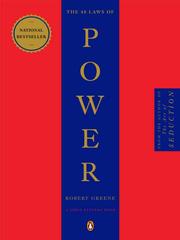
The 48 Laws of Power by 6699473|Robert Greene book cover

πŸ“˜ The 48 Laws of Power

Amoral, cunning, ruthless, and instructive, this piercing work distills three thousand years of the history of power in to forty-eight well explicated laws. As attention--grabbing in its design as it is in its content, this bold volume outlines the laws of power in their unvarnished essence, synthesizing the philosophies of Machiavelli, Sun-tzu, Carl von Clausewitz, and other great thinkers. Some laws teach the need for prudence ("Law 1: Never Outshine the Master"), the virtue of stealth ("Law 3: Conceal Your Intentions"), and many demand the total absence of mercy ("Law 15: Crush Your Enemy Totally"), but like it or not, all have applications in real life. Illustrated through the tactics of Queen Elizabeth I, Henry Kissinger, P. T. Barnum, and other famous figures who have wielded--or been victimized by--power, these laws will fascinate any reader interested in gaining, observing, or defending against ultimate control.

β˜…β˜…β˜…β˜…β˜…β˜…β˜…β˜…β˜…β˜… 4.1 (947 ratings)
Similar? ✓ Yes 0 ✗ No 0
The 48 Laws of Power by 6699473|Robert Greene book cover

πŸ“˜ The 48 Laws of Power

Amoral, cunning, ruthless, and instructive, this piercing work distills three thousand years of the history of power in to forty-eight well explicated laws. As attention--grabbing in its design as it is in its content, this bold volume outlines the laws of power in their unvarnished essence, synthesizing the philosophies of Machiavelli, Sun-tzu, Carl von Clausewitz, and other great thinkers. Some laws teach the need for prudence ("Law 1: Never Outshine the Master"), the virtue of stealth ("Law 3: Conceal Your Intentions"), and many demand the total absence of mercy ("Law 15: Crush Your Enemy Totally"), but like it or not, all have applications in real life. Illustrated through the tactics of Queen Elizabeth I, Henry Kissinger, P. T. Barnum, and other famous figures who have wielded--or been victimized by--power, these laws will fascinate any reader interested in gaining, observing, or defending against ultimate control.

β˜…β˜…β˜…β˜…β˜…β˜…β˜…β˜…β˜…β˜… 4.1 (947 ratings)
Similar? ✓ Yes 0 ✗ No 0
Of Mice and Men by 6891955|John Steinbeck book cover

πŸ“˜ Of Mice and Men

The second book in John Steinbeck’s labor trilogy, Of Mice and Men is a touching tale of two migrant laborers in search of work and eventual liberation from their social circumstances. Fiercely devoted to one another, George and Lennie plan to save up to finance their dream of someday owning a small piece of land. The pair seems unstoppable until tragedy strikes and their hopes come crashing down, forcing George to make a difficult decision regarding the welfare of his best friend. The novel is set on a ranch in Soledad, CA. Author Frank Bergon recalls reading Of Mice and Men for the first time as a teenager living in the San Joaquin Valley and remembers how he saw β€œas if in a jolt of light the ordinary surroundings of [his] life become worthy of literature.” Steinbeck works to propagate the notion that meaningful stories emerge from the marginalized; that even those on the fringes of society can make deserving contributions to the literary canon. Source: http://www.steinbeck.org/about-john/his-works/ ---------- Also contained in: - [Cannery Row / Of Mice and Men](https://openlibrary.org/works/OL23172W/Cannery_Row_Of_Mice_and_Men) - [Grapes of Wrath / The Moon is Down / Cannery Row / East of Eden / Of Mice and Men][1] - [Novels and Stories 1932-1937](https://openlibrary.org/works/OL23167W) - [Short Novels of John Steinbeck](https://openlibrary.org/works/OL23185W/The_Short_Novels_of_John_Steinbeck) - [Steinbeck](https://openlibrary.org/works/OL23183W/Steinbeck) - [Steinbeck Pocket Book](https://openlibrary.org/works/OL16051131W/The_Steinbeck_Pocket_Book) [1]: https://openlibrary.org/works/OL23165W/The_Grapes_of_Wrath_The_Moon_is_Down_Cannery_Row_East_of_Eden_Of_Mice_and_Men

β˜…β˜…β˜…β˜…β˜…β˜…β˜…β˜…β˜…β˜… 3.9 (257 ratings)
Similar? ✓ Yes 0 ✗ No 0
The Prince by 6646958|Niccolò Machiavelli book cover

πŸ“˜ The Prince

The Prince (Italian: Il Principe [il ˈprintΚƒipe]; Latin: De Principatibus) is a 16th-century political treatise written by Italian diplomat and political theorist NiccolΓ² Machiavelli as an instruction guide for new princes and royals. The general theme of The Prince is of accepting that the aims of princes – such as glory and survival – can justify the use of immoral means to achieve those ends. From Machiavelli's correspondence, a version appears to have been distributed in 1513, using a Latin title, De Principatibus (Of Principalities). However, the printed version was not published until 1532, five years after Machiavelli's death. This was carried out with the permission of the Medici pope Clement VII, but "long before then, in fact since the first appearance of The Prince in manuscript, controversy had swirled about his writings". Although The Prince was written as if it were a traditional work in the mirrors for princes style, it was generally agreed as being especially innovative. This is partly because it was written in the vernacular Italian rather than Latin, a practice that had become increasingly popular since the publication of Dante's Divine Comedy and other works of Renaissance literature.

β˜…β˜…β˜…β˜…β˜…β˜…β˜…β˜…β˜…β˜… 3.8 (89 ratings)
Similar? ✓ Yes 0 ✗ No 0
The Prince by 6646958|Niccolò Machiavelli book cover

πŸ“˜ The Prince

The Prince (Italian: Il Principe [il ˈprintΚƒipe]; Latin: De Principatibus) is a 16th-century political treatise written by Italian diplomat and political theorist NiccolΓ² Machiavelli as an instruction guide for new princes and royals. The general theme of The Prince is of accepting that the aims of princes – such as glory and survival – can justify the use of immoral means to achieve those ends. From Machiavelli's correspondence, a version appears to have been distributed in 1513, using a Latin title, De Principatibus (Of Principalities). However, the printed version was not published until 1532, five years after Machiavelli's death. This was carried out with the permission of the Medici pope Clement VII, but "long before then, in fact since the first appearance of The Prince in manuscript, controversy had swirled about his writings". Although The Prince was written as if it were a traditional work in the mirrors for princes style, it was generally agreed as being especially innovative. This is partly because it was written in the vernacular Italian rather than Latin, a practice that had become increasingly popular since the publication of Dante's Divine Comedy and other works of Renaissance literature.

β˜…β˜…β˜…β˜…β˜…β˜…β˜…β˜…β˜…β˜… 3.8 (89 ratings)
Similar? ✓ Yes 0 ✗ No 0
Leviathan by 9376057|Thomas Hobbes book cover

πŸ“˜ Leviathan

Thomas Hobbes' Leviathan, from 1651, is one of the first and most influential arguments towards social contract. Written in the midst of the English Civil War, it concerns the structure of government and society and argues for strong central governance and the rule of an absolute sovereign as the way to avoid civil war and chaos.

β˜…β˜…β˜…β˜…β˜…β˜…β˜…β˜…β˜…β˜… 3.3 (13 ratings)
Similar? ✓ Yes 0 ✗ No 0
Leviathan by 9376057|Thomas Hobbes book cover

πŸ“˜ Leviathan

Thomas Hobbes' Leviathan, from 1651, is one of the first and most influential arguments towards social contract. Written in the midst of the English Civil War, it concerns the structure of government and society and argues for strong central governance and the rule of an absolute sovereign as the way to avoid civil war and chaos.

β˜…β˜…β˜…β˜…β˜…β˜…β˜…β˜…β˜…β˜… 3.3 (13 ratings)
Similar? ✓ Yes 0 ✗ No 0
On Liberty by 902441|John Stuart Mill book cover

πŸ“˜ On Liberty

Book digitized by Google from the library of the New York Public Library and uploaded to the Internet Archive by user tpb.

β˜…β˜…β˜…β˜…β˜…β˜…β˜…β˜…β˜…β˜… 4.2 (9 ratings)
Similar? ✓ Yes 0 ✗ No 0
The end of power by 11860769|Moisés Naím book cover

πŸ“˜ The end of power

Argues that the leaders of today actually have less power than ever before, discussing the changing nature of leadership and the modern dynamics of power. "In The End of Power, award-winning columnist and former Foreign Policy editor MoisΓ©s NaΓ­m illuminates the struggle between once-dominant megaplayers and the new micropowers challenging them in every field of human endeavor. Drawing on provocative, original research, NaΓ­m shows how the antiestablishment drive of micropowers can topple tyrants, dislodge monopolies, and open remarkable new opportunities, but it can also lead to chaos and paralysis. NaΓ­m deftly covers the seismic changes underway in business, religion, education, within families, and in all matters of war and peace. Examples abound in all walks of life: In 1977, eighty-nine countries were ruled by autocrats while today more than half the world's population lives in democracies. CEO's are more constrained and have shorter tenures than their predecessors. Modern tools of war, cheaper and more accessible, make it possible for groups like Hezbollah to afford their own drones. In the second half of 2010, the top ten hedge funds earned more than the world's largest six banks combined. Those in power retain it by erecting powerful barriers to keep challengers at bay. Today, insurgent forces dismantle those barriers more quickly and easily than ever, only to find that they themselves become vulnerable in the process."--Publisher's description.

β˜…β˜…β˜…β˜…β˜…β˜…β˜…β˜…β˜…β˜… 3.7 (3 ratings)
Similar? ✓ Yes 0 ✗ No 0
O Principe by 7525241|Maquiavel book cover

πŸ“˜ O Principe
 by Maquiavel


β˜…β˜…β˜…β˜…β˜…β˜…β˜…β˜…β˜…β˜… 5.0 (1 rating)
Similar? ✓ Yes 0 ✗ No 0
The Social Contract by 7199233|Jean-Jacques Rousseau book cover

πŸ“˜ The Social Contract


β˜…β˜…β˜…β˜…β˜…β˜…β˜…β˜…β˜…β˜… 0.0 (0 ratings)
Similar? ✓ Yes 0 ✗ No 0
The Social Contract by 7199233|Jean-Jacques Rousseau book cover

πŸ“˜ The Social Contract


β˜…β˜…β˜…β˜…β˜…β˜…β˜…β˜…β˜…β˜… 0.0 (0 ratings)
Similar? ✓ Yes 0 ✗ No 0
El Principe by 13658150|Nicolas Maquivelo book cover

πŸ“˜ El Principe


β˜…β˜…β˜…β˜…β˜…β˜…β˜…β˜…β˜…β˜… 0.0 (0 ratings)
Similar? ✓ Yes 0 ✗ No 0

Some Other Similar Books

The Art of War by Sun Tzu
On the Basis of Morality by Immanuel Kant
The Art of War by Sun Tzu

Have a similar book in mind? Let others know!

Please login to submit books!