Books like You are not a gadget by Jaron Lanier
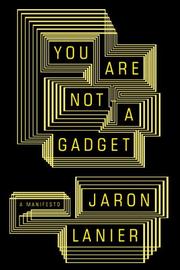

Jaron Lanier, a Silicon Valley visionary since the 1980s, examines how the early design decisions of the World Wide Web—such as anonymity and decentralization—have become ingrained, producing significant social and cultural effects. In this first book, he highlights how these choices have enabled phenomena like trolling, the erosion of the artistic middle class through file sharing, and the elevation of algorithmic collective wisdom over individual judgment in platforms like Wikipedia, Facebook, and Twitter. Lanier also explores the historical influence of 1960s anti‑government paranoia on online architecture and argues for a new humanistic approach to technology that prioritizes individual agency.
First publish date: 2010
Genre: Technology & Computing/Computer Science
Authors: Jaron Lanier
★ ★ ★ ★ ★ 0.0 (0 community ratings)

You are not a gadget by Jaron Lanier

How are these books recommended?

The books recommended for You are not a gadget by Jaron Lanier are shaped by reader interaction. Votes on how closely books relate, user ratings, and community comments all help refine these recommendations and highlight books readers genuinely find similar in theme, ideas, and overall reading experience.


Have you read any of these books?
Your votes, ratings, and comments help improve recommendations and make it easier for other readers to discover books they’ll enjoy.

Books similar to You are not a gadget (10 similar books)
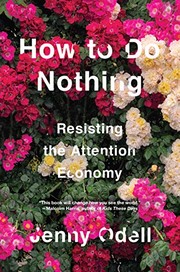
How to Do Nothing by 11966528|Jenny Odell book cover

📘 How to Do Nothing

An accessible guide that argues attention is the most valuable resource in our data‑driven world and offers practical ways to reclaim it for deeper reflection, ethical work, and political activism.

★★★★★★★★★★ 4.0 (21 ratings)
Similar? ✓ Yes 0 ✗ No 0
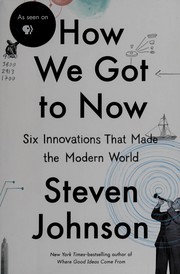
How we got to now by 8240611|Steven Johnson book cover

📘 How we got to now

An illustrated exploration of the hidden history behind everyday inventions, showing how seemingly unrelated discoveries shaped our modern world.

★★★★★★★★★★ 4.0 (10 ratings)
Similar? ✓ Yes 0 ✗ No 0
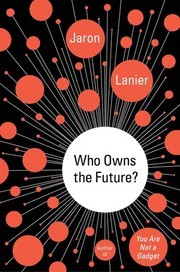
Who Owns the Future? by 8100241|Jaron Lanier book cover

📘 Who Owns the Future?

Jaron Lanier examines how digital networks concentrate money and power, endangering privacy, the middle class, and the economy, and proposes an information economy that rewards ordinary users.

★★★★★★★★★★ 4.0 (3 ratings)
Similar? ✓ Yes 0 ✗ No 0
Insatiable curiosity by 9604146|Helga Nowotny book cover

📘 Insatiable curiosity

"Curiosity is the main driving force behind scientific activity. Scientific curiosity, insatiable in its explorations, does not know what it will find, or where it will lead. Science needs autonomy to cultivate this kind of untrammeled curiosity; innovation, however, responds to the needs and desires of society. Innovation, argues influential European science studies scholar Helga Nowotny, tames the passion of science, harnessing it to produce "deliverables." Science brings uncertainties; innovation successfully copes with them. Society calls for both the passion for knowledge and its taming. This ambivalence, Nowotny contends, is an inevitable result of modernity." "In Insatiable Curiosity, Nowotny explores the strands of the often unexpected intertwining of science and technology and society. Uncertainty arises, she writes, from an oversupply of knowledge. The quest for innovation is society's response to the uncertainties that come with scientific and technological achievement. Our dilemma is how to balance the immense but unpredictable potential of science and technology with our acknowledgment that not everything that can be done should be done. We can escape the old polarities of utopias and dystopias, writes Nowotny, by accepting our ambivalence - as a legacy of modernism and a positive cultural resource."--Jacket.

★★★★★★★★★★ 5.0 (1 rating)
Similar? ✓ Yes 0 ✗ No 0
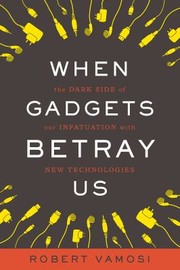
When Gadgets Betray Us by 11718084|Robert Vamosi book cover

📘 When Gadgets Betray Us

Looks at the important issues that are often overlooked in the race to find the best, fastest, and most cutting-edge technological wonders.

★★★★★★★★★★ 3.0 (1 rating)
Similar? ✓ Yes 0 ✗ No 0
The driver in the driverless car by 11874362|Vivek Wadhwa book cover

📘 The driver in the driverless car

Technology is advancing faster than ever--but for better or for worse? On the one hand, astonishing technology developments such as personalized genomics, self-driving cars, drones, and artificial intelligence could make our lives healthier, safer, and easier. On the other hand, these very same technologies could raise the specter of a frightening and alienating future--eugenics, a jobless economy, a complete loss of privacy, and an ever-worsening spiral of economic inequality. How can we make appropriate decisions about whether and how to adopt new technologies? Vivek Wadhwa and Alex Salkever propose that we ask three questions: Does the technology have the potential to benefit everyone equally? What are the risks and the rewards? Does the technology more strongly promote autonomy or independence? They subject a host of new and potential technologies to these questions, but ultimately it is up to the reader to make the final decision. -- Provided by publisher.

★★★★★★★★★★ 3.0 (1 rating)
Similar? ✓ Yes 0 ✗ No 0
Re-Engineering Humanity by 11983061|Brett Frischmann book cover

📘 Re-Engineering Humanity


★★★★★★★★★★ 0.0 (0 ratings)
Similar? ✓ Yes 0 ✗ No 0
Rewire by 11559389|Ethan Zuckerman book cover

📘 Rewire

In *Rewire*, Ethan Zuckerman examines how the Internet’s connectivity promises can fall short, analyzing why digital reach often fails to foster true global understanding and outlining innovations that can bridge cultural gaps.

★★★★★★★★★★ 0.0 (0 ratings)
Similar? ✓ Yes 0 ✗ No 0
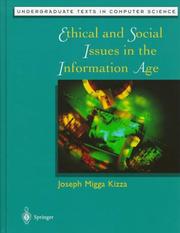
Ethical and social issues in the information age by 6622741|Joseph Migga Kizza book cover

📘 Ethical and social issues in the information age

The rapid pace of change in computing demands a continuous review of our defensive strategies, and a strong ethical framework in our computer science education.This fully revised and enhanced fifth edition of Ethical and Social Issues in the Information Age examines the ethical, social, and policy challenges stemming from the convergence of computing and telecommunication, and the proliferation of mobile information-enabling devices. This accessible and engaging text surveys thought-provoking questions about the impact of these new technologies.Topics and features:Establishes a philosophical framework and analytical tools for discussing moral theories and problems in ethical relativismOffers pertinent discussions on privacy, surveillance, employee monitoring, biometrics, civil liberties, harassment, the digital divide, and discriminationExamines the new ethical, cultural and economic realities of computer social network ecosystems (NEW)Reviews issues of property rights, responsibility and accountability relating to information technology and softwareDiscusses how virtualization technology informs our ethical behavior (NEW)Introduces the new frontiers of ethics: virtual reality, artificial intelligence, and the InternetSurveys the social, moral and ethical value systems in mobile telecommunications (NEW)Explores the evolution of electronic crime, network security, and computer forensicsProvides exercises, objectives, and issues for discussion with every chapterThis comprehensive textbook incorporates the latest requirements for computer science curricula. Both students and practitioners will find the book an invaluable source of insight into computer ethics and law, network security, and computer crime investigation.

★★★★★★★★★★ 0.0 (0 ratings)
Similar? ✓ Yes 0 ✗ No 0
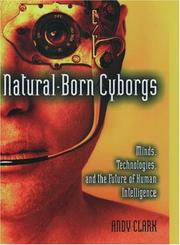
Natural-Born Cyborgs by 6954470|Andy Clark book cover

📘 Natural-Born Cyborgs
 by Andy Clark

From Robocop to the Terminator to Eve 8, no image better captures our deepest fears about technology than the cyborg, the person who is both flesh and metal, brain and electronics. But philosopher and cognitive scientist Andy Clark sees it differently. Cyborgs, he writes, are not something tobe feared--we already are cyborgs. In Natural-Born Cyborgs, Clark argues that what makes humans so different from other species is our capacity to fully incorporate tools and supporting cultural practices into our existence. Technology as simple as writing on a sketchpad, as familiar as Google or a cellular phone, and aspotentially revolutionary as mind-extending neural implants--all exploit our brains' astonishingly plastic nature. Our minds are primed to seek out and incorporate non-biological resources, so that we actually think and feel through our best technologies...

★★★★★★★★★★ 0.0 (0 ratings)
Similar? ✓ Yes 0 ✗ No 0

Some Other Similar Books

The Filter Bubble: What the Internet Is Hiding from You by Eli Pariser
The Age of Surveillance Capitalism: The Fight for a Human Future at the New Frontier of Power by Shoshana Zuboff
Ten Arguments for Denying the Anthropocene by James Bridle
The Shallows: What the Internet Is Doing to Our Brains by Nicholas Carr
Reclaiming Conversation: The Power of Talk in a Digital Age by Sherry Turkle
Technology and the Virtues: A Philosophical Guide to a Future Worth Wanting by Adrian Woods
The Code: Silicon Valley and the Remaking of America by Margaret O'Mara
Alone Together: Why We Expect More from Technology and Less from Each Other by Sherry Turkle
The Innovators: How a Group of Hackers, Geniuses, and Geeks Created the Digital Revolution by Walter Isaacson
Digital Minimalism: Choosing a Focused Life in a Noisy World by Cal Newport

Have a similar book in mind? Let others know!

Please login to submit books!