Books like Me vs Brain by Hayley Morris


First publish date: 2023
Subjects: Psychology
Authors: Hayley Morris
0.0 (0 community ratings)

Me vs Brain by Hayley Morris

How are these books recommended?

The books recommended for Me vs Brain by Hayley Morris are shaped by reader interaction. Votes on how closely books relate, user ratings, and community comments all help refine these recommendations and highlight books readers genuinely find similar in theme, ideas, and overall reading experience.


Have you read any of these books?
Your votes, ratings, and comments help improve recommendations and make it easier for other readers to discover books they’ll enjoy.

Books similar to Me vs Brain (16 similar books)

Thinking, fast and slow

πŸ“˜ Thinking, fast and slow

In his mega bestseller, Thinking, Fast and Slow, Daniel Kahneman, world-famous psychologist and winner of the Nobel Prize in Economics, takes us on a groundbreaking tour of the mind and explains the two systems that drive the way we think. System 1 is fast, intuitive, and emotional; System 2 is slower, more deliberative, and more logical. The impact of overconfidence on corporate strategies, the difficulties of predicting what will make us happy in the future, the profound effect of cognitive biases on everything from playing the stock market to planning our next vacation―each of these can be understood only by knowing how the two systems shape our judgments and decisions. Engaging the reader in a lively conversation about how we think, Kahneman reveals where we can and cannot trust our intuitions and how we can tap into the benefits of slow thinking. He offers practical and enlightening insights into how choices are made in both our business and our personal lives―and how we can use different techniques to guard against the mental glitches that often get us into trouble. Topping bestseller lists for almost ten years, Thinking, Fast and Slow is a contemporary classic, an essential book that has changed the lives of millions of readers.

β˜…β˜…β˜…β˜…β˜…β˜…β˜…β˜…β˜…β˜… 4.1 (189 ratings)
Similar? ✓ Yes 0 ✗ No 0
Thinking, fast and slow

πŸ“˜ Thinking, fast and slow

In his mega bestseller, Thinking, Fast and Slow, Daniel Kahneman, world-famous psychologist and winner of the Nobel Prize in Economics, takes us on a groundbreaking tour of the mind and explains the two systems that drive the way we think. System 1 is fast, intuitive, and emotional; System 2 is slower, more deliberative, and more logical. The impact of overconfidence on corporate strategies, the difficulties of predicting what will make us happy in the future, the profound effect of cognitive biases on everything from playing the stock market to planning our next vacation―each of these can be understood only by knowing how the two systems shape our judgments and decisions. Engaging the reader in a lively conversation about how we think, Kahneman reveals where we can and cannot trust our intuitions and how we can tap into the benefits of slow thinking. He offers practical and enlightening insights into how choices are made in both our business and our personal lives―and how we can use different techniques to guard against the mental glitches that often get us into trouble. Topping bestseller lists for almost ten years, Thinking, Fast and Slow is a contemporary classic, an essential book that has changed the lives of millions of readers.

β˜…β˜…β˜…β˜…β˜…β˜…β˜…β˜…β˜…β˜… 4.1 (189 ratings)
Similar? ✓ Yes 0 ✗ No 0
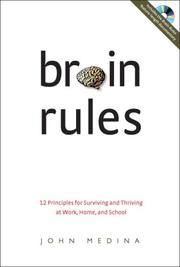
Brain Rules

πŸ“˜ Brain Rules

Most of us have no idea what's really going on inside our heads. Yet brain scientists have uncovered details every business leader, parent, and teacher should knowβ€”such as the brain's need for physical activity to work at its best.How do we learn? What exactly do sleep and stress do to our brains? Why is multi-tasking a myth? Why is it so easy to forgetβ€”and so important to repeat new knowledge? Is it true that men and women have different brains?In Brain Rules, molecular biologist John Medina shares his lifelong interest in how the brain sciences might influence the way we teach our children and the way we work. In each chapter, he describes a Brain Ruleβ€”what scientists know for sure about how our brains workβ€”and then offers transformative ideas for our daily lives. You will discover how:Exercise improves cognitionEvery brain is wired differentlyWe are designed never to stop learning and exploringMemories are volatile and susceptible to corruptionSleep is powerfully linked with the ability to learnVision trumps all of the other sensesStress changes the way we learnIn the end, you'll understand how your brain really worksβ€”and how to get the most out of it.

β˜…β˜…β˜…β˜…β˜…β˜…β˜…β˜…β˜…β˜… 3.8 (14 ratings)
Similar? ✓ Yes 0 ✗ No 0
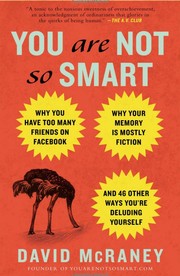
You are not so smart

πŸ“˜ You are not so smart

An entertaining illumination of the stupid beliefs that make us feel wise, based on the popular blog of the same name. Whether you’re deciding which smartphone to purchase or which politician to believe, you think you are a rational being whose every decision is based on cool, detached logic. But here’s the truth: You are not so smart. You’re just as deluded as the rest of usβ€”but that’s okay, because being deluded is part of being human. Growing out of David McRaney’s popular blog, You Are Not So Smart reveals that every decision we make, every thought we contemplate, and every emotion we feel comes with a story we tell ourselves to explain them. But often these stories aren’t true. Each short chapterβ€”covering topics such as Learned Helplessness, Selling Out, and the Illusion of Transparencyβ€”is like a psychology course with all the boring parts taken out. Bringing together popular science and psychology with humor and wit, You Are Not So Smart is a celebration of our irrational, thoroughly human behavior.

β˜…β˜…β˜…β˜…β˜…β˜…β˜…β˜…β˜…β˜… 4.2 (10 ratings)
Similar? ✓ Yes 0 ✗ No 0
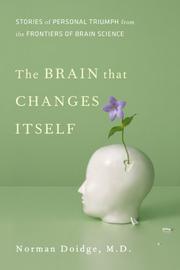
The Brain That Changes Itself

πŸ“˜ The Brain That Changes Itself

An astonishing new science called neuroplasticity is overthrowing the centuries-old notion that the human brain is immutable. Psychiatrist and psychoanalyst, Norman Doidge, M.D., traveled the country to meet both the brilliant scientists championing neuroplasticity and the people whose lives they've transformedβ€”people whose mental limitations or brain damage were seen as unalterable. We see a woman born with half a brain that rewired itself to work as a whole, blind people who learn to see, learning disorders cured, IQs raised, aging brains rejuvenated, stroke patients learning to speak, children with cerebral palsy learning to move with more grace, depression and anxiety disorders successfully treated, and lifelong character traits changed. Using these marvelous stories to probe mysteries of the body, emotion, love, sex, culture, and education, Dr. Doidge has written an immensely moving, inspiring book that will permanently alter the way we look at our brains, human nature, and human potential.

β˜…β˜…β˜…β˜…β˜…β˜…β˜…β˜…β˜…β˜… 3.0 (9 ratings)
Similar? ✓ Yes 0 ✗ No 0
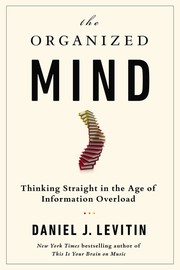
The organized mind

πŸ“˜ The organized mind


β˜…β˜…β˜…β˜…β˜…β˜…β˜…β˜…β˜…β˜… 3.4 (5 ratings)
Similar? ✓ Yes 0 ✗ No 0
The Woman who Changed Her Brain

πŸ“˜ The Woman who Changed Her Brain

xvii, 279 pages, 16 unnumbered pages of plates : 20 cm

β˜…β˜…β˜…β˜…β˜…β˜…β˜…β˜…β˜…β˜… 5.0 (1 rating)
Similar? ✓ Yes 0 ✗ No 0
An unquiet mind

πŸ“˜ An unquiet mind

From Kay Redfield Jamison - an international authority on manic-depressive illness, and one of the few women who are full professors of medicine at American universities - a remarkable personal testimony: the revelation of her own struggle since adolescence with manic-depression, and how it has shaped her life. Vividly, directly, with candor, wit, and simplicity, she takes us into the fascinating and dangerous territory of this form of madness - a world in which one pole can be the alluring dark land ruled by what Byron called the "melancholy star of the imagination," and the other a desert of depression and, all too frequently, death. A moving and exhilarating memoir by a woman whose furious determination to learn the enemy, to use her gifts of intellect to make a difference, led her to become, by the time she was forty, a world authority on manic-depression, and whose work has helped save countless lives.

β˜…β˜…β˜…β˜…β˜…β˜…β˜…β˜…β˜…β˜… 5.0 (1 rating)
Similar? ✓ Yes 0 ✗ No 0
The brain's way of healing

πŸ“˜ The brain's way of healing

"The New York Times bestselling author of The Brain That Changes Itself presents astounding advances in the treatment of brain injury and illness. In The Brain That Changes Itself, Norman Doidge described the most important breakthrough in our understanding of the brain in four hundred years: the discovery that the brain can change its own structure and function in response to mental experience-what we call neuroplasticity. His revolutionary new book shows, for the first time, how the amazing process of neuroplastic healing really works. It describes natural, non-invasive avenues into the brain provided by the forms of energy around us-light, sound, vibration, movement-which pass through our senses and our bodies to awaken the brain's own healing capacities without producing unpleasant side effects. Doidge explores cases where patients alleviated years of chronic pain or recovered from debilitating strokes or accidents; children on the autistic spectrum or with learning disorders normalizing; symptoms of multiple sclerosis, Parkinson's disease, and cerebral palsy radically improved, and other near-miracle recoveries. And we learn how to vastly reduce the risk of dementia with simple approaches anyone can use. For centuries it was believed that the brain's complexity prevented recovery from damage or disease. The Brain's Way of Healing shows that this very sophistication is the source of a unique kind of healing. As he did so lucidly in The Brain That Changes Itself, Doidge uses stories to present cutting-edge science with practical real-world applications, and principles that everyone can apply to improve their brain's performance and health"-- "Norman Doidge's revolutionary new book shows, for the first time, how the amazing process of neuroplastic healing really works. It describes natural, non-invasive avenues into the brain provided by the forms of energy around us--light, sound, vibration, movement--which pass through our senses and our bodies to awaken the brain's own healing capacities without producing unpleasant side effects. Doidge explores cases where patients alleviated years of chronic pain or recovered from debilitating strokes or accidents; children on the autistic spectrum or with learning disorders normalizing; symptoms of multiple sclerosis, Parkinson's disease, and cerebral palsy radically improved, and other near-miracle recoveries. And we learn how to vastly reduce the risk of dementia with simple approaches anyone can use. For centuries it was believed that the brain's complexity prevented recovery from damage or disease. The Brain's Way of Healing shows that this very sophistication is the source of a unique kind of healing"--

β˜…β˜…β˜…β˜…β˜…β˜…β˜…β˜…β˜…β˜… 3.0 (1 rating)
Similar? ✓ Yes 0 ✗ No 0
The brain's way of healing

πŸ“˜ The brain's way of healing

"The New York Times bestselling author of The Brain That Changes Itself presents astounding advances in the treatment of brain injury and illness. In The Brain That Changes Itself, Norman Doidge described the most important breakthrough in our understanding of the brain in four hundred years: the discovery that the brain can change its own structure and function in response to mental experience-what we call neuroplasticity. His revolutionary new book shows, for the first time, how the amazing process of neuroplastic healing really works. It describes natural, non-invasive avenues into the brain provided by the forms of energy around us-light, sound, vibration, movement-which pass through our senses and our bodies to awaken the brain's own healing capacities without producing unpleasant side effects. Doidge explores cases where patients alleviated years of chronic pain or recovered from debilitating strokes or accidents; children on the autistic spectrum or with learning disorders normalizing; symptoms of multiple sclerosis, Parkinson's disease, and cerebral palsy radically improved, and other near-miracle recoveries. And we learn how to vastly reduce the risk of dementia with simple approaches anyone can use. For centuries it was believed that the brain's complexity prevented recovery from damage or disease. The Brain's Way of Healing shows that this very sophistication is the source of a unique kind of healing. As he did so lucidly in The Brain That Changes Itself, Doidge uses stories to present cutting-edge science with practical real-world applications, and principles that everyone can apply to improve their brain's performance and health"-- "Norman Doidge's revolutionary new book shows, for the first time, how the amazing process of neuroplastic healing really works. It describes natural, non-invasive avenues into the brain provided by the forms of energy around us--light, sound, vibration, movement--which pass through our senses and our bodies to awaken the brain's own healing capacities without producing unpleasant side effects. Doidge explores cases where patients alleviated years of chronic pain or recovered from debilitating strokes or accidents; children on the autistic spectrum or with learning disorders normalizing; symptoms of multiple sclerosis, Parkinson's disease, and cerebral palsy radically improved, and other near-miracle recoveries. And we learn how to vastly reduce the risk of dementia with simple approaches anyone can use. For centuries it was believed that the brain's complexity prevented recovery from damage or disease. The Brain's Way of Healing shows that this very sophistication is the source of a unique kind of healing"--

β˜…β˜…β˜…β˜…β˜…β˜…β˜…β˜…β˜…β˜… 3.0 (1 rating)
Similar? ✓ Yes 0 ✗ No 0
The death and resurrection show

πŸ“˜ The death and resurrection show


β˜…β˜…β˜…β˜…β˜…β˜…β˜…β˜…β˜…β˜… 5.0 (1 rating)
Similar? ✓ Yes 0 ✗ No 0
The Brain

πŸ“˜ The Brain


β˜…β˜…β˜…β˜…β˜…β˜…β˜…β˜…β˜…β˜… 0.0 (0 ratings)
Similar? ✓ Yes 0 ✗ No 0
The developing mind

πŸ“˜ The developing mind

How does parent-infant attachment affect mental functioning throughout life? What are the pathways by which interpersonal experience shapes the structure and function of the brain? How are neural processes altered by psychological trauma, and how can psychotherapeutic intervention help? Going beyond the nature-nurture divisions that traditionally have constrained much of our thinking about development, this volume presents an integrative new framework for understanding the interface of the brain and the social environment. Daniel J. Siegel addresses fundamental questions about mental health and dysfunction as he explores the ways that interpersonal relationships influence the genetically programmed unfolding of the human mind. Offering a unique perspective on the brain in its natural environment - the growing, feeling, communicating mind - this book belongs on the shelf of professionals and students in a range of fields. It serves as an engaging and informative text for courses in psychiatry, clinical and developmental psychology, neuropsychology, and cognitive science.

β˜…β˜…β˜…β˜…β˜…β˜…β˜…β˜…β˜…β˜… 0.0 (0 ratings)
Similar? ✓ Yes 0 ✗ No 0
Getting Your Head Around the Brain

πŸ“˜ Getting Your Head Around the Brain

"This short and student-friendly introduction to the brain will help students to understand more about the links between the brain and behavior. Following the BPS accredited syllabus for biological psychology, its accessible structure, multiple examples and engaging tone make this book ideal introductory reading"--Publisher's website

β˜…β˜…β˜…β˜…β˜…β˜…β˜…β˜…β˜…β˜… 0.0 (0 ratings)
Similar? ✓ Yes 0 ✗ No 0
Your brain at work

πŸ“˜ Your brain at work
 by David Rock

Meet Emily and Paul, the parents of two young children. Emily is a newly promoted executive in a large corporation, while Paul has his own business as a consultant. Their lives, like all of ours, are filled with a bewildering blizzard of emails, phone calls, yet more emails, meetings, projects, proposals, and plans. For them, just staying ahead of the storm has become a seemingly insurmountable task.In this book, we travel inside the brains of Emily and Paul as they attempt to sort the vast quantities of information they're presented with and figure out how to prioritize, organize, and act on it. Fortunately for Emily and Paul-and for readers of Your Brain at Work-they're in good hands: David Rock knows how the brain works-and more specifically, how it works in a work setting.Your Brain at Work explores:Why your brains feels so taxed, and how to take full advantage of your mental resourcesWhy it's so hard to focus, and how to better manage distractionsHow to maximize your chance of finding insights that can solve seemingly insurmountable problemsHow to keep your cool in any situation, so that you can make the best decisions possibleHow to collaborate with others more effectivelyWhy providing feedback is so difficult, and how to make it easierHow to effectively change other people's behaviorRock shows how it's possible not only to survive in today's overwhelming work environment but to succeed in it-and still feel energized at the end of the day, with a sense of accomplishment.

β˜…β˜…β˜…β˜…β˜…β˜…β˜…β˜…β˜…β˜… 0.0 (0 ratings)
Similar? ✓ Yes 0 ✗ No 0
Brain Fiction

πŸ“˜ Brain Fiction

vi, 289 p. : 23 cm

β˜…β˜…β˜…β˜…β˜…β˜…β˜…β˜…β˜…β˜… 0.0 (0 ratings)
Similar? ✓ Yes 0 ✗ No 0

Some Other Similar Books

Brain Power: Improve Your Mind and Memory by Edward de Bono
The Brain: The Inside Story by Nicolelis Miguel
Spark: How Creativity Works by Julie Burstein
A Mind for Numbers: How to Excel at Math and Science by Barbara Oakley
The Tell-Tale Brain by V.S. Ramachandran
The Man Who Mistook His Wife for a Hat by Oliver Sacks
The Emotional Life of Your Brain by Richard J. Davidson with Sharon Begley
The Tell-Tale Brain by V.S. Ramachandran

Have a similar book in mind? Let others know!

Please login to submit books!