Books like Capitalism & Slavery by Eric Eustace Williams


In Capitalism & Slavery, Eric Eustace Williams argues that the slave trade was not a historical accident but a central force that propelled the early development of global capitalism and Britain’s accumulation of wealth. The book details how over 14 million Africans were forced into the Americas, supplying the labor that underpinned the first export‑oriented plantation economies. Williams shows that without the wealth generated by slavery, Britain’s economic, political, and military expansion would have been far more limited. His analysis also highlights the enduring gap in public understanding of this critical relationship between slavery and economic history.
First publish date: 1944
Genre: History/Modern History
Authors: Eric Eustace Williams
★ ★ ★ ★ ★ 5.0 (1 community ratings)

Capitalism & Slavery by Eric Eustace Williams

How are these books recommended?

The books recommended for Capitalism & Slavery by Eric Eustace Williams are shaped by reader interaction. Votes on how closely books relate, user ratings, and community comments all help refine these recommendations and highlight books readers genuinely find similar in theme, ideas, and overall reading experience.


Have you read any of these books?
Your votes, ratings, and comments help improve recommendations and make it easier for other readers to discover books they’ll enjoy.

Books similar to Capitalism & Slavery (9 similar books)
The Wealth of Nations by 8280760|Adam Smith book cover

📘 The Wealth of Nations
 by Adam Smith

Adam Smith’s seminal 1776 treatise that laid the groundwork for modern economic theory, presented here in a reprint of Edwin Cannan’s 1904 edition with a new preface by economist George J. Stigler.

★★★★★★★★★★ 4.1 (29 ratings)
Similar? ✓ Yes 0 ✗ No 0
Discourse on colonialism by 9400425|Aimé Césaire book cover

📘 Discourse on colonialism

"This classic work, first published in France in 1955, profoundly influenced the generation of scholars and activists at the forefront of liberation struggles in Africa, Latin America, and the Caribbean. Nearly twenty years later, when published for the first time in English, Discourse on Colonialism inspired a new generation engaged in the Civil Rights, Black Power and antiwar movements."--BOOK JACKET.

★★★★★★★★★★ 4.0 (1 rating)
Similar? ✓ Yes 0 ✗ No 0
The rise of modern industry by 3727915|John Lawrence Le Breton Hammond book cover

📘 The rise of modern industry


★★★★★★★★★★ 5.0 (1 rating)
Similar? ✓ Yes 0 ✗ No 0
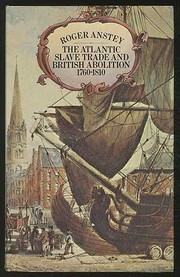
The Atlantic slave trade and British abolition, 1760-1810 by 6009176|Roger Anstey book cover

📘 The Atlantic slave trade and British abolition, 1760-1810

Few phenomena of modern history have cast so long a shadow as that of black slavery or branded themselves so deeply in the historical consciousness of both Africa and the Western world. Inevitably it has left a trail of controversy, not least among historians, who take violently opposed views of the internal effects of the slave trade upon Africa, who magnify or disparage its role in the Atlantic economy, and who assign widely differing explanations of British moves to secure its abolition. It is symptomatic of the paradox of much of our contemporary intellectual culture that under the influence of historical materialism it should instinctively deny an autonomous role to ideology while remaining itself so ideologically oriented. Yet the central statement of this viewpoint, Eric Williams' celebrated Capitalism and Slavery, undoubtedly threw a salutary douche of cold water over the smug complacency that had hitherto infected the received accounts of British abolition. The argument that British abolition, far from being an act of pure disinterested benevolence, fell into line with the country's economic interests and with the change from commercial to industrial capitalism has never been fully countered. The more exaggerated elements in his thesis have been duly assailed. That the profits of the slave trade should have been sufficiently large and well-directed to power the Industrial Revolution is a hypothesis as far-fetched as that which sees the wealth accumulated from the plunder of Bengal after the battle of Plassey as the main source of investment capital. Yet when purged of such exaggerated claims Williams' argument remains formidable. As D. B. Davis has acknowledged: "It is ... difficult ... to get around the simple fact that no country thought of abolishing the slave trade until its economic value had considerably declined." - Foreword.

★★★★★★★★★★ 0.0 (0 ratings)
Similar? ✓ Yes 0 ✗ No 0
Black cargoes by 7524844|Daniel P. Mannix book cover

📘 Black cargoes


★★★★★★★★★★ 0.0 (0 ratings)
Similar? ✓ Yes 0 ✗ No 0
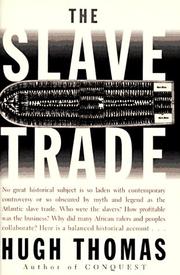
The slave trade by 7750973|Hugh Thomas book cover

📘 The slave trade

A comprehensive and vividly alive history of the transatlantic slave trade.

★★★★★★★★★★ 0.0 (0 ratings)
Similar? ✓ Yes 0 ✗ No 0
Transformations in slavery by 7768979|Paul E. Lovejoy book cover

📘 Transformations in slavery

An updated comprehensive study of African slavery from the fifteenth to the early twentieth centuries, exploring indigenous slave systems within the global slave trade and their economic and social impacts.

★★★★★★★★★★ 0.0 (0 ratings)
Similar? ✓ Yes 0 ✗ No 0
Black ivory by 6861646|Walvin, James. book cover

📘 Black ivory


★★★★★★★★★★ 0.0 (0 ratings)
Similar? ✓ Yes 0 ✗ No 0

Some Other Similar Books

The Political Economy of Slavery by Eric Williams
Slave Ship: A Human History by Marcus Rediker
The Origins of the Modern World: A Global and Environmental Narrative from the Fifteenth to the Twenty-First Century by Robert B. Marks
The Half Has Never Been Told: Slavery and the Making of American Capitalism by Edward E. Baptist
The Economic Consequences of the Atlantic Slave Trade by Sven Beckert
Thinking About Slavery by David Brion Davis
The Rise of African Capitalism: An Analysis of the Dynamics of Economic Development by N. N. Nwankwo

Have a similar book in mind? Let others know!

Please login to submit books!