Books like Turing's cathedral by George Dyson
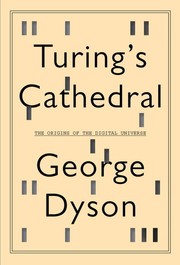

Legendary historian and philosopher of science George Dyson vividly re-creates the scenes of focused experimentation, incredible mathematical insight, and pure creative genius that gave us computers, digital television, modern genetics, models of stellar evolution--in other words, computer code. In the 1940s and '50s, a group of eccentric geniuses--led by John von Neumann--gathered at the newly created Institute for Advanced Study in Princeton, New Jersey. Their joint project was the realization of the theoretical universal machine, an idea that had been put forth by mathematician Alan Turing. This group of brilliant engineers worked in isolation, almost entirely independent from industry and the traditional academic community. But because they relied exclusively on government funding, the government wanted its share of the results: the computer that they built also led directly to the hydrogen bomb. George Dyson has uncovered a wealth of new material about this project, and in bringing the story of these men and women and their ideas to life, he shows how the crucial advancements that dominated twentieth-century technology emerged from one computer in one laboratory, where the digital universe as we know it was born.
First publish date: 2012
Authors: George Dyson
★ ★ ★ ★ ★ 0.0 (0 community ratings)

Turing's cathedral by George Dyson

How are these books recommended?

The books recommended for Turing's cathedral by George Dyson are shaped by reader interaction. Votes on how closely books relate, user ratings, and community comments all help refine these recommendations and highlight books readers genuinely find similar in theme, ideas, and overall reading experience.


Have you read any of these books?
Your votes, ratings, and comments help improve recommendations and make it easier for other readers to discover books they’ll enjoy.

Books similar to Turing's cathedral (7 similar books)
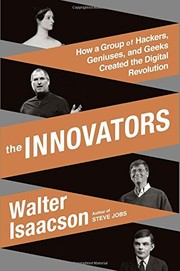
The Innovators by 12661862|Walter Isaacson book cover

📘 The Innovators

Walter Isaacson chronicles the minds that forged the digital age, from Ada Lovelace to Larry Page, showing how vision, collaboration, and engineering transformed abstract ideas into the computers, Internet, and technology we use today.

★★★★★★★★★★ 3.9 (21 ratings)
Similar? ✓ Yes 0 ✗ No 0
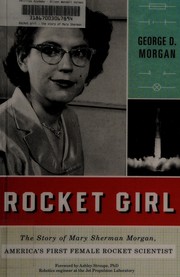
Rocket Girl by 11860493|George D. Morgan book cover

📘 Rocket Girl

"Blending a fascinating personal history with dramatic historical events, this book brings long-overdue attention to a brilliant woman whose work proved essential for America's early space program. This is the extraordinary true story of America's first female rocket scientist. Told by her son, it describes Mary Sherman Morgan's crucial contribution to launching America's first satellite and the author's labyrinthine journey to uncover his mother's lost legacy--one buried deep under a lifetime of secrets political, technological, and personal. In 1938, a young German rocket enthusiast named Wernher von Braun had dreams of building a rocket that could fly him to the moon. In Ray, North Dakota, a young farm girl named Mary Sherman was attending high school. In an age when girls rarely dreamed of a career in science, Mary wanted to be a chemist. A decade later the dreams of these two disparate individuals would coalesce in ways neither could have imagined. World War II and the Cold War space race with the Russians changed the fates of both von Braun and Mary Sherman Morgan. When von Braun and other top engineers could not find a solution to the repeated failures that plagued the nascent US rocket program, North American Aviation, where Sherman Morgan then worked, was given the challenge. Recognizing her talent for chemistry, company management turned the assignment over to young Mary. In the end, America succeeded in launching rockets into space, but only because of the joint efforts of the brilliant farm girl from North Dakota and the famous German scientist. While von Braun went on to become a high-profile figure in NASA's manned space flight, Mary Sherman Morgan and her contributions fell into obscurity--until now."--

★★★★★★★★★★ 0.0 (0 ratings)
Similar? ✓ Yes 0 ✗ No 0
Alan Turing by 7705502|Dermot Turing book cover

📘 Alan Turing

A first‑hand biography of Alan Turing written by his nephew, Dermot Turing, drawing on newly released National Archives documents, unpublished photographs, and fresh insights into Turing’s life as mathematician, codebreaker, and computer pioneer.

★★★★★★★★★★ 0.0 (0 ratings)
Similar? ✓ Yes 0 ✗ No 0
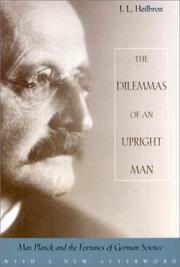
The dilemmas of an upright man by 8293387|J. L. Heilbron book cover

📘 The dilemmas of an upright man

Max Planck came to prominence after proposing the quantum idea in 1900 and rose steadily to the forefront of scientific leadership in Germany, which retained its lead in science especially in physics, chemistry, and mathematics during the first several decades of the 20th century. A close colleague of Einstein and most major continental scientists of his period, Planck fought a losing battle against overwhelming odds by defying the Nazi regime. Heilbron's biography carefully details the life of this courageous, humane, and brilliant scientist.

★★★★★★★★★★ 0.0 (0 ratings)
Similar? ✓ Yes 0 ✗ No 0
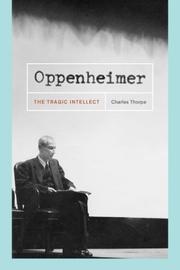
Oppenheimer by 6856902|Charles Thorpe book cover

📘 Oppenheimer

At a time when the Manhattan Project was synonymous with large-scale science, physicist J. Robert Oppenheimer (1904–67) represented the new sociocultural power of the American intellectual. Catapulted to fame as director of the Los Alamos atomic weapons laboratory, Oppenheimer occupied a key position in the compact between science and the state that developed out of World War II. By tracing the making—and unmaking—of Oppenheimer’s wartime and postwar scientific identity, Charles Thorpe illustrates the struggles over the role of the scientist in relation to nuclear weapons, the state, and culture.A stylish intellectual biography, Oppenheimer maps out changes in the roles of scientists and intellectuals in twentieth-century America, ultimately revealing transformations in Oppenheimer’s persona that coincided with changing attitudes toward science in society."This is an outstandingly well-researched book, a pleasure to read and distinguished by the high quality of its observations and judgments. It will be of special interest to scholars of modern history, but non-specialist readers will enjoy the clarity that Thorpe brings to common misunderstandings about his subject."—Graham Farmelo, Times Higher Education Supplement"A fascinating new perspective....Thorpe’s book provides the best perspective yet for understanding Oppenheimer’s Los Alamos years, which were critical, after all, not only to his life but, for better or worse, the history of mankind."—Catherine Westfall, Nature

★★★★★★★★★★ 0.0 (0 ratings)
Similar? ✓ Yes 0 ✗ No 0
Turing by 12719964|B. Jack Copeland book cover

📘 Turing

Brilliant mathematician and codebreaker Alan Turing’s life and ideas—from breaking Germany’s Enigma codes to founding theoretical computer science—are explored in this concise biography.

★★★★★★★★★★ 0.0 (0 ratings)
Similar? ✓ Yes 0 ✗ No 0

Some Other Similar Books

The Innovators: How a Group of Hackers, Geniuses, and Geeks Created the Digital Revolution by Walter Isaacson
Programmed Inequality: How Britain Discarded Women Technologists and Lost Its Edge in Computing by Mar Hicks
The Man Who Knew Infinity: A Life of the Genius Ramanujan by Robert Kanigel
The Code Book: The Science of Secrecy from Ancient Egypt to Quantum Cryptography by Simon Singh
Computing Machinery and Intelligence by Alan Turing
Alan Turing: The Enigma by Andrew Hodges
The Information: A History, a Theory, a Flood by James Gleick
The Digital Brain: Computational Neuroscience and Data Science by Stefan Kießlich
Dark Data: Why Computer Security is Harder Than We Think by Bruce Schneier
The Master Algorithm: How the Quest for the Ultimate Learning Machine Will Remake Our World by Pedro Domingos

Have a similar book in mind? Let others know!

Please login to submit books!