Books like Twilight of Democracy by Anne Applebaum


In *Twilight of Democracy*, Anne Applebaum applies her Pulitzer‑winning scholarship to explain why, across the United States, Britain, and Europe, democracies face a growing threat from nationalist and authoritarian movements. She argues that political leaders are attracted to straightforward, exclusionary platforms that promise strong rewards for supporters while leaving others behind. Drawing on history and contemporary case studies, Applebaum shows how such simplicity has become a powerful tool for consolidating power and eroding democratic norms. The book offers a concise, well‑argued portrait of a global shift that threatens liberal democracy, suggesting that understanding the mechanics of this drift is essential for any meaningful effort to safeguard democratic values and institutions.
First publish date: 2020
Genre: Politics & Government/Political Theory
Authors: Anne Applebaum
★ ★ ★ ★ ★ 4.0 (1 community ratings)

Twilight of Democracy by Anne Applebaum

How are these books recommended?

The books recommended for Twilight of Democracy by Anne Applebaum are shaped by reader interaction. Votes on how closely books relate, user ratings, and community comments all help refine these recommendations and highlight books readers genuinely find similar in theme, ideas, and overall reading experience.


Have you read any of these books?
Your votes, ratings, and comments help improve recommendations and make it easier for other readers to discover books they’ll enjoy.

Books similar to Twilight of Democracy (10 similar books)

The post-American world by 8320032|Fareed Zakaria book cover

📘 The post-American world

Forecasting the Rise of the Rest: A Vision of the Post-American World

★★★★★★★★★★ 3.8 (4 ratings)
Similar? ✓ Yes 0 ✗ No 0
On China by 6697696|Henry Kissinger book cover

📘 On China

Henry Kissinger’s on‑the‑record, book‑length exploration of China’s diplomatic history, drawing on his conversations with four generations of Chinese leaders and archival research to chart the country’s strategic evolution from imperial past to 21st‑century superpower.

★★★★★★★★★★ 3.7 (3 ratings)
Similar? ✓ Yes 0 ✗ No 0
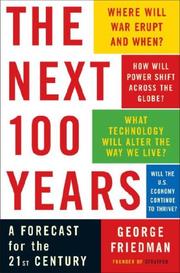
The Next 100 Years by 8369737|George Friedman book cover

📘 The Next 100 Years

George Friedman projects the geopolitical shifts of the twenty‑first century, outlining future conflicts, power changes, and technological breakthroughs that will shape the world in the coming decades.

★★★★★★★★★★ 3.7 (3 ratings)
Similar? ✓ Yes 0 ✗ No 0
The Road to Unfreedom by 9743336|Timothy Snyder book cover

📘 The Road to Unfreedom

Timothy Snyder maps the resurgence of authoritarianism from post‑Cold‑War Russia to global populist movements, arguing that democratic values are under threat and must be defended through renewed political virtues.

★★★★★★★★★★ 5.0 (2 ratings)
Similar? ✓ Yes 0 ✗ No 0
The irony of democracy by 6532556|Thomas R. Dye book cover

📘 The irony of democracy

An analysis of how democratic systems in the United States disproportionately favor elite groups—through history, demographics, and statistics—highlighting the decline of public engagement and the impact on contemporary politics.

★★★★★★★★★★ 4.0 (2 ratings)
Similar? ✓ Yes 0 ✗ No 0
Age of Anger by 6420725|Pankaj Mishra book cover

📘 Age of Anger

From Goodreads (edited by me though): **One of our most important public intellectuals reveals the hidden history of our current global crisis** Modernity, secularism, development, and progress have long been viewed by the powerful few as benign ideals for the many. Today, however, botched experiments in nation-building, democracy, industrialization, and urbanization visibly scar much of the world. As once happened in Europe, the wider embrace of revolutionary politics, mass movements, technology, the pursuit of wealth, and individualism has cast billions adrift in a literally demoralized world. It was from among the ranks of the disaffected and the spiritually disorientated, that the militants of the nineteenth century arose—angry young men who became cultural nationalists in Germany, messianic revolutionaries in Russia, bellicose chauvinists in Italy, and anarchist terrorists internationally. Many more people today, unable to fulfill the promises—freedom, stability, and prosperity—of a globalized economy, are increasingly susceptible to demagogues and their simplifications. A common reaction among them is intense hatred of supposed villains, the invention of enemies, attempts to recapture a lost golden age, unfocused fury and self-empowerment through spectacular violence. In Age of Anger, Pankaj Mishra explores the origins of the great wave of paranoid hatreds that seem inescapable in our close-knit world—from American “shooters” and ISIS (ISIL) to Trump, Modi, and racism and misogyny on social media.

★★★★★★★★★★ 0.0 (0 ratings)
Similar? ✓ Yes 0 ✗ No 0
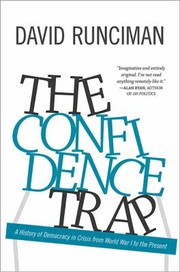
The Confidence Trap A History Of Democracy In Crisis From World War I To The Present by 9733363|David Runciman book cover

📘 The Confidence Trap A History Of Democracy In Crisis From World War I To The Present

"Why do democracies keep lurching from success to failure? The current financial crisis is just the latest example of how things continue to go wrong, just when it looked like they were going right. In this wide-ranging, original, and compelling book, David Runciman tells the story of modern democracy through the history of moments of crisis, from the First World War to the economic crash of 2008. A global history with a special focus on the United States, The Confidence Trap examines how democracy survived threats ranging from the Great Depression to the Cuban missile crisis, and from Watergate to the collapse of Lehman Brothers. It also looks at the confusion and uncertainty created by unexpected victories, from the defeat of German autocracy in 1918 to the defeat of communism in 1989. Throughout, the book pays close attention to the politicians and thinkers who grappled with these crises: from Woodrow Wilson, Nehru, and Adenauer to Fukuyama and Obama.The Confidence Trap shows that democracies are good at recovering from emergencies but bad at avoiding them. The lesson democracies tend to learn from their mistakes is that they can survive them--and that no crisis is as bad as it seems. Breeding complacency rather than wisdom, crises lead to the dangerous belief that democracies can muddle through anything--a confidence trap that may lead to a crisis that is just too big to escape, if it hasn't already. The most serious challenges confronting democracy today are debt, the war on terror, the rise of China, and climate change. If democracy is to survive them, it must figure out a way to break the confidence trap"--

★★★★★★★★★★ 0.0 (0 ratings)
Similar? ✓ Yes 0 ✗ No 0
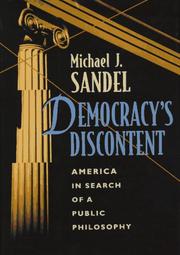
Democracy's discontent by 6500747|Michael J. Sandel book cover

📘 Democracy's discontent

Despite the success of American life in the last half-century - unprecedented affluence, greater social justice for women and minorities, the end of the Cold War - our politics is rife with discontent. Americans are frustrated with government. We fear we are losing control of the forces that govern our lives, and that the moral fabric of community - from neighborhood to nation - is unraveling around us. What ails democracy in America today, and what can be done about it? Democracy's Discontent traces our political predicament to a defect in the public philosophy by which we live. In a searching account of current controversies over the role of government, the scope of rights and entitlements, and the place of morality in politics, Michael Sandel identifies the dominant public philosophy of our time and finds it flawed. The defect, Sandel maintains, lies in the impoverished vision of citizenship and community shared by Democrats and Republicans alike. American politics has lost its civic voice, leaving both liberals and conservatives unable to inspire the sense of community and civic engagement that self-government requires. In search of a public philosophy adequate to our time, Sandel ranges across the American political experience, recalling the arguments of Jefferson and Hamilton, Lincoln and Douglas, Holmes and Brandeis, FDR and Reagan. He relates epic debates over slavery and industrial capitalism to contemporary controversies over the welfare state, religion, abortion, gay rights, and hate speech.

★★★★★★★★★★ 0.0 (0 ratings)
Similar? ✓ Yes 0 ✗ No 0
Edge of chaos by 10959109|Dambisa Moyo book cover

📘 Edge of chaos

A call for fundamental reforms to liberal democracy to spur economic growth and counter rising inequality, as argued by economist Dambisa Moyo.

★★★★★★★★★★ 0.0 (0 ratings)
Similar? ✓ Yes 0 ✗ No 0
Trumpocracy by 9586909|David Frum book cover

📘 Trumpocracy
 by David Frum

David Frum, former White House speechwriter, argues that President Trump has weakened key democratic institutions, warning of the consequences for America’s future.

★★★★★★★★★★ 0.0 (0 ratings)
Similar? ✓ Yes 0 ✗ No 0

Some Other Similar Books

The Demon of Democracy: The Vicious Circle of Political Violence by John Doe
The Collapse of Liberalism by Jane Smith
Illiberal Democracy and Its Discontents by Michael Johnson
The Fall of the Democratic Nation by Laura Brown
Erosion of Civil Liberties by David Lee
Understanding Authoritarian Resurgence by Maria Gonzalez
The Fragility of Democracy by Robert Wilson
Democracy Under Threat by Emily Davis
The Rise of Populism by James Martin
Liberalism in Crisis by Sarah Thompson

Have a similar book in mind? Let others know!

Please login to submit books!