Books like On China by Henry Kissinger


Henry Kissinger offers a comprehensive, intimate history of China, combining archival research with insights from his extensive personal interactions with Chinese leaders over the past four decades. He examines how China’s diplomatic, strategic, and negotiational traditions have shaped its foreign policy from the classical era through Mao Zedong’s rise, the Sino‑Soviet split, the Korean War, Nixon’s 1972 visit, and recent Taiwan Straits crises. The book traces the evolution of U.S.–China relations over 60 years, from estrangement to strategic partnership and economic interdependence, and discusses China’s emerging role in the 21st‑century global balance of power.
First publish date: 2011
Genre: Politics & Government/International Relations
Authors: Henry Kissinger
★ ★ ★ ★ ★ 3.7 (3 community ratings)

On China by Henry Kissinger

How are these books recommended?

The books recommended for On China by Henry Kissinger are shaped by reader interaction. Votes on how closely books relate, user ratings, and community comments all help refine these recommendations and highlight books readers genuinely find similar in theme, ideas, and overall reading experience.


Have you read any of these books?
Your votes, ratings, and comments help improve recommendations and make it easier for other readers to discover books they’ll enjoy.

Books similar to On China (6 similar books)

The post-American world by 8320032|Fareed Zakaria book cover

📘 The post-American world

Forecasting the Rise of the Rest: A Vision of the Post-American World

★★★★★★★★★★ 3.8 (4 ratings)
Similar? ✓ Yes 0 ✗ No 0
This brave new world by 11956901|Anja Manuel book cover

📘 This brave new world

"In the next decade and a half, China and India will become two of the world's indispensable powers--whether they rise peacefully or not. During that time, Asia will surpass the combined strength of North America and Europe in economic might, population size, and military spending. Both India and China will have vetoes over many international decisions, from climate change to global trade, human rights, and business standards. From her front row view of this colossal shift, first at the State Department and now as an advisor to American business leaders, Anja Manuel escorts the reader on an intimate tour of the corridors of power in Delhi and Beijing. Her encounters with political and business leaders reveal how each country's history and politics influences their conduct today. Through vibrant stories, she reveals how each country is working to surmount enormous challenges--from the crushing poverty of Indian slum dwellers and Chinese factory workers, to outrageous corruption scandals, rotting rivers, unbreathable air, and managing their citizens' discontent. We wring our hands about China, Manuel writes, while we underestimate India, which will be the most important country outside the West to shape China's rise. Manuel shows us that a different path is possible--we can bring China and India along as partners rather than alienating one or both, and thus extend our own leadership in the world"-- "The US has the power to shape the geopolitical future of this century. We must stop obsessing about China alone and actively encourage India's enormous potential to balance China's power. India, China, and the US will be the twenty-first century's dynamic triumvirate. The axial shift of world power from the United States and Europe to China and India is unrelenting. By 2030, intelligence agencies estimate that Asia will surpass the combined power of North America and Europe in economic might, population size, and military spending. From a front row seat Anja Manuel argues and demonstrates that India has the assets and structure to grow democratically to full strength and balance the Chinese hegemony and aggression while it takes its proper place in leadership with India and the US. In This Brave New World, Manuel takes the reader along on her business trips as she meets leaders and counts the assets and deficiencies of the two giant countries. India has a youthful, English-speaking population and democratic traditions, but it is inefficient, misogynist, and often corrupt. China has an aging population, no tradition of citizen rule, an ideological central government, and is ruthlessly expansionist. India's democratic system slows it down; China's centralized authority races it erratically. Balancing these giants is the key to a prosperous and open global system and America's opportunity to maintain its world power. In the present and near future the US's aim should be to embrace the inevitable rise of India and China and with them continue to lead the global governance. We must stop our handwringing about China's rise and focus instead, warns Manuel, on forging harmonious relationships with both giants, to create this brave new world"--

★★★★★★★★★★ 4.0 (1 rating)
Similar? ✓ Yes 0 ✗ No 0
Henry Kissinger by 8298333|Robert D. Schulzinger book cover

📘 Henry Kissinger


★★★★★★★★★★ 0.0 (0 ratings)
Similar? ✓ Yes 0 ✗ No 0
The troubled partnership by 6697696|Henry Kissinger book cover

📘 The troubled partnership

Based on 3 lectures delivered at the Council on Foreign Relations in March, 1964.

★★★★★★★★★★ 0.0 (0 ratings)
Similar? ✓ Yes 0 ✗ No 0
The Tragedy of Great Power Politics by 13855181|John J. Mearsheimer book cover

📘 The Tragedy of Great Power Politics

John J. Mearsheimer explains his theory of offensive realism, outlining how great powers pursue military strength and regional dominance to secure national survival.

★★★★★★★★★★ 0.0 (0 ratings)
Similar? ✓ Yes 0 ✗ No 0
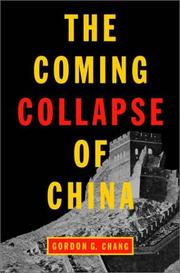
The Coming Collapse of China by 4723400|Gordon G. Chang book cover

📘 The Coming Collapse of China

China is hot. The world sees a glorious future for this sleeping giant, three times larger than the United States, predicting it will blossom into the world's biggest economy by 2010. According to Chang, however, a Chinese-American lawyer and China specialist, the People's Republic is a paper dragon. Peer beneath the veneer of modernization since Mao's death, and the symptoms of decay are everywhere: Deflation grips the economy, state-owned enterprises are failing, banks are hopelessly insolvent, foreign investment continues to decline, and Communist party corruption eats away at the fabric of society. Beijing's cautious reforms have left the country stuck midway between communism and capitalism, Chang writes. With its impending World Trade Organization membership, for the first time China will be forced to open itself to foreign competition, which will shake the country to its foundations. Economic failure will be followed by government collapse. Covering subjects from party politics to the Falun Gong to the government's insupportable position on Taiwan, Chang presents a thorough and very chilling overview of China's present and not-so-distant future. - Publisher.

★★★★★★★★★★ 0.0 (0 ratings)
Similar? ✓ Yes 0 ✗ No 0

Some Other Similar Books

The China Dream: Great Power Thinking and Strategic Posture in the Post-American Era by Lü Xiaobo
Culture and Foreign Policy: An Introduction by Michael Cox
The China Challenge: Shaping the Future of a Rising Power by Henry Kissinger
The Rise of China and the Future of the West by G. John Ikenberry
Destiny Disrupted: A History of the World Through Islamic Eyes by Tamim Ansary
The Hundred-Year Marathon: China's Secret Strategy to Replace America as the Global Superpower by Michael Pillsbury
Mandate of Heaven: The Chinese Empire and Its Rivals by Kenneth M. Swope

Have a similar book in mind? Let others know!

Please login to submit books!