Books like When Work Disappears by Wilson, William J.
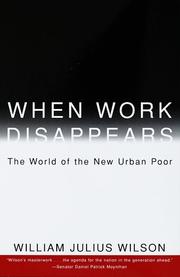

In *When Work Disappears*, William Julius Wilson uses extensive data and personal accounts to show how the decline of manufacturing and service jobs in the U.S. has created lasting hardship in urban poor communities. He argues that the resulting unemployment underlies the rise in poverty, crime, and family disruption seen in inner‑city neighborhoods, and offers policy solutions that could benefit all Americans.
First publish date: 1997
Genre: Politics & Government/Public Policy
Authors: Wilson, William J.
★ ★ ★ ★ ★ 0.0 (0 community ratings)

When Work Disappears by Wilson, William J.

How are these books recommended?

The books recommended for When Work Disappears by Wilson, William J. are shaped by reader interaction. Votes on how closely books relate, user ratings, and community comments all help refine these recommendations and highlight books readers genuinely find similar in theme, ideas, and overall reading experience.


Have you read any of these books?
Your votes, ratings, and comments help improve recommendations and make it easier for other readers to discover books they’ll enjoy.

Books similar to When Work Disappears (13 similar books)

The Color of Law by 6252918|Richard Rothstein book cover

πŸ“˜ The Color of Law

Richard Rothstein’s *The Color of Law* uncovers how federal, state, and local policies deliberately created and maintained racial segregation in U.S. cities.

β˜…β˜…β˜…β˜…β˜…β˜…β˜…β˜…β˜…β˜… 4.6 (9 ratings)
Similar? ✓ Yes 0 ✗ No 0
The Second Machine Age by 9671059|Erik Brynjolfsson book cover

πŸ“˜ The Second Machine Age

Erik Brynjolfsson explores how digital technologies are reshaping work, productivity, and societyβ€”highlighting both the opportunities and the disruptionsβ€”and offers strategies for education, collaboration, and policy in the emerging economy.

β˜…β˜…β˜…β˜…β˜…β˜…β˜…β˜…β˜…β˜… 3.7 (7 ratings)
Similar? ✓ Yes 0 ✗ No 0
Palaces for the people by 7108021|Eric Klinenberg book cover

πŸ“˜ Palaces for the people

In Palaces for the People, Eric Klinenberg argues that the future vitality of democratic cities depends on shared public spacesβ€”libraries, parks, and community centersβ€”that foster social connections and equity.

β˜…β˜…β˜…β˜…β˜…β˜…β˜…β˜…β˜…β˜… 3.0 (5 ratings)
Similar? ✓ Yes 0 ✗ No 0
City of Quartz by 6402071|Mike Davis book cover

πŸ“˜ City of Quartz
 by Mike Davis


β˜…β˜…β˜…β˜…β˜…β˜…β˜…β˜…β˜…β˜… 4.0 (3 ratings)
Similar? ✓ Yes 0 ✗ No 0
The new urban crisis by 13285877|Richard Florida book cover

πŸ“˜ The new urban crisis

Richard Florida examines how the return of young, educated residents to cities fuels growth but also deepens inequality, outlining a need for inclusive urban policies to balance prosperity and affordability.

β˜…β˜…β˜…β˜…β˜…β˜…β˜…β˜…β˜…β˜… 4.0 (2 ratings)
Similar? ✓ Yes 0 ✗ No 0
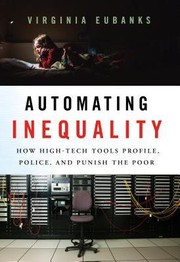
Automating Inequality by 11256268|Virginia Eubanks book cover

πŸ“˜ Automating Inequality

'Automating Inequality' exposes how data‑driven systems in health, housing, and child welfare perpetuate discrimination against the poor, revealing the hidden techβ€”often invisibleβ€”policing that shapes American policy.

β˜…β˜…β˜…β˜…β˜…β˜…β˜…β˜…β˜…β˜… 5.0 (1 rating)
Similar? ✓ Yes 0 ✗ No 0
All our kin: strategies for survival in a Black community by 8841110|Carol B. Stack book cover

πŸ“˜ All our kin: strategies for survival in a Black community

A young white woman's journey into a black community to study the family support systems coping with poverty, debunking the misconception that poor families were unstable and disorganized.

β˜…β˜…β˜…β˜…β˜…β˜…β˜…β˜…β˜…β˜… 4.0 (1 rating)
Similar? ✓ Yes 0 ✗ No 0
Labor and monopoly capital by 6725673|Harry Braverman book cover

πŸ“˜ Labor and monopoly capital


β˜…β˜…β˜…β˜…β˜…β˜…β˜…β˜…β˜…β˜… 4.0 (1 rating)
Similar? ✓ Yes 0 ✗ No 0
Mapping decline by 6240657|Colin Gordon book cover

πŸ“˜ Mapping decline


β˜…β˜…β˜…β˜…β˜…β˜…β˜…β˜…β˜…β˜… 5.0 (1 rating)
Similar? ✓ Yes 0 ✗ No 0
The new geography of jobs by 9496920|Enrico Moretti book cover

πŸ“˜ The new geography of jobs

From the author, an economist, this book is an examination of innovation and success, and where to find them in America. An unprecedented redistribution of jobs, population, and wealth is under way in America, and it is likely to accelerate in the years to come. America's new economic map shows growing differences, not just between people but especially between communities. In this book, the author provides a fresh perspective on the tectonic shifts that are reshaping America's labor market, from globalization and income inequality to immigration and technological progress, and how these shifts are affecting our communities. Drawing on a wealth of new studies, the author uncovers what smart policies may be appropriate to address the social challenges that are arising. We are used to thinking of the United States in dichotomous terms: red versus blue, black versus white, haves versus have-nots. But today there are three Americas. At one extreme are the brain hubs, cities like San Francisco, Boston, Austin, and Durham, with a well-educated labor force and a strong innovation sector. Their workers are among the most productive, creative, and best paid on the planet. At the other extreme are cities once dominated by traditional manufacturing, which are declining rapidly, losing jobs and residents. In the middle are a number of cities that could go either way. For the past thirty years, the three Americas have been growing apart at an accelerating rate. This divergence is one the most important recent developments in the United States and is causing growing geographic disparities is all other aspects of our lives, from health and longevity to family stability and political engagement. But the winners and losers are not necessarily who you would expect. The author's research shows that you do not have to be a scientist or an engineer to thrive in one of these brain hubs. Among the beneficiaries are the workers who support the "idea-creators", the carpenters, hair stylists, personal trainers, lawyers, doctors, teachers and the like. In fact, he has shown that for every new innovation job in a city, five additional non-innovation jobs are created, and those workers earn higher salaries than their counterparts in other cities. It was not supposed to be this way. As the global economy shifted from manufacturing to innovation, geography was supposed to matter less. But the pundits were wrong. A new map is being drawn, the inevitable result of deep-seated but rarely discussed economic forces. These trends are reshaping the very fabric of our society. Dealing with this split, supporting growth in the hubs while arresting the decline elsewhere, will be the challenge of the century.

β˜…β˜…β˜…β˜…β˜…β˜…β˜…β˜…β˜…β˜… 3.0 (1 rating)
Similar? ✓ Yes 0 ✗ No 0
Off the Books by 7044729|Sudhir Alladi Venkatesh book cover

πŸ“˜ Off the Books


β˜…β˜…β˜…β˜…β˜…β˜…β˜…β˜…β˜…β˜… 0.0 (0 ratings)
Similar? ✓ Yes 0 ✗ No 0
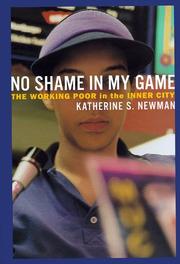
No shame in my game by 6682032|Katherine S. Newman book cover

πŸ“˜ No shame in my game

In No Shame in My Game, anthropologist Katherine Newman presents a view of inner-city poverty radically different from that commonly accepted. The all-too-prevalent picture we get of the poor today - in the media, in the political sphere, and in scholarly studies - is of alienated minorities living in big-city ghettos, lacking in values and family structure, criminally inclined, and permanently dependent on government handouts. What Newman reveals, however - as she focuses on the working poor in Harlem, one of the country's most depressed urban areas - is a community of people who are committed to earning a living, struggling to support themselves and their families on minimum-wage dead-end jobs, and clinging to the dignity of a regular paycheck, no matter how meager. For two years, Professor Newman and her assistants followed people in Harlem - from work to school to the streets to their homes - and spent hundreds of hours talking to employees, and their bosses and supervisors, their friends and families. From observations and interviews, we come to understand not only the essential contribution that low-wage earners make to the survival of poor households, but also the ways in which these jobs affect young people's attitudes, prospects, and self-image. Most powerfully, we listen as low-wage earners speak about their jobs, their ambitions, and their values - especially their devotion to family and belief in the work ethic.

β˜…β˜…β˜…β˜…β˜…β˜…β˜…β˜…β˜…β˜… 0.0 (0 ratings)
Similar? ✓ Yes 0 ✗ No 0
Ghost Work by 6725353|Mary L. Gray book cover

πŸ“˜ Ghost Work


β˜…β˜…β˜…β˜…β˜…β˜…β˜…β˜…β˜…β˜… 0.0 (0 ratings)
Similar? ✓ Yes 0 ✗ No 0

Some Other Similar Books

Evicted: Poverty and Profit in the American City by Matthew Desmond
Race, Poverty, and the Environment by Valerie L. Nelson
The Truly Disadvantaged by William J. Wilson
The End of the Suburbs by Leigh Gallagher
The Rise of the Meritocracy by Michael Young
The Rise of the Robots by Martin Ford
Race, Work, and Leadership by Clark, Joan C. Williams
The End of Work by Taylor, Jeremy
The Human Side of Automation by H. V. Jagadish

Have a similar book in mind? Let others know!

Please login to submit books!