Books like Alienated America by Timothy P. Carney
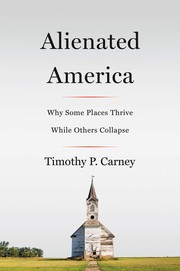

Respected conservative journalist and commentator Timothy P. Carney continues the conversation begun with Hillbilly Elegy and the classic Bowling Alone in this hard-hitting analysis that identifies the true factor behind the decline of the American dream: it is not purely the result of economics as the left claims, but the collapse of the institutions that made us successful, including marriage, church, and civic life. During the 2016 presidential campaign, Donald J. Trump proclaimed, “the American dream is dead,” and this message resonated across the country. Why do so many people believe that the American dream is no longer within reach? Growing inequality, stubborn pockets of immobility, rising rates of deadly addiction, the increasing and troubling fact that where you start determines where you end up, heightening political strife—these are the disturbing realities threatening ordinary American lives today. The standard accounts pointed to economic problems among the working class, but the root was a cultural collapse: While the educated and wealthy elites still enjoy strong communities, most blue-collar Americans lack strong communities and institutions that bind them to their neighbors. And outside of the elites, the central American institution has been religion That is, it’s not the factory closings that have torn us apart; it’s the church closings. The dissolution of our most cherished institutions—nuclear families, places of worship, civic organizations—has not only divided us, but eroded our sense of worth, belief in opportunity, and connection to one another. In Alienated America, Carney visits all corners of America, from the dim country bars of Southwestern Pennsylvania., to the bustling Mormon wards of Salt Lake City, and explains the most important data and research to demonstrate how the social connection is the great divide in America. He shows that Trump’s surprising victory was the most visible symptom of this deep-seated problem. In addition to his detailed exploration of how a range of societal changes have, in tandem, damaged us, Carney provides a framework that will lead us back out of a lonely, modern wilderness.
First publish date: 2019
Subjects: United states, social life and customs, United states, history, 21st century
Authors: Timothy P. Carney
4.5 (2 community ratings)

Alienated America by Timothy P. Carney

How are these books recommended?

The books recommended for Alienated America by Timothy P. Carney are shaped by reader interaction. Votes on how closely books relate, user ratings, and community comments all help refine these recommendations and highlight books readers genuinely find similar in theme, ideas, and overall reading experience.


Have you read any of these books?
Your votes, ratings, and comments help improve recommendations and make it easier for other readers to discover books they’ll enjoy.

Books similar to Alienated America (2 similar books)
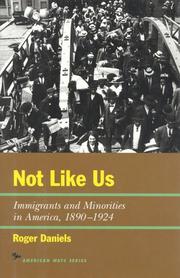
Not Like Us

📘 Not Like Us

In the thirty-five years after 1890, more than 20 million immigrants came to the United States - a greater number than in any comparable period before or since. Despite American mythology about "melting pots" and "tossed salads," the newcomers were often treated in hostile fashion. Tracing their experiences in confronting the forces of American nativism, Roger Daniels finds that a period of supposed progress was instead filled with conflict and xenophobia. If so many immigrants came to American shores in this period, how can it be called an age of nativism? "The answer," Mr. Daniels writes, "is that by the 1890s powerful anti-immigrant forces had already become organized. Slowly but surely these nativists worked toward what became their major triumph, the so-called National Origins Act of 1924." But immigrants alone were not the focus of reactionary forces; African Americans and Native Americans also suffered abuse and neglect. In his analytical narrative, Mr. Daniels examines the condition of these three groups, with attention to legislation, judicial decisions, mob violence, and the responses of minorities.

1.0 (1 rating)
Similar? ✓ Yes 0 ✗ No 0
The new geography of jobs

📘 The new geography of jobs

From the author, an economist, this book is an examination of innovation and success, and where to find them in America. An unprecedented redistribution of jobs, population, and wealth is under way in America, and it is likely to accelerate in the years to come. America's new economic map shows growing differences, not just between people but especially between communities. In this book, the author provides a fresh perspective on the tectonic shifts that are reshaping America's labor market, from globalization and income inequality to immigration and technological progress, and how these shifts are affecting our communities. Drawing on a wealth of new studies, the author uncovers what smart policies may be appropriate to address the social challenges that are arising. We are used to thinking of the United States in dichotomous terms: red versus blue, black versus white, haves versus have-nots. But today there are three Americas. At one extreme are the brain hubs, cities like San Francisco, Boston, Austin, and Durham, with a well-educated labor force and a strong innovation sector. Their workers are among the most productive, creative, and best paid on the planet. At the other extreme are cities once dominated by traditional manufacturing, which are declining rapidly, losing jobs and residents. In the middle are a number of cities that could go either way. For the past thirty years, the three Americas have been growing apart at an accelerating rate. This divergence is one the most important recent developments in the United States and is causing growing geographic disparities is all other aspects of our lives, from health and longevity to family stability and political engagement. But the winners and losers are not necessarily who you would expect. The author's research shows that you do not have to be a scientist or an engineer to thrive in one of these brain hubs. Among the beneficiaries are the workers who support the "idea-creators", the carpenters, hair stylists, personal trainers, lawyers, doctors, teachers and the like. In fact, he has shown that for every new innovation job in a city, five additional non-innovation jobs are created, and those workers earn higher salaries than their counterparts in other cities. It was not supposed to be this way. As the global economy shifted from manufacturing to innovation, geography was supposed to matter less. But the pundits were wrong. A new map is being drawn, the inevitable result of deep-seated but rarely discussed economic forces. These trends are reshaping the very fabric of our society. Dealing with this split, supporting growth in the hubs while arresting the decline elsewhere, will be the challenge of the century.

3.0 (1 rating)
Similar? ✓ Yes 0 ✗ No 0

Some Other Similar Books

The Vanishing American Dream: Politics and Class in the Postindustrial Society by Alan S. Blinder
The Divided States of America: The Ferocious Clash of Ideology and Class that Undermines Our Democracy by Angus H. Hervey
Our Kids: The American Dream in Crisis by Robert D. Putnam
Strangers in Their Own Land: Anger and Mourning on the American Right by Arlie Russell Hochschild
The Age of Austerity: How Scarcity Will Remake American Politics by Thomas M. Frank
The Coddling of the American Mind: How Good Intentions and Bad Ideas Are Setting Up a Generation for Failure by Jonathan Haidt & Greg Lukianoff
Hillbilly Elegy: A Memoir of a Family and Culture in Crisis by J.D. Vance
Evicted: Poverty and Profit in the American City by Matthew Desmond
The Big Sort: Why the Clustering of Like-Minded America is Tearing Us Apart by Bill Bishop

Have a similar book in mind? Let others know!

Please login to submit books!