Books like The mysteries of Taal by Thomas R. Hargrove


First publish date: 1991
Subjects: Taal
Authors: Thomas R. Hargrove
5.0 (3 community ratings)

The mysteries of Taal by Thomas R. Hargrove

How are these books recommended?

The books recommended for The mysteries of Taal by Thomas R. Hargrove are shaped by reader interaction. Votes on how closely books relate, user ratings, and community comments all help refine these recommendations and highlight books readers genuinely find similar in theme, ideas, and overall reading experience.


Have you read any of these books?
Your votes, ratings, and comments help improve recommendations and make it easier for other readers to discover books they’ll enjoy.

Books similar to The mysteries of Taal (4 similar books)
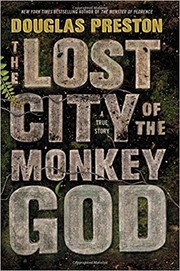
The Lost City of the Monkey God

πŸ“˜ The Lost City of the Monkey God

Since the days of conquistador HernΓ‘n CortΓ©s, rumors have circulated about a lost city of immense wealth hidden somewhere in the Honduran interior, called the White City or the Lost City of the Monkey God. Indigenous tribes speak of ancestors who fled there to escape the Spanish invaders, and they warn that anyone who enters this sacred city will fall ill and die. In 1940, swashbuckling journalist Theodore Morde returned from the rainforest with hundreds of artifacts and an electrifying story of having found the Lost City of the Monkey God--but then committed suicide without revealing its location. Three quarters of a century later, bestselling author Douglas Preston joined a team of scientists on a groundbreaking new quest. In 2012 he climbed aboard a rickety, single-engine plane carrying the machine that would change everything: lidar, a highly advanced, classified technology that could map the terrain under the densest rainforest canopy. In an unexplored valley ringed by steep mountains, that flight revealed the unmistakable image of a sprawling metropolis, tantalizing evidence of not just an undiscovered city but an enigmatic, lost civilization. Venturing into this raw, treacherous, but breathtakingly beautiful wilderness to confirm the discovery, Preston and the team battled torrential rains, quickmud, disease-carrying insects, jaguars, and deadly snakes. But it wasn't until they returned that tragedy struck: Preston and others found they had contracted in the ruins a horrifying, sometimes lethal--and incurable--disease.

β˜…β˜…β˜…β˜…β˜…β˜…β˜…β˜…β˜…β˜… 3.4 (5 ratings)
Similar? ✓ Yes 0 ✗ No 0
Language and linguistics

πŸ“˜ Language and linguistics


β˜…β˜…β˜…β˜…β˜…β˜…β˜…β˜…β˜…β˜… 0.0 (0 ratings)
Similar? ✓ Yes 0 ✗ No 0
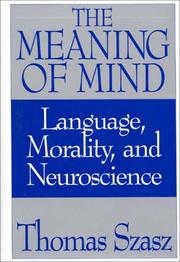
The meaning of mind

πŸ“˜ The meaning of mind

In The Meaning of Mind, Thomas Szasz argues that only as a verb does the word "mind" name something in the real world, namely, attending or heeding. Minding is the ability to pay attention and adapt to one's environment by using language to communicate with others and oneself. Viewing the "mind" as a potentially infinite variety of self-conversations is the key that unlocks many of the mysteries we associate with this concept. Modern neuroscience is a misdirected effort to explain "mind" in terms of brain functions. The claims and conclusions of the diverse academics and scientists who engage in this enterprise undermine the concepts of moral agency and personal responsibility. Szasz shows that the cognitive function of speech is to enable us to talk not only to others but to ourselves (in short, to be our own interlocutor) and that the view that mind is brain - embraced by both the scientific community and the popular press - is not an empirical finding but a rhetorical ruse concealing humanity's unceasing struggle to control persons by controlling their vocabulary. The discourse of brain-mind, unlike the discourse of man as moral agent, protects people from the dilemmas intrinsic to holding themselves responsible for their own actions and holding others responsible for theirs. Because we live in an age blessed by the fruits of materialist science, reductionist explanations of the relationship between brain and mind are more popular than ever, making this book an indispensable addition to the seemingly recondite debate about, simply, who we are.

β˜…β˜…β˜…β˜…β˜…β˜…β˜…β˜…β˜…β˜… 0.0 (0 ratings)
Similar? ✓ Yes 0 ✗ No 0
Topics in applied linguistics

πŸ“˜ Topics in applied linguistics


β˜…β˜…β˜…β˜…β˜…β˜…β˜…β˜…β˜…β˜… 0.0 (0 ratings)
Similar? ✓ Yes 0 ✗ No 0

Some Other Similar Books

In Search of Lost Worlds by Hugh Newman
Secret Chambers and Hidden Treasures of the World by Virginia McLoed
The Amazon: The Last Frontier by William Woods
Mysteries of the Jungle by Roy A. Gallant
The Temple of the Golden Pavement by Martin B. Bickford
Lost Civilizations: The Hidden Truth Behind the Great Pyramids by Christopher Knight
Uncharted: The Lost City of the Koguis by Graham Hancock
Hidden Treasures of the World by Marcello Lotti
The Enigmas of the Ancient World by Thornton D. Stersky

Have a similar book in mind? Let others know!

Please login to submit books!