Books like Plant Intelligence and the Imaginal Realm by Stephen Harrod Buhner


First publish date: 2014
Genre: Science/Biology
Authors: Stephen Harrod Buhner
★ ★ ★ ★ ★ 0.0 (0 community ratings)

Plant Intelligence and the Imaginal Realm by Stephen Harrod Buhner

How are these books recommended?

The books recommended for Plant Intelligence and the Imaginal Realm by Stephen Harrod Buhner are shaped by reader interaction. Votes on how closely books relate, user ratings, and community comments all help refine these recommendations and highlight books readers genuinely find similar in theme, ideas, and overall reading experience.


Have you read any of these books?
Your votes, ratings, and comments help improve recommendations and make it easier for other readers to discover books they’ll enjoy.

Books similar to Plant Intelligence and the Imaginal Realm (17 similar books)

The botany of desire by 9690938|Michael Pollan book cover

πŸ“˜ The botany of desire

A Random House Trade Paperback

β˜…β˜…β˜…β˜…β˜…β˜…β˜…β˜…β˜…β˜… 3.8 (16 ratings)
Similar? ✓ Yes 0 ✗ No 0
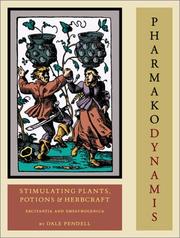
Pharmakodynamis by 10240754|Dale Pendell book cover

πŸ“˜ Pharmakodynamis

Pharmakodynamis examines the stimulating properties of plants and their preparations, covering both traditional substances such as coffee, tea, chocolate, coca, and modern empathogens.

β˜…β˜…β˜…β˜…β˜…β˜…β˜…β˜…β˜…β˜… 5.0 (2 ratings)
Similar? ✓ Yes 0 ✗ No 0
Hungry Plants by 7439642|Mary Batten book cover

πŸ“˜ Hungry Plants

An engaging exploration of carnivorous plants, detailing the anatomy and hunting strategies of the Venus flytrap, sundew, pitcher plant, and bladderwort for young readers.

β˜…β˜…β˜…β˜…β˜…β˜…β˜…β˜…β˜…β˜… 4.0 (2 ratings)
Similar? ✓ Yes 0 ✗ No 0
The revolutionary genius of plants by 11469146|Stefano Mancuso book cover

πŸ“˜ The revolutionary genius of plants

Plants are not passive; Stefano Mancuso shows they think, remember, and innovate, revealing their vital role in medicine, food, and even energy.

β˜…β˜…β˜…β˜…β˜…β˜…β˜…β˜…β˜…β˜… 4.5 (2 ratings)
Similar? ✓ Yes 0 ✗ No 0
El árbol de la quina (Cinchona spp.) by 9265145|Alfonso Garmendia Salvador book cover

πŸ“˜ El árbol de la quina (Cinchona spp.)


β˜…β˜…β˜…β˜…β˜…β˜…β˜…β˜…β˜…β˜… 5.0 (2 ratings)
Similar? ✓ Yes 0 ✗ No 0
The wild & weedy apothecary by 11146151|Doreen Shababy book cover

πŸ“˜ The wild & weedy apothecary


β˜…β˜…β˜…β˜…β˜…β˜…β˜…β˜…β˜…β˜… 5.0 (1 rating)
Similar? ✓ Yes 0 ✗ No 0
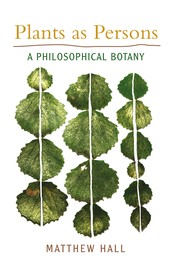
Plants as persons by 11366382|Matthew Hall book cover

πŸ“˜ Plants as persons

Challenges readers to reconsider the moral standing of plants. Plants are people too? Not exactly, but in this work of philosophical botany Matthew Hall challenges readers to reconsider the moral standing of plants, arguing that they are other-than-human persons. Plants constitute the bulk of our visible biomass, underpin all natural ecosystems, and make life on Earth possible. Yet plants are considered passive and insensitive beings rightly placed outside moral consideration. As the human assault on nature continues, more ethical behavior toward plants is needed. Hall surveys Western, Eastern, Pagan, and Indigenous thought, as well as modern science and botanical history, for attitudes toward plants, noting the particular resources for plant personhood and those modes of thought which most exclude plants. The most hierarchical systems typically put plants at the bottom, but Hall finds much to support a more positive view of plants. Indeed, some Indigenous animisms actually recognize plants as relational, intelligent beings who are the appropriate recipients of care and respect. New scientific findings encourage this perspective, revealing that plants possess many of the capacities of sentience and mentality traditionally denied them "All those who depend on plants should critically read Plants as Persons ... I highly recommend Plants as Persons as a challenging read for any carnivores, PETA advocates, or emerging academics; the book is thought-provoking for omnivores, medical practitioners, life science enthusiasts, and philosophers ... If you are fascinated by plants, you will want this for your personal collection." - Katie Kamelamela, Economic Botany "Overall, this book is a 'must read' for anyone interested in the state of the environment today, whether professionally or as a concerned citizen. It does not simplify the issues but has managed to attain that elusive balance between remaining accessible and readable without sacrificing intellectual range, subtlety and complexity of thought." - Australian Humanities Review "Dr. Hall does a wonderful job of presenting many layers of research and insight in a very organized way. His introduction outlines the content of his book clearly and each chapter ends with a helpful summary and a smooth transition into the next topic of discussion. There is a lot of information to think about in Plants as Persons. All of it enlightening. Now here is a book that is hard to put down." - ArtPlantae Today "If you are someone who thought philosophy began and ended with Aristotle and Socrates, then this book will be an eye opener ... [it] explains that plants are active, self-directed, and even intelligent. Hall puts forward the view that nature is a communion of subjective, collaborative beings, organizing and experiencing their environment." - Chicago Botanic Garden "The extension of ethics to the nonhuman, nonanimal is important, and ahead of its time. What a pleasure to experience this well-written, well-researched, interesting approach to applied comparative philosophy. Matthew Hall makes an outstanding contribution to a new and important field of study." - Christopher Key Chapple, author of Yoga and the Luminous: PataΓ±jali's Spiritual Path to Freedom "Ever since the publication of Peter Singer's Animal Liberation, many readers have been waiting for the other shoe to fall: plant liberation. This book gives it to us. It will be the poster child for the plant liberation movement, if ever there is such a thing." - Loyal Rue, author of Everybody's Story: Wising Up to the Epic of Evolution "This wide-ranging analysis is exactly what is needed to understand the complex character of contemporary human-Earth interactions. It is a significant contribution to our understanding of plants in the discourse on environmental concerns." - John Grim, cofounder of the Forum for Religion and Ecology, Yale University

β˜…β˜…β˜…β˜…β˜…β˜…β˜…β˜…β˜…β˜… 0.0 (0 ratings)
Similar? ✓ Yes 0 ✗ No 0
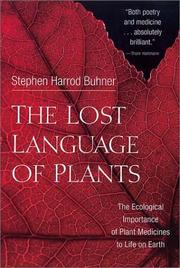
The lost language of plants by 6570203|Stephen Harrod Buhner book cover

πŸ“˜ The lost language of plants


β˜…β˜…β˜…β˜…β˜…β˜…β˜…β˜…β˜…β˜… 0.0 (0 ratings)
Similar? ✓ Yes 0 ✗ No 0

The Secret Teachings of Plants by 6570203|Stephen Harrod Buhner book cover

πŸ“˜ The Secret Teachings of Plants

Explore how ancient and indigenous peoples harness the nutritional and medicinal power of plants, revealing that the heart is a key organ for perception and that plant knowledge is rooted in nature rather than trial and error.

β˜…β˜…β˜…β˜…β˜…β˜…β˜…β˜…β˜…β˜… 0.0 (0 ratings)
Similar? ✓ Yes 0 ✗ No 0

Sacred Plant Medicine by 6570203|Stephen Harrod Buhner book cover

πŸ“˜ Sacred Plant Medicine


β˜…β˜…β˜…β˜…β˜…β˜…β˜…β˜…β˜…β˜… 0.0 (0 ratings)
Similar? ✓ Yes 0 ✗ No 0
Pharmako/poeia by 10240754|Dale Pendell book cover

πŸ“˜ Pharmako/poeia

"Pharmako/Poeia: Plant Powers, Poisons, and Herbcraft focuses on familiar psychoactive plant-derived substances and related synthetics, ranging from the licit (tobacco, alcohol) to the illicit (cannabis, opium) and the exotic (absinthe, salvia divinorum, nitrous oxide)"--Provided by publisher.

β˜…β˜…β˜…β˜…β˜…β˜…β˜…β˜…β˜…β˜… 0.0 (0 ratings)
Similar? ✓ Yes 0 ✗ No 0
Las the Secret Teachings of Plants by 6570203|Stephen Harrod Buhner book cover

πŸ“˜ Las the Secret Teachings of Plants


β˜…β˜…β˜…β˜…β˜…β˜…β˜…β˜…β˜…β˜… 0.0 (0 ratings)
Similar? ✓ Yes 0 ✗ No 0
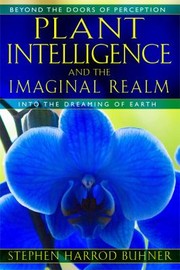
Plant Intelligence And The Imaginal Realm Beyond The Doors Of Perception Into The Dreaming Earth by 6570203|Stephen Harrod Buhner book cover

πŸ“˜ Plant Intelligence And The Imaginal Realm Beyond The Doors Of Perception Into The Dreaming Earth

A manual for opening the doors of perception and directly engaging the intelligence of the Natural World β€’ Provides exercises to directly perceive and interact with the complex, living, self-organizing being that is Gaia β€’ Reveals that every life form on Earth is highly intelligent and communicative β€’ Examines the ecological function of invasive plants, bacterial resistance to antibiotics, psychotropic plants and fungi, and the human species In Plant Intelligence and the Imaginal Realm, Stephen Harrod Buhner reveals that all life forms on Earth possess intelligence, language, a sense of I and not I, and the capacity to dream. He shows that by consciously opening the doors of perception, we can reconnect with the living intelligences in Nature as kindred beings, become again wild scientists, nondomesticated explorers of a Gaian world just as Goethe, Barbara McClintock, James Lovelock, and others have done. For as Einstein commented, β€œWe cannot solve the problems facing us by using the same kind of thinking that created them.” Buhner explains how to use analogical thinking and imaginal perception to directly experience the inherent meanings that flow through the world, that are expressed from each living form that surrounds us, and to directly initiate communication in return. He delves deeply into the ecological function of invasive plants, bacterial resistance to antibiotics, psychotropic plants and fungi, and, most importantly, the human species itself. He shows that human beings are not a plague on the planet, they have a specific ecological function as important to Gaia as that of plants and bacteria. Buhner shows that the capacity for depth connection and meaning-filled communication with the living world is inherent in every human being. It is as natural as breathing, as the beating of our own hearts, as our own desire for intimacy and love. We can change how we think and in so doing begin to address the difficulties of our times.

β˜…β˜…β˜…β˜…β˜…β˜…β˜…β˜…β˜…β˜… 0.0 (0 ratings)
Similar? ✓ Yes 0 ✗ No 0
The hidden life of trees by 11759163|Peter Wohlleben book cover

πŸ“˜ The hidden life of trees

Are trees social beings? Forester and author Peter Wohlleben makes the case that, yes, the forest is a social network. He draws on groundbreaking scientific discoveries to describe how trees are like human families: tree parents live together with their children, communicate with them, support them as they grow, share nutrients with those who are sick or struggling, and even warn each other of impending dangers. Wohlleben also shares his deep love of woods and forests, explaining the amazing processes of life, death, and regeneration he has observed in his woodland.

β˜…β˜…β˜…β˜…β˜…β˜…β˜…β˜…β˜…β˜… 0.0 (0 ratings)
Similar? ✓ Yes 0 ✗ No 0
Lessons from Plants by 13477976|Beronda L. Montgomery book cover

πŸ“˜ Lessons from Plants


β˜…β˜…β˜…β˜…β˜…β˜…β˜…β˜…β˜…β˜… 0.0 (0 ratings)
Similar? ✓ Yes 0 ✗ No 0
Harmonia plantarum by 3914900|Hans Kayser book cover

πŸ“˜ Harmonia plantarum


β˜…β˜…β˜…β˜…β˜…β˜…β˜…β˜…β˜…β˜… 0.0 (0 ratings)
Similar? ✓ Yes 0 ✗ No 0
The language of plants by 11404192|Julia Graves book cover

πŸ“˜ The language of plants


β˜…β˜…β˜…β˜…β˜…β˜…β˜…β˜…β˜…β˜… 0.0 (0 ratings)
Similar? ✓ Yes 0 ✗ No 0
Some Other Similar Books

The Spirit of the Plants by Stephen Harrod Buhner
The Thoughtful Flower by Steven Foster and James A. Duke
The Book of Plants: A Life-Size Guide to Six Hundred Species from Around the World by Peter Thomas and David Mabberley
Brambles: The Plants That Hooked the World by Mark Laurence
The Intelligent Plant: The Amazing New Science of Plant Consciousness by Stephen Harrod Buhner
The Nature of Plants: Living, Working, and Wondering with Plants by Gordon Whittaker
The Secret Life of Mosses and Liverworts by Richard H. P. A. Baker
The Inner Life of Plants by Stefan T. S. and Scott Maze

Have a similar book in mind? Let others know!

Please login to submit books!