Books like Neurospeak by Robert E. L. Masters

First publish date: 1994
Genre: Psychology/General Psychology
Authors: Robert E. L. Masters
★ ★ ★ ★ ★ 0.0 (0 community ratings)

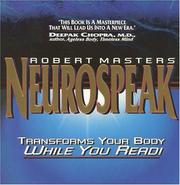
Neurospeak by Robert E. L. Masters

How are these books recommended?

The books recommended for Neurospeak by Robert E. L. Masters are shaped by reader interaction. Votes on how closely books relate, user ratings, and community comments all help refine these recommendations and highlight books readers genuinely find similar in theme, ideas, and overall reading experience.


Have you read any of these books?
Your votes, ratings, and comments help improve recommendations and make it easier for other readers to discover books they’ll enjoy.

Books similar to Neurospeak (16 similar books)

Why people don't heal and how they can by 7018415|Caroline Myss book cover

📘 Why people don't heal and how they can

Caroline Myss explores why many people fail to heal and offers practical strategies grounded in energy medicine, mind‑body connection, and spiritual practices to overcome mental and emotional barriers to wellness.

★★★★★★★★★★ 3.0 (1 rating)
Similar? ✓ Yes 0 ✗ No 0
Love, medicine and miracles by 6687273|Bernie S. Siegel book cover

📘 Love, medicine and miracles

An exploration of how patients’ active engagement in their own care can lead to healing, emotional growth, and a deeper understanding of the mind–body connection.

★★★★★★★★★★ 5.0 (1 rating)
Similar? ✓ Yes 0 ✗ No 0
Kinds of minds by 7745734|Daniel C. Dennett book cover

📘 Kinds of minds

In Kinds of Minds, Dennett asks the ultimate metaphysical questions: What is a mind and who else (besides the questioner) has one? Combining ideas from philosophy, artificial intelligence, and neurobiology, Dennett leads the reader on a fascinating journey of inquiry, exploring such intriguing possibilities as: Can any of us really know what is going on in someone else's mind? What distinguishes the human mind from the minds of animals, especially those capable of complex behavior? If such animals, for instance, were magically given the power of language, would their communities evolve an intelligence as subtly discriminating as ours? Would they be capable of developing the uniquely human ability to theorize about the world they inhabit? Will robots, once they have been endowed with sensory systems like those that provide us with experience, ever exhibit the particular traits long thought to distinguish the human mind, including the ability to think about thinking? . Dennett address these questions from an evolutionary perspective. Beginning with the macromolecules of DNA and RNA, whose evolution was determined by Darwinian natural selection, Dennett shows how, step by step, animal life moved from a simple ability to respond to frequently recurring environmental conditions to much more powerful ways of beating the odds, ways of using patterns of past experience to predict the future in never-before-encountered situations. He argues that a series of small but revolutionary steps moved us from there to the unique human capability to frame and execute specific long-range intentions. These changes included first the emergence of speech, then, because of situations in which the ability to keep secrets conferred an evolutionary advantage, a skill in conversing with ourselves, and finally, the creation of artifacts that permit us to expand our minds into the surrounding environment.

★★★★★★★★★★ 4.0 (1 rating)
Similar? ✓ Yes 0 ✗ No 0
Neurophilosophy by 12040471|Patricia Smith Churchland book cover

📘 Neurophilosophy


★★★★★★★★★★ 3.0 (1 rating)
Similar? ✓ Yes 0 ✗ No 0
Matter and consciousness by 8348431|Paul M. Churchland book cover

📘 Matter and consciousness


★★★★★★★★★★ 5.0 (1 rating)
Similar? ✓ Yes 0 ✗ No 0
The brain's way of healing by 7038154|Norman Doidge book cover

📘 The brain's way of healing

"The New York Times bestselling author of The Brain That Changes Itself presents astounding advances in the treatment of brain injury and illness. In The Brain That Changes Itself, Norman Doidge described the most important breakthrough in our understanding of the brain in four hundred years: the discovery that the brain can change its own structure and function in response to mental experience-what we call neuroplasticity. His revolutionary new book shows, for the first time, how the amazing process of neuroplastic healing really works. It describes natural, non-invasive avenues into the brain provided by the forms of energy around us-light, sound, vibration, movement-which pass through our senses and our bodies to awaken the brain's own healing capacities without producing unpleasant side effects. Doidge explores cases where patients alleviated years of chronic pain or recovered from debilitating strokes or accidents; children on the autistic spectrum or with learning disorders normalizing; symptoms of multiple sclerosis, Parkinson's disease, and cerebral palsy radically improved, and other near-miracle recoveries. And we learn how to vastly reduce the risk of dementia with simple approaches anyone can use. For centuries it was believed that the brain's complexity prevented recovery from damage or disease. The Brain's Way of Healing shows that this very sophistication is the source of a unique kind of healing. As he did so lucidly in The Brain That Changes Itself, Doidge uses stories to present cutting-edge science with practical real-world applications, and principles that everyone can apply to improve their brain's performance and health"-- "Norman Doidge's revolutionary new book shows, for the first time, how the amazing process of neuroplastic healing really works. It describes natural, non-invasive avenues into the brain provided by the forms of energy around us--light, sound, vibration, movement--which pass through our senses and our bodies to awaken the brain's own healing capacities without producing unpleasant side effects. Doidge explores cases where patients alleviated years of chronic pain or recovered from debilitating strokes or accidents; children on the autistic spectrum or with learning disorders normalizing; symptoms of multiple sclerosis, Parkinson's disease, and cerebral palsy radically improved, and other near-miracle recoveries. And we learn how to vastly reduce the risk of dementia with simple approaches anyone can use. For centuries it was believed that the brain's complexity prevented recovery from damage or disease. The Brain's Way of Healing shows that this very sophistication is the source of a unique kind of healing"--

★★★★★★★★★★ 3.0 (1 rating)
Similar? ✓ Yes 0 ✗ No 0
The master and his emissary by 1210988|Iain McGilchrist book cover

📘 The master and his emissary

A study of how the brain’s right and left hemispheres shape cultures, history, and social change.

★★★★★★★★★★ 0.0 (0 ratings)
Similar? ✓ Yes 0 ✗ No 0
Self Comes to Mind by 6950916|Antonio Damasio book cover

📘 Self Comes to Mind


★★★★★★★★★★ 0.0 (0 ratings)
Similar? ✓ Yes 0 ✗ No 0
The self and its brain by 6724044|Karl Popper book cover

📘 The self and its brain


★★★★★★★★★★ 0.0 (0 ratings)
Similar? ✓ Yes 0 ✗ No 0
The power of the mind to heal by 8336423|Joan Borysenko book cover

📘 The power of the mind to heal


★★★★★★★★★★ 0.0 (0 ratings)
Similar? ✓ Yes 0 ✗ No 0
International Library of Psychology by 6984093|Routledge book cover

📘 International Library of Psychology
 by Routledge


★★★★★★★★★★ 0.0 (0 ratings)
Similar? ✓ Yes 0 ✗ No 0
Healing into immortality by 10130573|Gerald Epstein book cover

📘 Healing into immortality

Dr. Gerald Epstein’s *Healing into Immortality* presents a 45‑year‑old mind‑body program that links thought, will, and imagination to prevent illness and extend life.

★★★★★★★★★★ 0.0 (0 ratings)
Similar? ✓ Yes 0 ✗ No 0
Getting well again by 12079743|O. Carl Simonton book cover

📘 Getting well again


★★★★★★★★★★ 0.0 (0 ratings)
Similar? ✓ Yes 0 ✗ No 0
Who gets sick by 6962263|Blair Justice book cover

📘 Who gets sick

Who Gets Sick explores the psychological aspects of physical illness, covering affective disorders, disease susceptibility, psychoneuroimmunology, and the mind-body relationship.

★★★★★★★★★★ 0.0 (0 ratings)
Similar? ✓ Yes 0 ✗ No 0
Minding the body, mending the mind by 8336423|Joan Borysenko book cover

📘 Minding the body, mending the mind


★★★★★★★★★★ 0.0 (0 ratings)
Similar? ✓ Yes 0 ✗ No 0
Consciousness Unbound by 5838758|Edward F. Kelly book cover

📘 Consciousness Unbound


★★★★★★★★★★ 0.0 (0 ratings)
Similar? ✓ Yes 0 ✗ No 0

Some Other Similar Books

The Divided Brain and the Search for Meaning by Iain McGilchrist
How the Brain Works by Steven Pinker
The Tell-Tale Brain by V.S. Ramachandran
The Human Brain Book by Marieb, Hoehn
Phantoms in the Brain by V.S. Ramachandran
Consciousness and the Brain by Ap Dijksterhuis
The Neurobrain by Richard Restak

Have a similar book in mind? Let others know!

Please login to submit books!