Books like New perspectives on organizational effectiveness by Paul S. Goodman


First publish date: 1977
Genre: Business & Economics/Business Management
Authors: Paul S. Goodman
★ ★ ★ ★ ★ 0.0 (0 community ratings)

New perspectives on organizational effectiveness by Paul S. Goodman

How are these books recommended?

The books recommended for New perspectives on organizational effectiveness by Paul S. Goodman are shaped by reader interaction. Votes on how closely books relate, user ratings, and community comments all help refine these recommendations and highlight books readers genuinely find similar in theme, ideas, and overall reading experience.


Have you read any of these books?
Your votes, ratings, and comments help improve recommendations and make it easier for other readers to discover books they’ll enjoy.

Books similar to New perspectives on organizational effectiveness (10 similar books)

The Fifth Discipline by 7078650|Peter Senge book cover

πŸ“˜ The Fifth Discipline

Peter Senge’s acclaimed classic explains how organizations can sustain competitive advantage by becoming learning entities, integrating new thinking and collective aspirations to boost performance.

β˜…β˜…β˜…β˜…β˜…β˜…β˜…β˜…β˜…β˜… 4.3 (7 ratings)
Similar? ✓ Yes 0 ✗ No 0
Organizations by 6740689|Gibson, James L. book cover

πŸ“˜ Organizations


β˜…β˜…β˜…β˜…β˜…β˜…β˜…β˜…β˜…β˜… 4.5 (2 ratings)
Similar? ✓ Yes 0 ✗ No 0
Internal evaluation by 13201468|Arnold J. Love book cover

πŸ“˜ Internal evaluation


β˜…β˜…β˜…β˜…β˜…β˜…β˜…β˜…β˜…β˜… 5.0 (1 rating)
Similar? ✓ Yes 0 ✗ No 0
Alignment by 8284609|Robert S. Kaplan book cover

πŸ“˜ Alignment


β˜…β˜…β˜…β˜…β˜…β˜…β˜…β˜…β˜…β˜… 0.0 (0 ratings)
Similar? ✓ Yes 0 ✗ No 0
The ultimate advantage by 6523768|Edward E. Lawler book cover

πŸ“˜ The ultimate advantage

In 1986 Edward Lawler alerted American business to the power of the high-involvement organization--one that fosters quick adaptation and change through fewer levels of hierarchy and satisfying work relationships. The logic is simple and the results indisputable: people give more to their work when they have more say in how the company is run. Now Lawler, called "one of today's most prominent scholars" in management literature by Choice magazine, shows us that high-involvement is not just a good idea--it's an economic necessity. Rather than try to copy other nations' management styles, Lawler says, organizations should develop approaches rooted in their own cultures. He explains, "We need an alternative to the total quality management approach that builds on many of its key elements but goes beyond it to provide a competitive advantage for organizations in societies that are characterized by diversity, democracy, entrepreneurial behavior, and respect for the individual.". The Ultimate Advantage is an informed and detailed overview of how an organization must be designed to encourage innovation, increase cost-effectiveness, and deliver enhanced quality, customer service, and speed. Lawler demonstrates how to set up work teams, improvement groups, skill-based pay systems, and other practices that can create an environment where employees grow and the organization prospers. And throughout, Lawler emphasizes the need for interrelated, organizationwide implementation so that quality comes from within, rather than being added on or "inspected in" at a later stage.

β˜…β˜…β˜…β˜…β˜…β˜…β˜…β˜…β˜…β˜… 0.0 (0 ratings)
Similar? ✓ Yes 0 ✗ No 0
Organizational strategy and change by 5947340|Johannes M. Pennings book cover

πŸ“˜ Organizational strategy and change


β˜…β˜…β˜…β˜…β˜…β˜…β˜…β˜…β˜…β˜… 0.0 (0 ratings)
Similar? ✓ Yes 0 ✗ No 0
The knowing-doing gap by 8288967|Jeffrey Pfeffer book cover

πŸ“˜ The knowing-doing gap

"The so-called knowledge advantage is a fallacy - even though companies pour billions of dollars into training programs, consultants, and executive education. The reason is not that knowledge isn't important. It's that most companies know, or can know, the same things. Moreover, even as companies talk about the importance of learning, intellectual capital, and knowledge management, they frequently fail to take the vital next step of transforming knowledge into action. The Knowing-Doing Gap confronts the paradox of companies that know too much and do too little by showing how some companies are successful at turning knowledge into action."--BOOK JACKET. "Jeffrey Pfeffer and Robert Sutton, identify the causes of the knowing-doing gap and explain how to close it."--BOOK JACKET.

β˜…β˜…β˜…β˜…β˜…β˜…β˜…β˜…β˜…β˜… 0.0 (0 ratings)
Similar? ✓ Yes 0 ✗ No 0
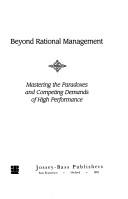
Beyond Rational Management by 9643653|Robert E. Quinn book cover

πŸ“˜ Beyond Rational Management

Beyond Rational Management offers managers a research‑based framework for understanding and navigating the paradoxes that shape organizational performance, guiding them toward innovative structures, job designs, and problem‑solving strategies.

β˜…β˜…β˜…β˜…β˜…β˜…β˜…β˜…β˜…β˜… 0.0 (0 ratings)
Similar? ✓ Yes 0 ✗ No 0
On organizational learning by 12672446|Chris Argyris book cover

πŸ“˜ On organizational learning


β˜…β˜…β˜…β˜…β˜…β˜…β˜…β˜…β˜…β˜… 0.0 (0 ratings)
Similar? ✓ Yes 0 ✗ No 0
The New Lean Toolbox by 5898766|John Bicheno book cover

πŸ“˜ The New Lean Toolbox


β˜…β˜…β˜…β˜…β˜…β˜…β˜…β˜…β˜…β˜… 0.0 (0 ratings)
Similar? ✓ Yes 0 ✗ No 0

Some Other Similar Books

Organizational Theory: Modern, Symbolic, and Postmodern Perspectives by Mary Jo Hatch
The Organization of Business by James W. Fredrick
Organizations: Behavior, Structure, Processes by James L. Gibson
Understanding Organizations by Charles W. L. Hill
Managing Organizations: Strategies, Structure, and Techniques by Herbert J. Briloff
Organizational Effectiveness: The Role of Context by David W. Milliman
Strategic Management and Organizational Dynamics by Raymond E. Miles
The Organizational Context of Leadership by John Wagner

Have a similar book in mind? Let others know!

Please login to submit books!