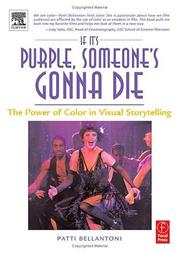
Books like If it's purple, someone's gonna die by Patti Bellantoni

First publish date: 2005
Subjects: Performing arts, History & criticism, Film & Video, Colors in motion pictures, Couleurs au cinéma
Authors: Patti Bellantoni
4.0 (2 community ratings)

If it's purple, someone's gonna die by Patti Bellantoni

How are these books recommended?

The books recommended for If it's purple, someone's gonna die by Patti Bellantoni are shaped by reader interaction. Votes on how closely books relate, user ratings, and community comments all help refine these recommendations and highlight books readers genuinely find similar in theme, ideas, and overall reading experience.


Have you read any of these books?
Your votes, ratings, and comments help improve recommendations and make it easier for other readers to discover books they’ll enjoy.

Books similar to If it's purple, someone's gonna die (11 similar books)
Musicophilia by 6502167|Oliver Sacks book cover

📘 Musicophilia

Music can move us to the heights or depths of emotion. It can persuade us to buy something, or remind us of our first date. It can lift us out of depression when nothing else can. It can get us dancing to its beat. But the power of music goes much, much further. Indeed, music occupies more areas of our brain than language does–humans are a musical species. Oliver Sacks’s compassionate, compelling tales of people struggling to adapt to different neurological conditions have fundamentally changed the way we think of our own brains, and of the human experience. In Musicophilia, he examines the powers of music through the individual experiences of patients, musicians, and everyday people–from a man who is struck by lightning and suddenly inspired to become a pianist at the age of forty-two, to an entire group of children with Williams syndrome who are hypermusical from birth; from people with “amusia,” to whom a symphony sounds like the clattering of pots and pans, to a man whose memory spans only seven seconds–for everything but music. Our exquisite sensitivity to music can sometimes go wrong: Sacks explores how catchy tunes can subject us to hours of mental replay, and how a surprising number of people acquire nonstop musical hallucinations that assault them night and day. Yet far more frequently, music goes right: Sacks describes how music can animate people with Parkinson’s disease who cannot otherwise move, give words to stroke patients who cannot otherwise speak, and calm and organize people whose memories are ravaged by Alzheimer’s or amnesia. Music is irresistible, haunting, and unforgettable, and in Musicophilia, Oliver Sacks tells us why. ([source][1]) [1]: https://www.oliversacks.com/books-by-oliver-sacks/musicophilia/

3.7 (21 ratings)
Similar? ✓ Yes 0 ✗ No 0
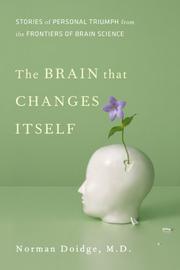
The Brain That Changes Itself by 7038154|Norman Doidge book cover

📘 The Brain That Changes Itself

An astonishing new science called neuroplasticity is overthrowing the centuries-old notion that the human brain is immutable. Psychiatrist and psychoanalyst, Norman Doidge, M.D., traveled the country to meet both the brilliant scientists championing neuroplasticity and the people whose lives they've transformed—people whose mental limitations or brain damage were seen as unalterable. We see a woman born with half a brain that rewired itself to work as a whole, blind people who learn to see, learning disorders cured, IQs raised, aging brains rejuvenated, stroke patients learning to speak, children with cerebral palsy learning to move with more grace, depression and anxiety disorders successfully treated, and lifelong character traits changed. Using these marvelous stories to probe mysteries of the body, emotion, love, sex, culture, and education, Dr. Doidge has written an immensely moving, inspiring book that will permanently alter the way we look at our brains, human nature, and human potential.

3.0 (9 ratings)
Similar? ✓ Yes 0 ✗ No 0
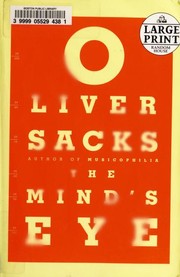
The Mind's Eye by 6502167|Oliver Sacks book cover

📘 The Mind's Eye

"Ich wuchs in einem Haushalt voller Ärzte und medizinischer Gespräche auf – mein Vater und meine älteren Brüder waren Allgemeinärzte und meine Mutter Chirurgin. Viele Unterhaltungen bei Tisch drehten sich zwangsläufig um medizinische Themen, es ging aber nie nur um ‹Fälle›. Ein Patient mochte als Beispiel für diese oder jene Erkrankung erwähnt werden, doch in den Gesprächen meiner Eltern wurden Fälle immer zu Biographien, Geschichten über das Leben von Menschen, die auf Krankheit oder Verletzung, Stress oder Unglück reagierten. So war es vielleicht unvermeidlich, dass auch ich Arzt und Geschichtenerzähler wurde. (…) Als ich mit der Veröffentlichung von Fallgeschichten begann, 1970 zunächst mit Migräne, erhielt ich Briefe von Menschen, die ihre persönlichen Erfahrungen mit neurologischen Erkrankungen verstehen oder kommentieren wollten. Diese Korrespondenz ist in gewisser Weise eine Erweiterung meiner Praxis geworden. Daher sind einige der Menschen, die ich in diesem Buch beschreibe, Patienten; andere haben mir geschrieben, nachdem sie eine meiner Fallgeschichten gelesen haben. Ihnen allen bin ich dafür dankbar, dass sie bereit waren, ihre Erfahrungen mitzuteilen, denn sie erweitern die Grenzen unserer Vorstellung, und es wird sichtbar, was sich oft hinter Gesundheit verbirgt: die komplexen Funktionen und die erstaunliche Fähigkeit des Gehirns, sich angesichts neurologischer Probleme, die wir anderen uns kaum vorstellen können, an Beeinträchtigungen anzupassen und sie zu überwinden – ganz zu schweigen von dem Mut und der Stärke, den inneren Kraftquellen, die die Betroffenen mobilisieren können."

4.4 (5 ratings)
Similar? ✓ Yes 0 ✗ No 0
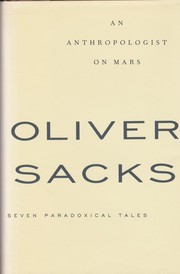
An Anthropologist on Mars by 6502167|Oliver Sacks book cover

📘 An Anthropologist on Mars

Zeven portretten van buitengewone, neurologische patiënten.

4.4 (5 ratings)
Similar? ✓ Yes 0 ✗ No 0
Neurotribes by 11642723|Steve Silberman book cover

📘 Neurotribes

What is autism? A lifelong disability, or a naturally occurring form of cognitive difference akin to certain forms of genius? In truth, it is all of these things and more—and the future of our society depends on our understanding it. WIRED reporter Steve Silberman unearths the secret history of autism, long suppressed by the same clinicians who became famous for discovering it, and finds surprising answers to the crucial question of why the number of diagnoses has soared in recent years. Going back to the earliest days of autism research and chronicling the brave and lonely journey of autistic people and their families through the decades, Silberman provides long-sought solutions to the autism puzzle, while mapping out a path for our society toward a more humane world in which people with learning differences and those who love them have access to the resources they need to live happier, healthier, more secure, and more meaningful lives. Along the way, he reveals the untold story of Hans Asperger, the father of Asperger’s syndrome, whose “little professors” were targeted by the darkest social-engineering experiment in human history; exposes the covert campaign by child psychiatrist Leo Kanner to suppress knowledge of the autism spectrum for fifty years; and casts light on the growing movement of "neurodiversity" activists seeking respect, support, technological innovation, accommodations in the workplace and in education, and the right to self-determination for those with cognitive differences.

5.0 (4 ratings)
Similar? ✓ Yes 0 ✗ No 0
The disordered mind by 4672274|Eric R. Kandel book cover

📘 The disordered mind

Eric R. Kandel, the winner of the Nobel Prize in Physiology or Medicine for his foundational research into memory storage in the brain, is one of the pioneers of modern brain science. His work continues to shape our understanding of how learning and memory work and to break down age-old barriers between the sciences and the arts. In his seminal new book, The Disordered Mind, Kandel draws on a lifetime of pathbreaking research and the work of many other leading neuroscientists to take us on an unusual tour of the brain. He confronts one of the most difficult questions we face: How does our mind, our individual sense of self, emerge from the physical matter of the brain? The brain's 86 billion neurons communicate with one another through very precise connections. But sometimes those connections are disrupted. The brain processes that give rise to our mind can become disordered, resulting in diseases such as autism, depression, schizophrenia, Parkinson's, addiction, and post-traumatic stress disorder. While these disruptions bring great suffering, they can also reveal the mysteries of how the brain produces our most fundamental experiences and capabilities--the very nature of what it means to be human. Studies of autism illuminate the neurological foundations of our social instincts; research into depression offers important insights on emotions and the integrity of the self; and paradigm-shifting work on addiction has led to a new understanding of the relationship between pleasure and willpower. By studying disruptions to typical brain functioning and exploring their potential treatments, we will deepen our understanding of thought, feeling, behavior, memory, and creativity. Only then can we grapple with the big question of how billions of neurons generate consciousness itself.

4.5 (2 ratings)
Similar? ✓ Yes 0 ✗ No 0
Feminist film theorists by 6987592|Shohini Chaudhuri book cover

📘 Feminist film theorists

Feminist film theory has been one of the, if not the, most important strands within film theory. Shohini Chaudhuri's book will focus on the work of three leading feminist film theorists - Laura Mulvey, Kaja Silverman and Teresa De Lauretis, whose working (in keeping with the format for generic RCT volumes) represents key schools of thought or emphases within feminist film theory. Key ideas explored through a discussion of the work of these three thinkers include the male gaze, the female voice, technologies of gender, fantasy and body horror, and masculinity in crisis.

0.0 (0 ratings)
Similar? ✓ Yes 0 ✗ No 0
A Purple Place for Dying by 11074108|John D. MacDonald book cover

📘 A Purple Place for Dying

Travis McGee #3 Travis McGee is summoned to Arizona by a rich, beautiful arrogant woman. And then she's dead - shot in the back at long range, lying crumpled on the ground at his feet. With the would-be client eliminated, and on a dime's worth of fee in his pocket, any ordinary detective would walk away fast. But Travis McGee is no ordinary detective.

0.0 (0 ratings)
Similar? ✓ Yes 0 ✗ No 0
Image studies by 8300330|Sunil Manghani book cover

📘 Image studies

"Image Studies provides an engaging introduction to visual studies analysis and an account of existing and emergent visual culture debates, along with chapters on a range of topics, including: consumer culture and identity; photography and digital imaging; painting and drawing; the moving image; the relationship between image and text (including reference to text in art, comics and animation); and scientific imaging.Written in an engaging and accessible way, the text will also include extracts of existing critical materials. Each chapter will include key set readings, including short extracts from existing literatures with accompanying study notes and questions. The chapters will also include a range of critical and creative tasks, designed to bring the academic study of visual culture into direct contact with practical aspects of visual culture and image-making.Image Studies is a new text aimed predominantly at undergraduate students in visual culture, but which will also be useful for media studies students and arts students more generally"--

0.0 (0 ratings)
Similar? ✓ Yes 0 ✗ No 0
The colour of death by 6759854|Michael Cordy book cover

📘 The colour of death

In a residential neighbourhood of Portland, Oregon, an unknown young woman uncovers a shocking crime scene by inexplicably sensing the evil within its walls. To the police, she is a mystery. She can't even tell them her own name. They christen her Jane Doe. Suffering terrifying hallucinations, Jane is assigned to Nathan Fox, a forensic psychiatrist struggling with his own demons. Together they must piece together the jigsaw that is Jane's identity. Then a sequence of brutal killings terrorizes the city and Fox learns Jane is the only cryptic link between the unrelated victims. To solve the murders, Fox must discard his black and white preconceptions, look beyond the spectrum of normal human experience and confront the dark truth of her past.and his own.

0.0 (0 ratings)
Similar? ✓ Yes 0 ✗ No 0

Some Other Similar Books

The Island of the Colorblind by Oliver Sacks
The Man Who Tasted Words by Larry Bartlett
Conscious: A Brief Guide to the Fundamental Mystery of the Mind by Annaka Harris

Have a similar book in mind? Let others know!

Please login to submit books!