Books like Economic growth by Olivier de La Grandville


Olive de la Grandville offers a clear, user‑friendly introduction to the theory of economic growth, addressing fundamental questions about how societies can improve living standards and achieve prosperity. The book explains the mechanics of the growth process, dedicating two chapters to the crucial issue of labor‑capital substitution. It also examines the optimal investment rate for an economy and demonstrates how combining descriptive and normative perspectives can yield new insights, including a formal proof of Adam Smith’s Invisible Hand conjecture. By weaving together rigorous theory with practical implications, the text provides readers with a comprehensive understanding of the forces that drive economic development.
First publish date: 2008
Genre: Business & Economics/Finance
Authors: Olivier de La Grandville
0.0 (0 community ratings)

Economic growth by Olivier de La Grandville

How are these books recommended?

The books recommended for Economic growth by Olivier de La Grandville are shaped by reader interaction. Votes on how closely books relate, user ratings, and community comments all help refine these recommendations and highlight books readers genuinely find similar in theme, ideas, and overall reading experience.


Have you read any of these books?
Your votes, ratings, and comments help improve recommendations and make it easier for other readers to discover books they’ll enjoy.

Books similar to Economic growth (11 similar books)
Development Economics by 8316383|Debraj Ray book cover

📘 Development Economics
 by Debraj Ray

Debraj Ray, one of the most accomplished theorists in development economics today, presents in this book a synthesis of recent and older literature in the field and raises important questions that will help to set the agenda for future research. He covers such vital subjects as theories of economic growth, economic inequality, poverty and undernutrition, population growth, trade policy, and the markets for land, labor, and credit. The book takes the position that there is no single cause for economic progress, but that a combination of factors - among them the improvement of physical and human capital, the reduction of inequality, and institutions that enable the background flow of information essential to market performance - consistently favor development. Ray supports his arguments throughout with examples from around the world. The book assumes a knowledge of only introductory economics and explains sophisticated concepts in simple, direct language, keeping the use of mathematics to a minimum.

5.0 (1 rating)
Similar? ✓ Yes 0 ✗ No 0
Managing for Results by 8650470|Peter F. Drucker book cover

📘 Managing for Results

The effective business, Peter Drucker observes, focuses on opportunities rather than problems. How this focus is achieved in order to make the organization prosper and grow is the subject of this companion to his classic, The Practice of Management. The earlier book was chiefly concerned with how management functions; this volume shows what the executive decision-maker must do to move his enterprise forward. One of the notable accomplishments of this book is its combining specific economic analysis with a grasp of the entrepreneurial force in business prosperity. For though it discusses "what to do" more than Drucker's previous works, the book stresses the qualitative aspect of enterprise: every successful business requires a goal and spirit all its own. Peter Drucker again employs his particular genius for breaking through conventional outlooks and opening up new perspectives--for profits and growth.

4.0 (1 rating)
Similar? ✓ Yes 0 ✗ No 0
Economic growth by 11589306|David N. Weil book cover

📘 Economic growth

xxv, 565 p. : 24 cm

3.0 (1 rating)
Similar? ✓ Yes 0 ✗ No 0
The White Man's Burden by 6894725|William Russell Easterly book cover

📘 The White Man's Burden

From one of the world's best-known development economists—an excoriating attack on the tragic hubris of the West's efforts to improve the lot of the so-called developing worldIn his previous book, The Elusive Quest for Growth, William Easterly criticized the utter ineffectiveness of Western organizations to mitigate global poverty, and he was promptly fired by his then-employer, the World Bank. The White Man's Burden is his widely anticipated counterpunch—a brilliant and blistering indictment of the West's economic policies for the world's poor. Sometimes angry, sometimes irreverent, but always clear-eyed and rigorous, Easterly argues that we in the West need to face our own history of ineptitude and draw the proper conclusions, especially at a time when the question of our ability to transplant Western institutions has become one of the most pressing issues we face.

5.0 (1 rating)
Similar? ✓ Yes 0 ✗ No 0
Endogenous Growth Theory by 8966136|Philippe Aghion book cover

📘 Endogenous Growth Theory

Whereas other books on endogenous growth stress a particular aspect, such as trade or convergence, this book provides a comprehensive survey of the theoretical and empirical debates raised by modern growth theory. Advanced economies have experienced a tremendous increase in material well- being since the industrial revolution. Modern innovations such as personal computers, laser surgery, jet airplanes, and satellite communication have made us rich and transformed the way we live and work. But technological change has also brought with it a variety of social problems. It has been blamed at various times for increasing wage and income inequality, unemployment, obsolescence of physical and human capital, environmental deterioration, and prolonged recessions. To understand the contradictory effects of technological change on the economy, one must delve into structural details of the innovation process to analyze how laws, institutions, customs, and regulations affect peoples' incentive and ability to create new knowledge and profit from it. To show how this can be done, Philippe Aghion and Peter Howitt make use of Schumpeter's concept of creative destruction, the competitive process whereby entrepreneurs constantly seek new ideas that will render their rivals' ideas obsolete. Whereas other books on endogenous growth stress a particular aspect, such as trade or convergence, this book provides a comprehensive survey of the theoretical and empirical debates raised by modern growth theory. It develops a powerful engine of analysis that sheds light not only on economic growth per se, but on the many other phenomena that interact with growth, such as inequality, unemployment, capital accumulation, education, competition, natural resources, international trade, economic cycles, and public policy. source: https://mitpress.mit.edu/books/endogenous-growth-theory

0.0 (0 ratings)
Similar? ✓ Yes 0 ✗ No 0
Handbook of economic growth by 8966136|Philippe Aghion book cover

📘 Handbook of economic growth


0.0 (0 ratings)
Similar? ✓ Yes 0 ✗ No 0
Post-capitalist society by 8650470|Peter F. Drucker book cover

📘 Post-capitalist society

Business guru Peter Drucker provides an incisive analysis of the major world transformation taking place, from the Age of Capitalism to the Knowledge Society, and examines the radical effects it will have on society, politics, and business now and in the coming years. This searching and incisive analysis of the major world transformation now taking place shows how it will affect society, economics, business, and politics and explains how we are moving from a society based on capital, land, and labor to a society whose primary source is knowIedge and whose key structure is the organization.

0.0 (0 ratings)
Similar? ✓ Yes 0 ✗ No 0
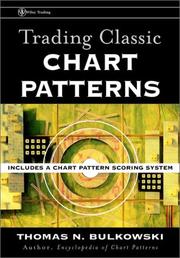
Trading Classic Chart Patterns by 7028843|Thomas N. Bulkowski book cover

📘 Trading Classic Chart Patterns

Thomas Bulkowski’s Trading Classic Chart Patterns turns proven chart patterns into a practical playbook, offering performance tables, scoring systems, and case studies for both novice and professional traders.

0.0 (0 ratings)
Similar? ✓ Yes 0 ✗ No 0
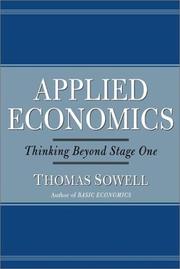
Applied Economics by 6656310|Thomas Sowell book cover

📘 Applied Economics

This revised edition of Applied Economics is about fifty percent larger than the first edition. It now includes a chapter on the economics of immigration and new sections of other chapters on such topics as the “creative” financing of home-buying that led to the current “subprime” mortgage crisis, the economics of organ transplants, and the political and economic incentives that lead to money earmarked for highways being diverted to mass transit and to a general neglect of infrastructure. On these and other topics, its examples are drawn from around the world. Much material in the first edition has been updated and supplemented. The revised and enlarged edition of Applied Economics retains the easy readability of the first edition, even for people with no prior knowledge of economics.

0.0 (0 ratings)
Similar? ✓ Yes 0 ✗ No 0
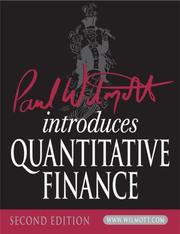
Paul Wilmott Introduces Quantitative Finance by 9660070|Paul Wilmott book cover

📘 Paul Wilmott Introduces Quantitative Finance

Paul Wilmott’s updated student edition presents contemporary financial theories and mathematical models, equipped with practical Bloomberg screen dumps, Visual Basic code, and spreadsheet explanations to clarify derivatives, options, and futures.

0.0 (0 ratings)
Similar? ✓ Yes 0 ✗ No 0

Some Other Similar Books

The Economics of Growth by Robert J. Barro
Growth and Development by Timothy Besley and Hannes Mueller
Introduction to Economic Growth by Daron Acemoglu
Theories of Economic Growth by Arthur O'Sullivan
Economic Development and Growth by David L. Lindauer
The Rise of Economic Societies by Frank G. Higgs
The Dynamics of Economic Growth by Yannick G. K. A. Ndikumana
Pathways to Sustainable Growth by Justin Yifu Lin

Have a similar book in mind? Let others know!

Please login to submit books!