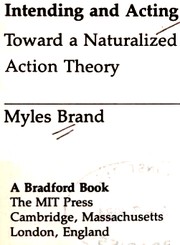
Books like Intending and acting by Myles Brand

First publish date: 1984
Subjects: Philosophy, Act (Philosophy), Philosophie, Psychologie, Intentionality (Philosophy)
Authors: Myles Brand
2.0 (2 community ratings)

Intending and acting by Myles Brand

How are these books recommended?

The books recommended for Intending and acting by Myles Brand are shaped by reader interaction. Votes on how closely books relate, user ratings, and community comments all help refine these recommendations and highlight books readers genuinely find similar in theme, ideas, and overall reading experience.


Have you read any of these books?
Your votes, ratings, and comments help improve recommendations and make it easier for other readers to discover books they’ll enjoy.

Books similar to Intending and acting (2 similar books)
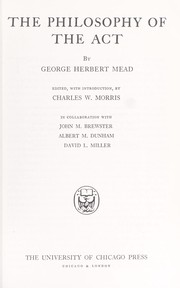
The philosophy of the act by 8256606|George Herbert Mead book cover

πŸ“˜ The philosophy of the act

George Herbert Mead's "Philosophy of the Act" explores the social nature of mind and self, arguing that human behavior and consciousness emerge from social interaction and communication, particularly through language, play, and games. Here's a more detailed overview: Social Emergence of Mind and Self: Mead believed that the mind and the self are not innate but arise from the social process of communication and interaction. The Act as a Unit of Analysis: Mead analyzed the act as a fundamental unit of behavior, breaking it down into stages like impulse, perception, manipulation, and consummation. The Role of Language and Symbols: Mead emphasized the importance of language and symbolic interaction in the development of the mind and self, arguing that humans learn to think and act through shared meanings and symbols. The "I" and the "Me": Mead introduced the concepts of the "I" (the active, spontaneous self) and the "me" (the social self, reflecting the attitudes of others) as key components of the self. Role-Taking and the Generalized Other: Mead argued that individuals develop a sense of self by taking on the roles of others and internalizing the perspectives of the "generalized other" (society as a whole). The Importance of Social Interaction: Mead's work highlights the importance of social interaction and communication in shaping human behavior, thought, and consciousness.

β˜…β˜…β˜…β˜…β˜…β˜…β˜…β˜…β˜…β˜… 5.0 (1 rating)
Similar? ✓ Yes 0 ✗ No 0
Freedom of the Will by 2606775|Jonathan Edwards book cover

πŸ“˜ Freedom of the Will

IT may possibly be thought, that there is no great need of going about to define or describe the Will; this word being generally as well understood as any other words we can use to explain it: and so perhaps it would be, had not philosophers, metaphysicians, and polemic divines, brought the matter into obscurity by the things they have said of it. But since it is so, I think it may be of some use, and will tend to greater clearness in the following discourse, to say a few things concerning it.And therefore I observe, that the Will (without any metaphysical refining) is, That by which the mind chooses any thing. The faculty of the will, is that power, or principle of mind, by which it is capable of choosing: an act of the will is the same as an act of choosing or choice.If any think it is a more perfect definition of the will, to say, that it is that by which the soul either chooses or refuses, I am content with it; though I think it enough to say, it is that by which the soul chooses: for in every act of will whatsoever, the mind chooses one thing rather than another; it chooses something rather than the contrary or rather than the want or non-existence of that thing. So in every act of refusal, the mind chooses the absence of the thing refused; the positive and the negative are set before the mind for its choice, and it chooses the negative; and the mind's making its choice in that case is properly the act of the Will: the Will's determining between the two, is a voluntary determination; but that is the same thing as making a choice. So that by whatever names we call the act of the Will, choosing, refusing, approving, disapproving, liking, disliking, embracing, rejecting, determining, directing, commanding, forbidding, inclining, or being averse, being pleased or displeased with; all may be reduced to this of choosing. For the soul to act voluntarily, is evermore to act electively.

β˜…β˜…β˜…β˜…β˜…β˜…β˜…β˜…β˜…β˜… 5.0 (1 rating)
Similar? ✓ Yes 0 ✗ No 0

Some Other Similar Books

The Philosophy of Action by Neil Levy
Action and Responsibility by G.E.M. Anscombe
Practical Reasoning by Michael Smith
The Concept of Intentional Action by Jerrold Levinson
The Nature of Agency by Martha C. Nussbaum
Agency and Embodiment by S. N. Haji
The Willing Mind by Dana K. Nelson
Practical Reason and Ethical Action by Christine M. Korsgaard
The Philosophy of Action by Michael Bratman
Practical Reasoning and Ethical Decision by Michael Smith
Action and Responsibility by Kim Sterelny
Freedom and Responsibility by Kristin Booth Glen
Motivational Internalism by Floyd Merrell
The Nature of Rationality by R. Jay Wallace
Agency and Responsibility by G. A. Cohen
Decision, Control, and Causality by Huw Price
The Philosophy of Action and Mind by J. D. Greenwood
Intention and Action by Michael E. Bratman

Have a similar book in mind? Let others know!

Please login to submit books!