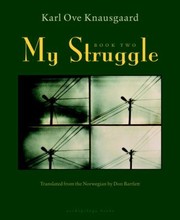
"A family of four--mother, father and two boys--move to the South Coast of Norway to a new house on a newly developed site. It is the early 1970s and the family's trajectory, upwardly mobile: the future seems limitless. In painstaking, sometimes self-lacerating detail, Knausgaard paints a world familiar to anyone who can recall the intensity and novelty of childhood experience, one in which children and adults lead parallel lives that never meet. Perhaps the most Proustian in the series, Book Three gives us Knausgaard's vivid, technicolor recollections of childhood, his emerging self-understanding, and the multilayered nature of time's passing, memory, and existence. "Of course, I remember nothing from this time. It is completely impossible to identify with the infant my parents photographed; this is in fact so difficult it almost seems wrong to use the word 'I' when referring to it, lying in the baby bath, for instance, its skin unnaturally red, its arms and legs sprawling, and its face distorted in a scream no one remembers the reason for anymore... Is that creature the same as the one sitting here in Malmo, writing this?" --from Book Three of My Struggle More praise for Book Three: "A superbly told childhood story... Knausgaard writes about everyday life as a child with a flow and continuity that all hangs together... the text has a gravitational pull that draws the reader in only further." --Dag Og Tid (Norway) "An aesthetic pleasure... A patient, chiseled, and intense portrayal of a child's sensory experience. Book Three is a classic." --Klassekampen (Norway) "Compelling reading... Knausgaard has an equally good eye for small and large events." --Aftenposten (Norway) "A gripping novel... This childhood portrayal drifts off with a lightness and sensitivity that not many will associate with him... There is no doubt that the series is worth following the author all the way." --Dagens Næringsliv (Norway) "The man can write a novel about a solid, pretty traditional upbringing too... A sensitive, sharp depiction of growing up in the 70's." --Adresseavisen (Norway)"--
"A portrait of the artist as a young boy. On the heels of Book One and Two of the internationally celebrated autobiographical novel series My Struggle, Book Three finds us in the sensuous realm of Karl Ove's childhood. A family of four -- mother, father, and two boys -- move to the South Coast of Norway to a new house on a newly developed site. It's the early 1970s and the family's trajectory: upwardly mobile. The future seems limitless. We follow Karl Ove through bicycle expeditions, tense swim meets and locker rooms, girls, football pyromaniac pranks, and rock music in what seem like a traditional, if brutal, coming-of-age novel. In painstaking, sometimes self-lacerating detail, Knausgaard paints a world familiar to anyone who can recall the intensity and singularity of childhood experience, one in which children and adults lead parallel lives that never meet. Perhaps the most Proustian in the series, Book Three gives us Knausgaard's vivid, technicolor recollections of childhood, his emerging self-understanding, and the multilayered nature of time's passing, memory, and existence, all formed by the fear of his controlling, unpredictable, and omnipresent father"--
The books recommended for My Struggle Book Three by
Karl Ove Knausgaard are shaped by reader interaction.
Votes on how closely books relate, user ratings, and community comments all help
refine these recommendations and highlight books readers genuinely find similar
in theme, ideas, and overall reading experience.
Have you read any of these books?
Your votes, ratings, and comments help improve recommendations and make it easier
for other readers to discover books they’ll enjoy.
Books similar to My Struggle Book Three (7 similar books)
Jonathan Franzen’s *Purity: A Novel* explores layered family dynamics and adolescent identity against a backdrop of personal and governmental intrigue.
Elyria abandons her life in Manhattan and flies alone to New Zealand, where her isolated journey through forest, field, and park forces her to confront the grief of her sister’s death and her own hidden rage.
Two newcomers—an older man and a boy—arrive in a new land, learn Spanish, and are assigned new names. They navigate a desert camp, a relocation center, and the city of Novilla while the man searches for the boy’s mother, all amid themes of immigration, family, and fate.