Books like Pancho Villa days at Pilares by Joyce E. Means
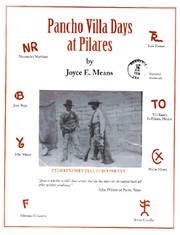

A record of oral histories about the now-forgotten town of Pilares, N.M., U.S.A., mostly pertaining to the period when Pancho Villa and his revolutionaries attacked and burned- to-the-ground the town of Columbus, N.M.. Joyce Means was no storyteller, but she made up in reseach what she lacked in prose. It's a difficult book to read in one sitting, but it serves well as a sort of almanac and is best approached that way, in my opinion.
First publish date: 1976
Subjects: History, Biography, Revolutionaries
Authors: Joyce E. Means
3.5 (4 community ratings)

Pancho Villa days at Pilares by Joyce E. Means

How are these books recommended?

The books recommended for Pancho Villa days at Pilares by Joyce E. Means are shaped by reader interaction. Votes on how closely books relate, user ratings, and community comments all help refine these recommendations and highlight books readers genuinely find similar in theme, ideas, and overall reading experience.


Have you read any of these books?
Your votes, ratings, and comments help improve recommendations and make it easier for other readers to discover books they’ll enjoy.

Books similar to Pancho Villa days at Pilares (1 similar books)
Beatha Theobald Wolfe Tone by 7066422|Theobald Wolfe Tone book cover

πŸ“˜ Beatha Theobald Wolfe Tone

Theobald Wolfe Tone, a Protestant revolutionary and founding father of Irish republicanism, was born in Dublin in 1763, became a lawyer, and later dedicated his life to political reform and Irish independence, founding the United Irishmen and leading a 1798 uprising. Here's a more detailed overview of his life and adventures: Early Life and Education: Born in Dublin on June 20, 1763, Tone was educated at Trinity College and studied law, becoming a lawyer in 1789. Political Activism: He soon abandoned his legal practice to focus on political reform and Irish independence, influenced by the ideals of the French Revolution. Founding the United Irishmen: Tone was a key figure in the founding of the United Irishmen, a society advocating for Irish independence from British rule. 1798 Uprising: In 1798, Tone led the United Irishmen in a major uprising, aiming for a nationalist and republican revolution in Ireland with the support of French troops. Capture and Trial: He was captured and put on trial in Dublin, where he defiantly proclaimed his undying hostility to England and his desire to separate the two countries. Death: On the day he was to be hanged, he cut his throat with a penknife and died seven days later. Legacy: Tone's life and writings, particularly his autobiography and journals, have been regarded as an indispensable source for the history of the 1790s and for the life of Tone himself. Influence: He is remembered as a Protestant revolutionary and founding father of Irish republicanism, striving to promote "the common name of Irishman".

β˜…β˜…β˜…β˜…β˜…β˜…β˜…β˜…β˜…β˜… 0.0 (0 ratings)
Similar? ✓ Yes 0 ✗ No 0

Some Other Similar Books

The Life and Times of Pancho Villa by James W. Hurst
Villa and Zapata: A History of the Mexican Revolution by Adalberto Aguender
The Mexican Revolution: A Short History 1910-1940 by Stuart Easterling
Pancho Villa: A Biography by Carlos Hernandez
Revolution in the Ranks: The Mexican Anarchists, 1910-1920 by John Womack
The Mexican Revolution: A Very Short Introduction by Alan Knight
The Life of Pancho Villa by William Beezley
The Mexican Revolution and the Catholic Church by Michael Slevin
Mexican Its Revolution Not Yet Told by Gilbert Joseph
Viva Villa!: A Biography of Pancho Villa by Edward T. James

Have a similar book in mind? Let others know!

Please login to submit books!