Books like The bottom of the harbor by Joseph Mitchell


On the centennial of Joseph Mitchell's birth, here is a new edition of the classic collection containing his most celebrated pieces about New York City. Fifty years after its original publication, The Bottom of the Harbor is still considered a fundamental New York book. Every story Mitchell tells, every person he introduces, every scene he describes is illuminated by his passion for the eccentrics and eccentricities of his beloved adopted city.All of the pieces here are connected in one way or another--some directly, some with a kind of mysterious circuitousness--to New York's fabled waterfront, the terrain that Mitchell brilliantly made his own. They tell of a life that has passed--of vacant hotel rooms, deserted communities, once-thriving fishing areas that are now polluted and studded with wrecks. Included are "Up in the Old Hotel," a portrait of Louis Morino, the proprietor of a restaurant called (to his disgust) Sloppy Louie's; "The Rats on the Waterfront," which has inspired countless writers to attempt portraits of these most demonized New Yorkers; and "Mr. Hunter's Grave," widely considered to be the finest single piece of nonfiction to have ever appeared in the pages of The New Yorker.Here is the essential work of a legendary writer.From the Hardcover edition.
First publish date: 1959
Subjects: History, Social life and customs, Sociology, Nonfiction, Harbors
Authors: Joseph Mitchell
0.0 (0 community ratings)

The bottom of the harbor by Joseph Mitchell

How are these books recommended?

The books recommended for The bottom of the harbor by Joseph Mitchell are shaped by reader interaction. Votes on how closely books relate, user ratings, and community comments all help refine these recommendations and highlight books readers genuinely find similar in theme, ideas, and overall reading experience.


Have you read any of these books?
Your votes, ratings, and comments help improve recommendations and make it easier for other readers to discover books they’ll enjoy.

Books similar to The bottom of the harbor (7 similar books)

Flapper by 4657777|Joshua Zeitz book cover

πŸ“˜ Flapper

Blithely flinging aside the Victorian manners that kept her disapproving mother corseted, the New Woman of the 1920s puffed cigarettes, snuck gin, hiked her hemlines, danced the Charleston, and necked in roadsters. More important, she earned her own keep, controlled her own destiny, and secured liberties that modern women take for granted. Her newfound freedom heralded a radical change in American culture.Whisking us from the Alabama country club where Zelda Sayre first caught the eye of F. Scott Fitzgerald to Muncie, Indiana, where would-be flappers begged their mothers for silk stockings, to the Manhattan speakeasies where patrons partied till daybreak, historian Joshua Zeitz brings the era to exhilarating life. This is the story of America's first sexual revolution, its first merchants of cool, its first celebrities, and its most sparkling advertisement for the right to pursue happiness.The men and women who made the flapper were a diverse lot. There was Coco Chanel, the French orphan who redefined the feminine form and silhouette, helping to free women from the torturous corsets and crinolines that had served as tools of social control. Three thousand miles away, Lois Long, the daughter of a Connecticut clergyman, christened herself "Lipstick" and gave New Yorker readers a thrilling entree into Manhattan's extravagant Jazz Age nightlife.In California, where orange groves gave way to studio lots and fairytale mansions, three of America's first celebrities--Clara Bow, Colleen Moore, and Louise Brooks, Hollywood's great flapper triumvirate--fired the imaginations of millions of filmgoers.Dallas-born fashion artist Gordon Conway and Utah-born cartoonist John Held crafted magazine covers that captured the electricity of the social revolution sweeping the United States.Bruce Barton and Edward Bernays, pioneers of advertising and public relations, taught big business how to harness the dreams and anxieties of a newly industrial America--and a nation of consumers was born.Towering above all were Zelda and Scott Fitzgerald, whose swift ascent and spectacular fall embodied the glamour and excess of the era that would come to an abrupt end on Black Tuesday, when the stock market collapsed and rendered the age of abundance and frivolity instantly obsolete.With its heady cocktail of storytelling and big ideas, Flapper is a dazzling look at the women who launched the first truly modern decade.From the Hardcover edition.

β˜…β˜…β˜…β˜…β˜…β˜…β˜…β˜…β˜…β˜… 5.0 (1 rating)
Similar? ✓ Yes 0 ✗ No 0
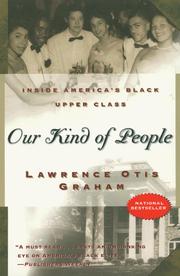
Our Kind of People by 6923155|Lawrence Otis Graham book cover

πŸ“˜ Our Kind of People

Debutante cotillions. Million-dollar homes. Summers in Martha's Vineyard. Membership in the Links, Jack & Jill, Deltas, Boule, and AKAs. An obsession with the right schools, families, social clubs, and skin complexion. This is the world of the black upper class and the focus of the first book written about the black elite by a member of this hard-to-penetrate group.Author and TV commentator Lawrence Otis Graham, one of the nation's most prominent spokesmen on race and class, spent six years interviewing the wealthiest black families in America. He includes historical photos of a people that made their first millions in the 1870s. Graham tells who's in and who's not in the group today with separate chapters on the elite in New York, Los Angeles, Washington, Chicago, Detroit, Memphis, Atlanta, Philadelphia, Nashville, and New Orleans. A new Introduction explains the controversy that the book elicited from both the black and white communities.

β˜…β˜…β˜…β˜…β˜…β˜…β˜…β˜…β˜…β˜… 4.0 (1 rating)
Similar? ✓ Yes 0 ✗ No 0
740 Park by 7643754|Gross, Michael book cover

πŸ“˜ 740 Park

For seventy-five years, it's been Manhattan's richest apartment building, and one of the most lusted-after addresses in the world. One apartment had 37 rooms, 14 bathrooms, 43 closets, 11 working fireplaces, a private elevator, and his-and-hers saunas; another at one time had a live-in service staff of 16. To this day, it is steeped in the purest luxury, the kind most of us could only imagine, until now. The last great building to go up along New York's Gold Coast, construction on 740 Park finished in 1930. Since then, 740 has been home to an ever-evolving cadre of our wealthiest and most powerful families, some of America's (and the world's) oldest money--the kind attached to names like Vanderbilt, Rockefeller, Bouvier, Chrysler, Niarchos, Houghton, and Harkness--and some whose names evoke the excesses of today's monied elite: Kravis, Koch, Bronfman, Perelman, Steinberg, and Schwarzman. All along, the building has housed titans of industry, political power brokers, international royalty, fabulous scam-artists, and even the lowest scoundrels.The book begins with the tumultuous story of the building's construction. Conceived in the bubbling financial, artistic, and social cauldron of 1920's Manhattan, 740 Park rose to its dizzying heights as the stock market plunged in 1929--the building was in dire financial straits before the first apartments were sold. The builders include the architectural genius Rosario Candela, the scheming businessman James T. Lee (Jacqueline Kennedy Onassis's grandfather), and a raft of financiers, many of whom were little more than white-collar crooks and grand-scale hustlers. Once finished, 740 became a magnet for the richest, oldest families in the country: the Brewsters, descendents of the leader of the Plymouth Colony; the socially-registered Bordens, Hoppins, Scovilles, Thornes, and Schermerhorns; and top executives of the Chase Bank, American Express, and U.S. Rubber. Outside the walls of 740 Park, these were the people shaping America culturally and economically. Within those walls, they were indulging in all of the Seven Deadly Sins. As the social climate evolved throughout the last century, so did 740 Park: after World War II, the building's rulers eased their more restrictive policies and began allowing Jews (though not to this day African Americans) to reside within their hallowed walls. Nowadays, it is full to bursting with new money, people whose fortunes, though freshly-made, are large enough to buy their way in. At its core this book is a social history of the American rich, and how the locus of power and influence has shifted haltingly from old bloodlines to new money. But it's also much more than that: filled with meaty, startling, often tragic stories of the people who lived behind 740's walls, the book gives us an unprecedented access to worlds of wealth, privilege, and extraordinary folly that are usually hidden behind a scrim of money and influence. This is, truly, how the other half--or at least the other one hundredth of one percent--lives.

β˜…β˜…β˜…β˜…β˜…β˜…β˜…β˜…β˜…β˜… 5.0 (1 rating)
Similar? ✓ Yes 0 ✗ No 0

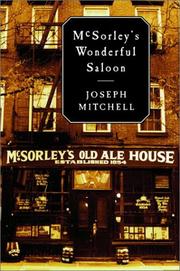
McSorley's wonderful saloon by 8804735|Joseph Mitchell book cover

πŸ“˜ McSorley's wonderful saloon


β˜…β˜…β˜…β˜…β˜…β˜…β˜…β˜…β˜…β˜… 2.0 (1 rating)
Similar? ✓ Yes 0 ✗ No 0

Times Square Red, Times Square Blue (Sexual Cultures) by 8693134|Samuel R. Delany book cover

πŸ“˜ Times Square Red, Times Square Blue (Sexual Cultures)

Twentieth anniversary edition of a landmark book that cataloged a vibrant but disappearing neighborhood in New York City In the two decades that preceded the original publication of Times Square Red, Times Square Blue, Forty-second Street, then the most infamous street in America, was being remade into a sanitized tourist haven. In the forced disappearance of porn theaters, peep shows, and street hustlers to make room for a Disney store, a children’s theater, and large, neon-lit cafes, Samuel R. Delany saw a disappearance, not only of the old Times Square, but of the complex social relationships that developed there. Samuel R. Delany bore witness to the dismantling of the institutions that promoted points of contact between people of different classes and races in a public space, and in this hybrid text, argues for the necessity of public restrooms and tree-filled parks to a city's physical and psychological landscape. This twentieth anniversary edition includes a new foreword by Robert Reid-Pharr that traces the importance and continued resonances of Samuel R. Delany’s groundbreaking Times Square Red, Times Square Blue.

β˜…β˜…β˜…β˜…β˜…β˜…β˜…β˜…β˜…β˜… 0.0 (0 ratings)
Similar? ✓ Yes 0 ✗ No 0
Hip by 6921631|John Leland undifferentiated book cover

πŸ“˜ Hip

Hip: The History is the story of how American pop culture has evolved throughout the twentieth century to its current position as world cultural touchstone. How did hip become such an obsession? From sex and music to fashion and commerce, John Leland tracks the arc of ideas as they move from subterranean Bohemia to Madison Avenue and back again. Hip: The History examines how hip has helped shape -- and continues to influence -- America's view of itself, and provides an incisive account of hip's quest for authenticity.This P.S. edition features an extra 16 pages of insights into the book, including author interviews, recommended reading, and more.

β˜…β˜…β˜…β˜…β˜…β˜…β˜…β˜…β˜…β˜… 0.0 (0 ratings)
Similar? ✓ Yes 0 ✗ No 0
Among the Tibetans by 1169065|Isabella L. Bird book cover

πŸ“˜ Among the Tibetans

"There never was anybody," wrote the Spectator, "who had adventures as well as Miss Bird." In Among the Tibetans you can see why, as Isabella Lucy Bird writes of her journey through the Himalayas on horseback and of her four months of living with "the pleasantest of people." She offers evocative and colourful descriptions of Tibetan rituals and culture, along with vivid descriptions of its villages, monasteries, temples and palaces."Up to Kargil the scenery, though growing more Tibetan with every march, had exhibited at intervals some traces of natural verdure; but beyond, after leaving the Suru, there is not a green thing, and on the next march the road crosses a lofty, sandy plateau, on which the heat was terrible - blazing gravel and a blazing heaven, then fiery cliffs and scorched hillsides, then a deep ravine and the large village of Paskim (dominated by a fort-crowned rock), and some planted and irrigated acres; then a narrow ravine and magnificent scenery flaming with colour, which opens out after some miles on a burning chaos of rocks and sand, mountain-girdled, and on some remarkable dwellings on a steep slope, with religious buildings singularly painted. This is Shergol, the first village of Buddhists, and there I was 'among the Tibetans.'"

β˜…β˜…β˜…β˜…β˜…β˜…β˜…β˜…β˜…β˜… 0.0 (0 ratings)
Similar? ✓ Yes 0 ✗ No 0

Some Other Similar Books

Here Is New York by Edith Wharton
Up in the Old Hotel by Joseph Mitchell
Fitzgerald's World: An Examined Life by Stephen J. Pedersen
The Great New York City Drinking Song Book by Various
White Unequivocally by Joseph P. O'Brien
The Brooklyn Bridge by Hartley Rogers
New York Lines by Sue Coe
City of Dreams: The Making and Remaking of New York by Tyler Anbinder
The Ghosts of Morningside Heights by Thomas J. Campanella

Have a similar book in mind? Let others know!

Please login to submit books!