Books like A Ghost's Memoir by John McDonald
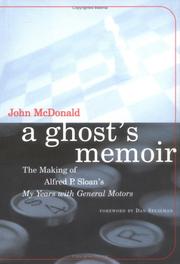

John McDonald’s account chronicles the near‑suppression of Alfred P. Sloan Jr.’s memoir, *My Years with General Motors*, and his struggle to bring the book into print. With permission from General Motors and back‑up from Fortune magazine, McDonald navigated the company, the publisher, and Time, Inc. to secure publication, ultimately turning a corporate saga into a classic study of strategy. The narrative documents the legal and political obstacles that threatened to keep Sloan’s insights hidden and showcases McDonald’s persistence as a journalist‑turned‑ghostwriter in the face of the world’s largest automobile maker.
First publish date: 2002
Genre: Memoir/Professional Memoir
Authors: John McDonald
★ ★ ★ ★ ★ 4.8 (6 community ratings)

A Ghost's Memoir by John McDonald

How are these books recommended?

The books recommended for A Ghost's Memoir by John McDonald are shaped by reader interaction. Votes on how closely books relate, user ratings, and community comments all help refine these recommendations and highlight books readers genuinely find similar in theme, ideas, and overall reading experience.


Have you read any of these books?
Your votes, ratings, and comments help improve recommendations and make it easier for other readers to discover books they’ll enjoy.

Books similar to A Ghost's Memoir (5 similar books)

How to Get Rich by 8334183|Donald Trump book cover

📘 How to Get Rich

Donald Trump shares his secrets for making a fortune and running a successful business in his book 'How to Get Rich'.

★★★★★★★★★★ 4.5 (8 ratings)
Similar? ✓ Yes 0 ✗ No 0
On a clear day you can see General Motors by 2166317|John Z. De Lorean book cover

📘 On a clear day you can see General Motors

From the Dust Jacket: During his 17 year career at General Motors, John De Lorean was one of the automotive industry's most controversial figures, and also one of its most talented and successful executives. So his resignation from GM in April, 1973 shocked the business community. When word leaked out that he was writing a book about life at General Motors, with journalist J. Patrick Wright, GM and the auto industry anxiously awaited its arrival. But in a jolting new move, De Lorean refused to let the book be published saying he feared that reprisals from GM would sink his attempts to launch a new car company. He continued to block publication of On A Clear Day You Can See General Motors for four years. Now in an unprecedented move this edition is being published without the cooperation of John De Lorean, General Motors or the original publisher. Nevertheless, because of his critical position in top management, De Lorean's disclosures of the inside workings of General Motors are nothing short of shocking. His highly critical assessment will blow the lid off of some of Detroit's most closely held secrets such as: Horrendous product decisions-the ill-fated Corvair's questionable safety was well documented and debated inside GM long before its introduction. Sinister business practices-GM executives were regularly dunned for substantial and possibly illegal political campaign contributions. Serious management blunders-hundreds of millions of dollars were wasted annually in capricious executive decisions which would have ruined smaller companies, but were easily absorbed by GM's vast enterprise. John De Lorean's story is more than an expose, however. It is a personal account of one modern executive's struggle with big business management. As the antithesis of the traditional, stodgy, dark-suited GM executive, De Lorean operated with flare and panache. He openly criticized his company and his industry when he felt they deserved it. He avoided the corporate social scene in favor of a cadre of friends that included professional athletes and movie stars. And he dated models and actresses who were often younger than the daughters of his fellow executives. While his life style chafed his superiors, his exceptional talents as an engineer and a crack executive, produced business success after success, and filled GM's coffers with profit. By age 47, his meteoric rise had placed De Lorean in a key management post, earning over half-a-million dollars a year, with an even-odds chance of becoming president of the industrial giant. But life at the top was a disappointment. De Lorean found his job on executive row to be boring. Moreover, he began to question GM's management system which he felt often promoted mediocrity, sometimes produced illegal and immoral business practices, and stressed personal loyalties to the detriment of the corporation. His efforts to push for change from within were fruitless. To these frustrations was added the startling revelation that resentments inside GM had been formed into a campaign to destroy him. So he quit. It is, therefore, from the privileged perspective of an ex-GM executive, that De Lorean reveals General Motors to be something quite different than the well-run, precisely managed corporation that is its public image today. At a time when Americans are demanding more reliability from American business, On A Clear Day You Can See General Motors demonstrates how one corporate leviathan grew less accountable to its many publics amid booming sales and dwindling competition. And it is this disclosure that makes this book an important document for citizens, politicians and businessmen.

★★★★★★★★★★ 5.0 (1 rating)
Similar? ✓ Yes 0 ✗ No 0
Andy Grove by 8833058|Richard S. Tedlow book cover

📘 Andy Grove

Biography of a Business Legend: The Autobiography of Andy Grove

★★★★★★★★★★ 0.0 (0 ratings)
Similar? ✓ Yes 0 ✗ No 0
Carolyn 101 by 7112398|Carolyn Kepcher book cover

📘 Carolyn 101


★★★★★★★★★★ 0.0 (0 ratings)
Similar? ✓ Yes 0 ✗ No 0
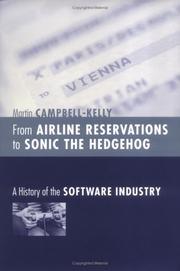
From Airline Reservations to Sonic the Hedgehog by 9564750|Martin Campbell-Kelly book cover

📘 From Airline Reservations to Sonic the Hedgehog

From its first glimmerings in the 1950s, the software industry has evolved to become the fourth largest industrial sector of the US economy. Starting with a handful of software contractors who produced specialized programs for the few existing machines, the industry grew to include producers of corporate software packages and then makers of mass-market products and recreational software. This book tells the story of each of these types of firm, focusing on the products they developed, the business models they followed, and the markets they served. By describing the breadth of this industry, Martin Campbell-Kelly corrects the popular misconception that one firm is at the center of the software universe. He also tells the story of lucrative software products such as IBM's CICS and SAP's R/3, which, though little known to the general public, lie at the heart of today's information infrastructure. With its wealth of industry data and its thoughtful judgments, this book will become a starting point for all future investigations of this fundamental component of computer history.

★★★★★★★★★★ 0.0 (0 ratings)
Similar? ✓ Yes 0 ✗ No 0

Some Other Similar Books

The Haunting of Maple Manor by Sara Bennett
Whispers in the Dark by Michael Reynolds
Echoes of the Past by Emily Carter
Spectral Secrets by David Mitchell
Phantom Memories by Laura Stevens
The Spirits' Tale by James Oliver
Haunted Reflections by Rebecca Turner
Shadows of the Unseen by Anthony Blake
Ghostly Encounters by Samantha Lee
Beyond the Veil by Christopher Morgan

Have a similar book in mind? Let others know!

Please login to submit books!