Books like The Power to Compete by Hiroshi Mikitani
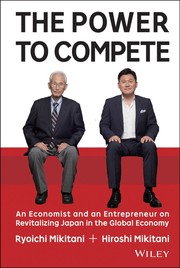

"The Power to Compete tackles the issues central to the prosperity of Japan -- and the world -- in search of a cure for the "Japan Disease." As founder and CEO of Rakuten, one of the world's largest Internet companies, author Hiroshi Mikitani brings an entrepreneur's perspective to bear on the country's economic stagnation. Through a freewheeling and candid conversation with his economist father, Ryoichi Mikitani, the two examine the issues facing Japan, and explore possible roadmaps to revitalization. How can Japan overhaul its economy, education system, immigration, public infrastructure, and hold its own with China? Their ideas include applying business techniques like Key Performance Indicators to fix the economy, using information technology to cut government bureaucracy, and increasing the number of foreign firms with a head office in Japan. Readers gain rare insight into Japan's future, from both academic and practical perspectives on the inside. Mikitani argues that Japan's tendency to shun international frameworks and hide from global realities is the root of the problem, while Mikitani Sr.'s background as an international economist puts the issue in perspective for a well-rounded look at today's Japan.--
First publish date: 2014
Subjects: Nationalism, Economic development, Japan, history, Japan, politics and government, 1945-, Japan, relations, foreign countries
Authors: Hiroshi Mikitani
4.5 (2 community ratings)

The Power to Compete by Hiroshi Mikitani

How are these books recommended?

The books recommended for The Power to Compete by Hiroshi Mikitani are shaped by reader interaction. Votes on how closely books relate, user ratings, and community comments all help refine these recommendations and highlight books readers genuinely find similar in theme, ideas, and overall reading experience.


Have you read any of these books?
Your votes, ratings, and comments help improve recommendations and make it easier for other readers to discover books they’ll enjoy.

Books similar to The Power to Compete (8 similar books)
The hard thing about hard things

πŸ“˜ The hard thing about hard things


β˜…β˜…β˜…β˜…β˜…β˜…β˜…β˜…β˜…β˜… 3.8 (45 ratings)
Similar? ✓ Yes 0 ✗ No 0
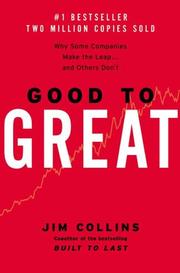
Good to Great

πŸ“˜ Good to Great

The Challenge: Built to Last, the defining management study of the nineties, showed how great companies triumph over time and how long-term sustained performance can be engineered into the DNA of an enterprise from the verybeginning. But what about the company that is not born with great DNA? How can good companies, mediocre companies, even bad companies achieve enduring greatness? The Study: For years, this question preyed on the mind of Jim Collins. Are there companies that defy gravity and convert long-term mediocrity or worse into long-term superiority? And if so, what are the universal distinguishing characteristics that cause a company to go from good to great? The Standards: Using tough benchmarks, Collins and his research team identified a set of elite companies that made the leap to great results and sustained those results for at least fifteen years. How great? After the leap, the good-to-great companies generated cumulative stock returns that beat the general stock market by an average of seven times in fifteen years, better than twice the results delivered by a composite index of the world's greatest companies, including Coca-Cola, Intel, General Electric, and Merck. The Comparisons: The research team contrasted the good-to-great companies with a carefully selected set of comparison companies that failed to make the leap from good to great. What was different? Why did one set of companies become truly great performers while the other set remained only good? Over five years, the team analyzed the histories of all twenty-eight companies in the study. After sifting through mountains of data and thousands of pages of interviews, Collins and his crew discovered the key determinants of greatness -- why some companies make the leap and others don't. The Findings: The findings of the Good to Great study will surprise many readers and shed light on virtually every area of management strategy and practice. The findings include: Level 5 Leaders: The research team was shocked to discover the type of leadership required to achieve greatness. The Hedgehog Concept: (Simplicity within the Three Circles): To go from good to great requires transcending the curse of competence. A Culture of Discipline: When you combine a culture of discipline with an ethic of entrepreneurship, you get the magical alchemy of great results. Technology Accelerators: Good-to-great companies think differently about the role of technology. The Flywheel and the Doom Loop: Those who launch radical change programs and wrenching restructurings will almost certainly fail to make the leap. β€œSome of the key concepts discerned in the study,” comments Jim Collins, "fly in the face of our modern business culture and will, quite frankly, upset some people.” Perhaps, but who can afford to ignore these findings?

β˜…β˜…β˜…β˜…β˜…β˜…β˜…β˜…β˜…β˜… 3.8 (20 ratings)
Similar? ✓ Yes 0 ✗ No 0
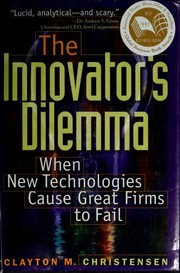
The Innovator's Dilemma

πŸ“˜ The Innovator's Dilemma

In his book, The Innovator's Dilemma [3], Professor Clayton Christensen of Harvard Business School describes a theory about how large, outstanding firms can fail "by doing everything right." The Innovator's Dilemma, according to Christensen, describes companies whose successes and capabilities can actually become obstacles in the face of changing markets and technologies. ([Source][1]) This book takes the radical position that great companies can fail precisely because they do everything right. It demonstrates why outstanding companies that had their competitive antennae up, listened astutely to customers, and invested aggressively in new technologies still lost their market leadership when confronted with disruptive changes in technology and market structure. And it tells how to avoid a similar fate. Using the lessons of successes and failures of leading companies, The Innovator's Dilemma presents a set of rules for capitalizing on the phenomenon of disruptive innovation. These principles will help managers determine when it is right not to listen to customers, when to invest in developing lower-performance products that promise lower margins, and when to pursue small markets at the expense of seemingly larger and more lucrative ones. - Jacket flap. [1]: http://web.mit.edu/6.933/www/Fall2000/teradyne/clay.html

β˜…β˜…β˜…β˜…β˜…β˜…β˜…β˜…β˜…β˜… 3.9 (16 ratings)
Similar? ✓ Yes 0 ✗ No 0
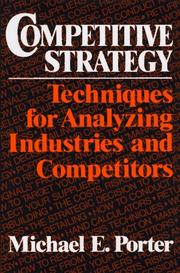
Competitive Strategy

πŸ“˜ Competitive Strategy

ISBN: 9780029253601

β˜…β˜…β˜…β˜…β˜…β˜…β˜…β˜…β˜…β˜… 5.0 (2 ratings)
Similar? ✓ Yes 0 ✗ No 0
The abacus and the sword

πŸ“˜ The abacus and the sword

Duus analyzes Japan's acquisition of Korea, the largest and most populous of its colonial possessions, as the result of two separate but interlinked processes, one political/military and the other economic: every attempt at increasing Japanese political influence licensed new opportunities for trade, and every new push for Japanese economic interest buttressed, and sometimes justified, further political advances. The sword was the servant of the abacus; the abacus, the handmaiden of the sword. The political process was driven by the attempt of the Meiji leaders, backed and prodded by politicians and military men at home, to create a stable cadre of Korean collaborators committed to self-strengthening; when this attempt failed, the Japanese leaders finally decided to extend full political control over the peninsula. The economic process, propelled by industrial change, involved penetration of the Korean market by an anonymous army of Japanese traders, sojourners, and settlers in search of new economic opportunities. While suggesting that Meiji imperialism shared much with Western colonial expansion that provided both its model and its context, Duus also argues that it was "backward imperialism," shaped by Japan's sense of inferiority to the West, as well as its relatively undeveloped economy, limited history of foreign contacts, economic dependency on the advanced economies, and intense desire to catch up. Drawing on a diverse range of new source material, this careful and informed study casts light on a wide array of topics in social, economic, and diplomatic history and contributes to a better understanding of modern Japanese imperialism.

β˜…β˜…β˜…β˜…β˜…β˜…β˜…β˜…β˜…β˜… 0.0 (0 ratings)
Similar? ✓ Yes 0 ✗ No 0
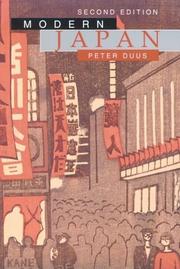
Modern Japan

πŸ“˜ Modern Japan


β˜…β˜…β˜…β˜…β˜…β˜…β˜…β˜…β˜…β˜… 0.0 (0 ratings)
Similar? ✓ Yes 0 ✗ No 0
Modern Japan

πŸ“˜ Modern Japan


β˜…β˜…β˜…β˜…β˜…β˜…β˜…β˜…β˜…β˜… 0.0 (0 ratings)
Similar? ✓ Yes 0 ✗ No 0
Promises not kept

πŸ“˜ Promises not kept

"John Isbister brings the dilemmas of international poverty and the Third World into the twenty-first century in the fifth edition of this broadly-read text. Besides including the most current information and a discussion of political change around the world, Promises Not Kept now highlights the divergent paths chosen by different developing regions - some embracing modern technology and institutions, while others seek different paths.". "Through a blend of political and economic theory and historical narrative, Isbister asks the reader to consider the forces and structures that have led to unequal conditions and poverty in developing countries, and to face the ongoing problem of a widening gap between the rich and the poor."--BOOK JACKET.

β˜…β˜…β˜…β˜…β˜…β˜…β˜…β˜…β˜…β˜… 0.0 (0 ratings)
Similar? ✓ Yes 0 ✗ No 0

Some Other Similar Books

Lean Startup by Eric Ries
Zero to One by Peter Thiel
Playing to Win by A.G. Lafley & Roger L. Martin
The Art of Strategy by Avinash K. Dixit & Barry J. Nalebuff
Blue Ocean Strategy by W. Chan Kim & RenΓ©e Mauborgne
Bold by Peter H. Diamandis & Steven Kotler

Have a similar book in mind? Let others know!

Please login to submit books!