Books like No Place to Hide by Glenn Greenwald
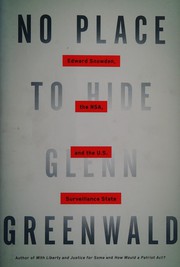

No Place to Hide recounts the pivotal 2013 disclosures by former National Security Agency (NSA) contractor Edward Snowden, as reported by journalist Glenn Greenwald. The book details how the NSA’s extensive electronic surveillance of U.S. citizens and worldwide communications was uncovered through Snowden’s leaked documents, and examines the profound effects on privacy, civil liberties, and U.S. national security policy.
First publish date: 2014
Genre: Technology & Computing/Cybersecurity
Authors: Glenn Greenwald
★ ★ ★ ★ ★ 4.1 (19 community ratings)

No Place to Hide by Glenn Greenwald

How are these books recommended?

The books recommended for No Place to Hide by Glenn Greenwald are shaped by reader interaction. Votes on how closely books relate, user ratings, and community comments all help refine these recommendations and highlight books readers genuinely find similar in theme, ideas, and overall reading experience.


Have you read any of these books?
Your votes, ratings, and comments help improve recommendations and make it easier for other readers to discover books they’ll enjoy.

Books similar to No Place to Hide (12 similar books)

Permanent Record by 11966795|Edward Snowden book cover

📘 Permanent Record

Edward Snowden tells the full story of his rise as a CIA and NSA insider, the creation of the U.S. mass‑surveillance system, and his decision to expose it, revealing the motivations behind his whistleblowing.

★★★★★★★★★★ 4.5 (49 ratings)
Similar? ✓ Yes 0 ✗ No 0
The Age of Surveillance Capitalism by 857852|Shoshana Zuboff book cover

📘 The Age of Surveillance Capitalism

Shoshana Zuboff explains how digital data is turned into a new market form—surveillance capitalism—where corporations predict and shape behavior for profit, reshaping power, privacy, and democracy in the digital age.

★★★★★★★★★★ 3.9 (11 ratings)
Similar? ✓ Yes 0 ✗ No 0
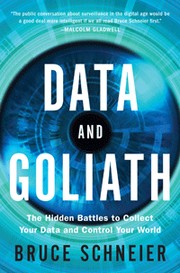
Data and Goliath by 8727556|Bruce Schneier book cover

📘 Data and Goliath

Bruce Schneier’s investigative analysis explores the growth of Mass surveillance in the United States, examining how data collection, electronic surveillance, and national security practices shape privacy and social control.

★★★★★★★★★★ 4.3 (6 ratings)
Similar? ✓ Yes 0 ✗ No 0
The Snowden files by 10615074|Luke Harding book cover

📘 The Snowden files

Edward Snowden, a former National Security Agency employee, released a trove of classified documents exposing global mass surveillance, sparking a worldwide debate on privacy and security.

★★★★★★★★★★ 4.0 (1 rating)
Similar? ✓ Yes 0 ✗ No 0
Snowden by 8268409|Ted Rall book cover

📘 Snowden
 by Ted Rall

A graphic overview of Edward Snowden’s whistle‑blowing leak of NSA surveillance files, examining the consequences of mass electronic surveillance in the U.S.

★★★★★★★★★★ 3.0 (1 rating)
Similar? ✓ Yes 0 ✗ No 0
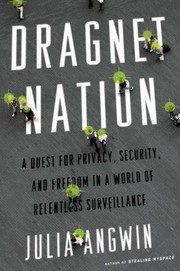
Dragnet Nation A Quest For Privacy Security And Freedom In A World Of Relentless Surveillance by 9444170|Julia Angwin book cover

📘 Dragnet Nation A Quest For Privacy Security And Freedom In A World Of Relentless Surveillance

Dragnet Nation exposes how governments, businesses, and criminals harvest personal data through online ads, mobile tracking, and electronic surveillance, warning that internalized monitoring can silence freedom and erode civil rights.

★★★★★★★★★★ 5.0 (1 rating)
Similar? ✓ Yes 0 ✗ No 0
The Shadow Factory by 2412549|James Bamford book cover

📘 The Shadow Factory

A rigorous exposé of the National Security Agency’s evolution after 9/11, detailing how its expanded electronic surveillance of American citizens has altered civil liberties and national security policy.

★★★★★★★★★★ 1.0 (1 rating)
Similar? ✓ Yes 0 ✗ No 0
American Spies by 11459055|Jennifer Stisa Granick book cover

📘 American Spies


★★★★★★★★★★ 3.0 (1 rating)
Similar? ✓ Yes 0 ✗ No 0
Routledge handbook of surveillance studies by 10119480|David Lyon book cover

📘 Routledge handbook of surveillance studies
 by David Lyon

This comprehensive handbook examines the global and local dimensions of surveillance, covering empirical evidence, theoretical frameworks, and ethical concerns, with a focus on privacy, data protection, and social control in the digital age.

★★★★★★★★★★ 0.0 (0 ratings)
Similar? ✓ Yes 0 ✗ No 0
The new digital age by 10655865|Eric Schmidt book cover

📘 The new digital age

In collaboration, two leading global thinkers from in technology and foreign affairs from Google give readers their widely anticipated, transformational vision of the future: a world where everyone is connected, a world full of challenges and benefits that are ours to meet and to harness. With their combined knowledge and experiences, the authors are uniquely positioned to take on some of the toughest questions about our future: Who will be more powerful in the future, the citizen or the state? Will technology make terrorism easier or harder to carry out? What is the relationship between privacy and security, and how much will we have to give up to be part of the new digital age? In this they combine observation and insight to outline the promise and peril awaiting us in the coming decades. This is a forward-thinking account of where our world is headed and what this means for people, states and businesses. With the confidence and clarity of visionaries, the authors illustrate just how much we have to look forward to, and beware of, as the greatest information and technology revolution in human history continues to evolve. On individual, community and state levels, across every geographical and socioeconomic spectrum, they reveal the dramatic developments both good and bad, that will transform both our everyday lives and our understanding of self and society, as technology advances and our virtual identities become more and more fundamentally real. As their nuanced vision of the near future unfolds, an urban professional takes his driverless car to work, attends meetings via hologram and dispenses housekeeping robots by voice; a Congolese fisherwoman uses her smart phone to monitor market demand and coordinate sales (saving on costly refrigeration and preventing overfishing); the potential arises for "virtual statehood" and "Internet asylum" to liberate political dissidents and oppressed minorities, but also for tech-savvy autocracies (and perhaps democracies) to exploit their citizens' mobile devices for ever more ubiquitous surveillance. Along the way, we meet a cadre of international figures, including Julian Assange, who explain their own visions of our technology-saturated future. This book is an analysis of how our hyper-connected world will soon look.

★★★★★★★★★★ 0.0 (0 ratings)
Similar? ✓ Yes 0 ✗ No 0
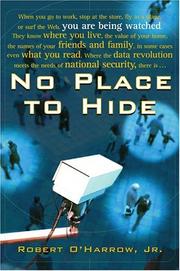
No Place to Hide by 6950517|Robert O'Harrow book cover

📘 No Place to Hide

"In No Place to Hide, Washington Post reporter Robert O'Harrow, Jr., lays out in detail the post-9/11 marriage of private data and technology companies and government anti-terror initiatives to create something entirely new: a security-industrial complex. Drawing on his years of investigation, O'Harrow shows how the government now depends on burgeoning private reservoirs of information about almost every aspect of our lives to promote homeland security and fight the war on terror." "Consider the following: When you use your cell phone, the phone company knows where you are and when. If you use a discount card, your grocery and prescription purchases are recorded, profiled, and analyzed. Many new cars have built-in devices that enable companies to track from afar details about your movements. Software and information companies can even generate graphical link-analysis charts illustrating exactly how each person in a room is related to every other - through jobs, roommates, family, and the like. Almost anyone can buy a dossier on you, including almost everything it takes to commit identity theft, for less than fifty dollars." "O'Harrow tells the inside stories of key players in this new world, from software inventors to counterintelligence officials. He reveals how the government is creating a national intelligence infrastructure with the help of private companies. And he examines the impact of this new security system on our traditional notions of civil liberties, autonomy, and privacy, and the ways it threatens to undermine some of our society's most cherished values, even while offering us a sense of security."--BOOK JACKET

★★★★★★★★★★ 0.0 (0 ratings)
Similar? ✓ Yes 0 ✗ No 0
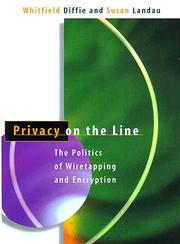
Privacy on the line by 8356546|Whitfield Diffie book cover

📘 Privacy on the line

Telecommunication has never been perfectly secure, as the Cold War culture of wiretaps and international spying taught us. Yet many of us still take our privacy for granted, even as we become more reliant than ever on telephones, computer networks, and electronic transactions of all kinds. So many of our relationships now use telecommunication as the primary mode of communication that the security of these transactions has become a source of wide public concern and debate. Whitfield Diffie and Susan Landau argue that if we are to retain the privacy that characterized face-to-face relationships in the past, we must build the means of protecting that privacy into our communication systems. Diffie and Landau examine the national-security, law-enforcement, commercial, and civil-liberties issues. They discuss privacy's social function, how it underlies a democratic society, and what happens when it is lost. They also explore how intelligence and law-enforcement organizations work, how they intercept communications, and how they use what they intercept.

★★★★★★★★★★ 0.0 (0 ratings)
Similar? ✓ Yes 0 ✗ No 0

Some Other Similar Books

Cyber Privacy: Who Has Your Data and Why You Should Care by Jeffrey Rosen
Dark Mirror: Edward Snowden and the American Surveillance State by Jane Mayer
Privacy in the Age of Big Data by Terence Craig and Mary E. Ludloff
Spycraft: The Secret History of the CIA's Spytech by Robert Wallace and H. Keith Melton

Have a similar book in mind? Let others know!

Please login to submit books!