Books like The Denial of Death by Ernest Becker


First publish date: 1973
Genre: Psychology/General Psychology
Authors: Ernest Becker
★ ★ ★ ★ ★ 2.5 (4 community ratings)

The Denial of Death by Ernest Becker

How are these books recommended?

The books recommended for The Denial of Death by Ernest Becker are shaped by reader interaction. Votes on how closely books relate, user ratings, and community comments all help refine these recommendations and highlight books readers genuinely find similar in theme, ideas, and overall reading experience.


Have you read any of these books?
Your votes, ratings, and comments help improve recommendations and make it easier for other readers to discover books they’ll enjoy.

Books similar to The Denial of Death (11 similar books)

Man's search for meaning by 10537135|Viktor E. Frankl book cover

📘 Man's search for meaning


★★★★★★★★★★ 5.0 (3 ratings)
Similar? ✓ Yes 0 ✗ No 0
The psychology of death by 7306826|Robert Kastenbaum book cover

📘 The psychology of death

"A classic, fascinating readers for nearly 30 years. New to the Third Edition are chapters on how we construct death, death in adolescence and adulthood including discussion on suicide, physician-assisted death, and Regret Theory and Denial, new approaches to the role of death anxiety, Terror Management Theory, and Edge Theory, and much more."--BOOK JACKET.

★★★★★★★★★★ 5.0 (1 rating)
Similar? ✓ Yes 0 ✗ No 0
On death and dying by 7434499|Elisabeth Kübler-Ross book cover

📘 On death and dying


★★★★★★★★★★ 0.0 (0 ratings)
Similar? ✓ Yes 0 ✗ No 0
The birth and death of meaning by 6322897|Ernest Becker book cover

📘 The birth and death of meaning

Ernest Becker’s mature synthesis of human behavior, drawing on psychoanalysis, anthropology, and philosophy, reassesses human nature’s darker aspects while avoiding cynicism.

★★★★★★★★★★ 0.0 (0 ratings)
Similar? ✓ Yes 0 ✗ No 0
The structure of evil by 6322897|Ernest Becker book cover

📘 The structure of evil

The history of the science of man that I draw in these pages is based on the following assumptions, and seeks to support them: In order to understand the problem of a unified science of man today, we must go back at least to the decline of the medieval cosmology, and to the more or less decisive break from the old order that took the form of the French Enlightenment and, subsequently, the French Revolution. [...] In the second place, each rereading of history is occupied with "new" facts, even if it uses facts that have been used time and time again. [...] The specific vantage point that I use for this rereading of history II is a new, unified theory of human behavior. The theory has been very long and very slow in the making, and it is only now that it has become possible to articulate it. This means that my endeavor is a circular one, but I hope a justified, self-reinforcing circularity: a new reading of history that derives from a new theoretical understanding; and a new theoretical understanding that is substantiated by a new reading of history. The circularity, then, is not a "vicious" or sterile one, but rather an incremental one of enhanced logical consistency, and added insight and meaningfulness. This book, then, is actually the third of a trilogy, which records the development of my ideas and the substantiation of the early perspectives I reached for. In the first work, *The Birth and Death of Meaning: A Perspective in Psychiatry and Anthropology*, I pulled together an abstract scheme for conceptualizing human behavior, and offered a suggestion for a new orientation for the science of man. The book was directed partly against the ascendancy of medical-psychiatric explanations of human behavior, including Freudian, instinctivist ones. Thus it stressed the largely fictional nature of human meanings, the uniquely linguistic aspects of human experience, and the wholly social-psychological genesis of the self. In a second work, *The Revolution in Psychiatry: The New Understanding of Man*, I attempted to fill out this perspective by elaborating comprehensive, social-behavioral theories of mental illness. This second book sought to provide a broader and more detailed explanation of human action and its failures, and to see them as grounded in total, organismic functioning—and not merely in symbolic, linguistic modes. On the one hand, it had to do this without losing the truth of the symbolic approach, specifically, of the social-psychological explanation of the origin and nature of the human self, and how it functions in social interaction. On the other hand, it had to accomplish this total organismic restatement without resorting to the facile reductionist and Freudian-instinctivist explanations of total biological functioning. These two works supplied, I think, the necessary basis for a unified theory of action. The present, third work, finally, complements the first two, by rounding out and substantiating historically a unified theory of action. Its task is to place the whole understanding of human nature into the historical perspective of the past two centuries, during which time this understanding was gradually being developed. Furthermore, it continues the task begun in the second book, which is to introduce frankly ideas from philosophy and naturalistic descriptive ontology and to attempt to show their indispensable place in a science of man. The overall result, I dare to hope, is an integral framework for setting in motion a socially experimental science of man—something we have been building for over two centuries. [From the Preface]

★★★★★★★★★★ 0.0 (0 ratings)
Similar? ✓ Yes 0 ✗ No 0
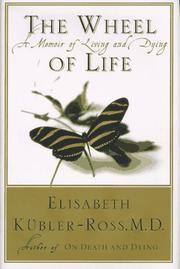
The wheel of life by 7434499|Elisabeth Kübler-Ross book cover

📘 The wheel of life


★★★★★★★★★★ 0.0 (0 ratings)
Similar? ✓ Yes 0 ✗ No 0

Grief, dying, and death by 11729930|Therese A. Rando book cover

📘 Grief, dying, and death


★★★★★★★★★★ 0.0 (0 ratings)
Similar? ✓ Yes 0 ✗ No 0

Paranormal experience and survival of death by 12706968|Carl B. Becker book cover

📘 Paranormal experience and survival of death


★★★★★★★★★★ 0.0 (0 ratings)
Similar? ✓ Yes 0 ✗ No 0

Existential psychotherapy by 8261783|Irvin D. Yalom book cover

📘 Existential psychotherapy


★★★★★★★★★★ 0.0 (0 ratings)
Similar? ✓ Yes 0 ✗ No 0

Ernest Becker Reader by 6322897|Ernest Becker book cover

📘 Ernest Becker Reader

A single-volume collection that brings together Ernest Becker's early writings, offering context for his later work and sustaining interest in his influential ideas on psychology and anthropology.

★★★★★★★★★★ 0.0 (0 ratings)
Similar? ✓ Yes 0 ✗ No 0
Death, society, and human experience by 7306826|Robert Kastenbaum book cover

📘 Death, society, and human experience

Providing an understanding of the relationship with death, both as an individual and as a member of society. This book is intended to contribute to your understanding of your relationship with death, both as an individual and as a member of society. Kastenbaum shows how individual and societal attitudes influence both how and when we die and how we live and deal with the knowledge of death and loss. Robert Kastenbaum is a renowned scholar who developed one of the world's first death education courses and introduced the first text for this market. This landmark text draws on contributions from the social and behavioral sciences as well as the humanities, such as history, religion, philosophy, literature, and the arts, to provide thorough coverage of understanding death and the dying process.

★★★★★★★★★★ 0.0 (0 ratings)
Similar? ✓ Yes 0 ✗ No 0

Some Other Similar Books

The Worm at the Core: On the Role of Death in Life by Sheldon Solomon, Jeff Greenberg, Tom Pyszczynski
Death and Life by Fyodor Dostoevsky
The Psychology of Death by Ernest Becker
Staring at the Sun: Overcoming the Terror of Death by Irvin D. Yalom
The Death of Ivan Ilyich by Leo Tolstoy
The Book of Life: An Illustrated History of the Evolution of Life on Earth by Stephen Jay Gould

Have a similar book in mind? Let others know!

Please login to submit books!