Books like Principles Of Power by Eric Schleien


First publish date: 2020
Authors: Eric Schleien
3.0 (2 community ratings)

Principles Of Power by Eric Schleien

How are these books recommended?

The books recommended for Principles Of Power by Eric Schleien are shaped by reader interaction. Votes on how closely books relate, user ratings, and community comments all help refine these recommendations and highlight books readers genuinely find similar in theme, ideas, and overall reading experience.


Have you read any of these books?
Your votes, ratings, and comments help improve recommendations and make it easier for other readers to discover books they’ll enjoy.

Books similar to Principles Of Power (5 similar books)
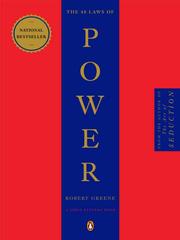
The 48 Laws of Power

πŸ“˜ The 48 Laws of Power

Amoral, cunning, ruthless, and instructive, this piercing work distills three thousand years of the history of power in to forty-eight well explicated laws. As attention--grabbing in its design as it is in its content, this bold volume outlines the laws of power in their unvarnished essence, synthesizing the philosophies of Machiavelli, Sun-tzu, Carl von Clausewitz, and other great thinkers. Some laws teach the need for prudence ("Law 1: Never Outshine the Master"), the virtue of stealth ("Law 3: Conceal Your Intentions"), and many demand the total absence of mercy ("Law 15: Crush Your Enemy Totally"), but like it or not, all have applications in real life. Illustrated through the tactics of Queen Elizabeth I, Henry Kissinger, P. T. Barnum, and other famous figures who have wielded--or been victimized by--power, these laws will fascinate any reader interested in gaining, observing, or defending against ultimate control.

β˜…β˜…β˜…β˜…β˜…β˜…β˜…β˜…β˜…β˜… 4.1 (947 ratings)
Similar? ✓ Yes 0 ✗ No 0
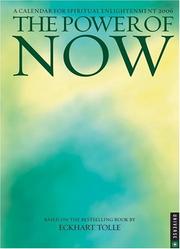
The Power of Now

πŸ“˜ The Power of Now

Eckhart Tolle has emerged as one of today's most inspiring teachers. In The Power of Now, already a worldwide bestseller, the author describes his transition from despair to self-realization soon after his 29th birthday. Tolle took another ten years to understand this transformation, during which time he evolved a philosophy that has parallels in Buddhism, relaxation techniques, and meditation theory but is also eminently practical. In The Power of Now he shows readers how to recognize themselves as the creators of their own pain, and how to have a pain-free existence by living fully in the present. Accessing the deepest self, the true self, can be learned, he says, by freeing ourselves from the conflicting, unreasonable demands of the mind and living "present, fully, and intensely, in the Now."

β˜…β˜…β˜…β˜…β˜…β˜…β˜…β˜…β˜…β˜… 3.7 (99 ratings)
Similar? ✓ Yes 0 ✗ No 0
The Prince

πŸ“˜ The Prince

The Prince (Italian: Il Principe [il ˈprintΚƒipe]; Latin: De Principatibus) is a 16th-century political treatise written by Italian diplomat and political theorist NiccolΓ² Machiavelli as an instruction guide for new princes and royals. The general theme of The Prince is of accepting that the aims of princes – such as glory and survival – can justify the use of immoral means to achieve those ends. From Machiavelli's correspondence, a version appears to have been distributed in 1513, using a Latin title, De Principatibus (Of Principalities). However, the printed version was not published until 1532, five years after Machiavelli's death. This was carried out with the permission of the Medici pope Clement VII, but "long before then, in fact since the first appearance of The Prince in manuscript, controversy had swirled about his writings". Although The Prince was written as if it were a traditional work in the mirrors for princes style, it was generally agreed as being especially innovative. This is partly because it was written in the vernacular Italian rather than Latin, a practice that had become increasingly popular since the publication of Dante's Divine Comedy and other works of Renaissance literature.

β˜…β˜…β˜…β˜…β˜…β˜…β˜…β˜…β˜…β˜… 3.8 (89 ratings)
Similar? ✓ Yes 0 ✗ No 0
Ego is the Enemy

πŸ“˜ Ego is the Enemy

Many of us insist the main impediment to a full, successful life is the outside world. In fact, the most common enemy lies within: our ego. Early in our careers, it impedes learning and the cultivation of talent. With success, it can blind us to our faults and sow future problems. In failure, it magnifies each blow and makes recovery more difficult. At every stage, ego holds us back. Ego Is the Enemy draws on a vast array of stories and examples, from literature to philosophy to history. We meet fascinating figures such as George Marshall, Jackie Robinson, Katharine Graham, Bill Belichick, and Eleanor Roosevelt, who all reached the highest levels of power and success by conquering their own egos. Their strategies and tactics can be ours as well. In an era that glorifies social media, reality TV, and other forms of shameless self-promotion, the battle against ego must be fought on many fronts. Armed with the lessons in this book, as Holiday writes, "you will be less invested in the story you tell about your own specialness, and as a result, you will be liberated to accomplish the world-changing work you've set out to achieve."--

β˜…β˜…β˜…β˜…β˜…β˜…β˜…β˜…β˜…β˜… 3.6 (34 ratings)
Similar? ✓ Yes 0 ✗ No 0
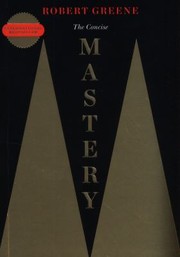
Mastery

πŸ“˜ Mastery

Robert Greene, the "modern Machiavelli" debunks the prevailing mythology of success and presents a radical new way to greatness.

β˜…β˜…β˜…β˜…β˜…β˜…β˜…β˜…β˜…β˜… 3.9 (30 ratings)
Similar? ✓ Yes 0 ✗ No 0

Some Other Similar Books

Power: Why Some People Have It and Others Don't by Jeffrey Pfeffer
The Art of Power by Thich Nhat Hanh
The 50th Law by 52 Centers & Robert Greene
The Art of War by Sun Tzu
Leadership and Self-Deception by The Arbinger Institute

Have a similar book in mind? Let others know!

Please login to submit books!