Books like Lost discoveries by Dick Teresi
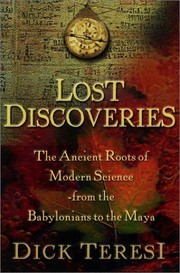

Lost Discoveries, Dick Teresi's innovative history of science, explores the unheralded scientific breakthroughs from peoples of the ancient world -- Babylonians, Egyptians, Indians, Africans, New World and Oceanic tribes, among others -- and the non-European medieval world. They left an enormous heritage in the fields of mathematics, astronomy, cosmology, physics, geology, chemistry, and technology. The mathematical foundation of Western science is a gift from the Indians, Chinese, Arabs, Babylonians, and Maya. The ancient Egyptians developed the concept of the lowest common denominator, and they developed a fraction table that modern scholars estimate required 28,000 calculations to compile. The Babylonians developed the first written math and used a place-value number system. Our numerals, 0 through 9, were invented in ancient India; the Indians also boasted geometry, trigonometry, and a kind of calculus. Planetary astronomy as well may have begun with the ancient Indians, who correctly identified the relative distances of the known planets from the sun, and knew the moon was nearer to the earth than the sun was. The Chinese observed, reported, dated, recorded, and interpreted eclipses between 1400 and 1200 BC. Most of the names of our stars and constellations are Arabic. Arabs built the first observatories. Five thousand years ago, the Sumerians said the earth was circular. In the sixth century, a Hindu astronomer taught that the daily rotation of the earth on its axis provided the rising and setting of the sun. Chinese and Arab scholars were the first to use fossils scientifically to trace earth's history. Chinese alchemists realized that most physical substances were merely combinations of other substances, which could be mixed in different proportions. Islamic scholars are legendary for translating scientific texts of many languages into Arabic, a tradition that began with alchemical books. In the eleventh century, Avicenna of Persia divined that outward qualities of metals were of little value in classification, and he stressed internal structure, a notion anticipating Mendeleyev's periodic chart of elements. Iron suspension bridges came from Kashmir, printing from India; papermaking was from China, Tibet, India, and Baghdad; movable type was invented by Pi Sheng in about 1041; the Quechuan Indians of Peru were the first to vulcanize rubber; Andean farmers were the first to freeze-dry potatoes. European explorers depended heavily on Indian and Filipino shipbuilders, and collected maps and sea charts from Javanese and Arab merchants. The first comprehensive, authoritative, popularly written, multicultural history of science, Lost Discoveries fills a crucial gap in the history of science. - Jacket flap.
First publish date: 2002
Authors: Dick Teresi
★ ★ ★ ★ ★ 0.0 (0 community ratings)

Lost discoveries by Dick Teresi

How are these books recommended?

The books recommended for Lost discoveries by Dick Teresi are shaped by reader interaction. Votes on how closely books relate, user ratings, and community comments all help refine these recommendations and highlight books readers genuinely find similar in theme, ideas, and overall reading experience.


Have you read any of these books?
Your votes, ratings, and comments help improve recommendations and make it easier for other readers to discover books they’ll enjoy.

Books similar to Lost discoveries (6 similar books)

A short history of nearly everything by 6500568|Bill Bryson book cover

πŸ“˜ A short history of nearly everything

Bill Bryson turns the universe into a conversational guide, tracing science from the Big Bang through evolution, geology, chemistry, astronomy, and particle physics with humor and clarity.

β˜…β˜…β˜…β˜…β˜…β˜…β˜…β˜…β˜…β˜… 4.2 (90 ratings)
Similar? ✓ Yes 0 ✗ No 0
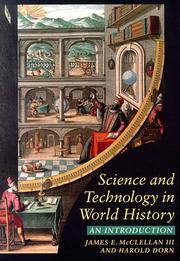
Science and technology in world history by 6636245|James E. McClellan book cover

πŸ“˜ Science and technology in world history

This comprehensive survey explores the evolving relationship between science and technology throughout human history.

β˜…β˜…β˜…β˜…β˜…β˜…β˜…β˜…β˜…β˜… 4.0 (6 ratings)
Similar? ✓ Yes 0 ✗ No 0
Wait and see by 3785482|Friso Henstra book cover

πŸ“˜ Wait and see

Having only wanted to prove himself remarkable, a little man, saddened by the failure of three previous inventions, from sheer need creates something heralded by the world.

β˜…β˜…β˜…β˜…β˜…β˜…β˜…β˜…β˜…β˜… 5.0 (1 rating)
Similar? ✓ Yes 0 ✗ No 0
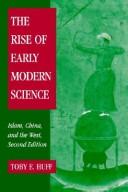
The rise of early modern science by 9444745|Toby E. Huff book cover

πŸ“˜ The rise of early modern science


β˜…β˜…β˜…β˜…β˜…β˜…β˜…β˜…β˜…β˜… 0.0 (0 ratings)
Similar? ✓ Yes 0 ✗ No 0
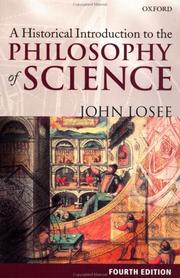
A historical introduction to the philosophy of science by 11545466|Losee, John. book cover

πŸ“˜ A historical introduction to the philosophy of science


β˜…β˜…β˜…β˜…β˜…β˜…β˜…β˜…β˜…β˜… 0.0 (0 ratings)
Similar? ✓ Yes 0 ✗ No 0
The book of lost things by 6983732|John Connolly book cover

πŸ“˜ The book of lost things

After his mother dies, 12‑year‑old David escapes into the stories that once comforted him, only for myth and war to collide in a world where a Crooked Man and a faded king rule over wolves and hidden secrets.

β˜…β˜…β˜…β˜…β˜…β˜…β˜…β˜…β˜…β˜… 0.0 (0 ratings)
Similar? ✓ Yes 0 ✗ No 0

Some Other Similar Books

The Information: A History, a Theory, a Flood by James Gleick
The Disappearing Spoon: And Other True Tales of Madness, Love, and the History of the World from the Periodic Table of Elements by Sam Kean
The Innovators: How a Group of Hackers, Geniuses, and Geeks Created the Digital Revolution by Walter Isaacson
The Mathematical Universe: My Quest for the Ultimate Nature of Reality by Max Tegmark
The Pen and the Sword: The Art of Preaching & the Power of the Word by Edward P. Wimberly
The Map that Changed the World: William Smith and the Birth of Modern Geology by Simon Winchester
The Art of Scientific Investigation by W.I.B. Beveridge
The Age of Wonder: The Romantic Generation and the Discovery of the Beautiful by Richard Holmes

Have a similar book in mind? Let others know!

Please login to submit books!