Books like The Idea Guide by David Ceolin


First publish date: 1995
Subjects: New business enterprises, Small business, Planning, Entrepreneurship, Petites et moyennes entreprises
Authors: David Ceolin
0.0 (0 community ratings)

The Idea Guide by David Ceolin

How are these books recommended?

The books recommended for The Idea Guide by David Ceolin are shaped by reader interaction. Votes on how closely books relate, user ratings, and community comments all help refine these recommendations and highlight books readers genuinely find similar in theme, ideas, and overall reading experience.


Have you read any of these books?
Your votes, ratings, and comments help improve recommendations and make it easier for other readers to discover books they’ll enjoy.

Books similar to The Idea Guide (18 similar books)

Thinking, fast and slow by 6390436|Daniel Kahneman book cover

πŸ“˜ Thinking, fast and slow

In his mega bestseller, Thinking, Fast and Slow, Daniel Kahneman, world-famous psychologist and winner of the Nobel Prize in Economics, takes us on a groundbreaking tour of the mind and explains the two systems that drive the way we think. System 1 is fast, intuitive, and emotional; System 2 is slower, more deliberative, and more logical. The impact of overconfidence on corporate strategies, the difficulties of predicting what will make us happy in the future, the profound effect of cognitive biases on everything from playing the stock market to planning our next vacation―each of these can be understood only by knowing how the two systems shape our judgments and decisions. Engaging the reader in a lively conversation about how we think, Kahneman reveals where we can and cannot trust our intuitions and how we can tap into the benefits of slow thinking. He offers practical and enlightening insights into how choices are made in both our business and our personal lives―and how we can use different techniques to guard against the mental glitches that often get us into trouble. Topping bestseller lists for almost ten years, Thinking, Fast and Slow is a contemporary classic, an essential book that has changed the lives of millions of readers.

β˜…β˜…β˜…β˜…β˜…β˜…β˜…β˜…β˜…β˜… 4.1 (189 ratings)
Similar? ✓ Yes 0 ✗ No 0
The Lean Startup by 7173148|Eric Ries book cover

πŸ“˜ The Lean Startup
 by Eric Ries

"Most startups are built to fail. But those failures, according to entrepreneur Eric Ries, are preventable. Startups don't fail because of bad execution, or missed deadlines, or blown budgets. They fail because they are building something nobody wants. Whether they arise from someone's garage or are created within a mature Fortune 500 organization, new ventures, by definition, are designed to create new products or services under conditions of extreme uncertainly. Their primary mission is to find out what customers ultimately will buy. One of the central premises of The Lean Startup movement is what Ries calls "validated learning" about the customer. It is a way of getting continuous feedback from customers so that the company can shift directions or alter its plans inch by inch, minute by minute. Rather than creating an elaborate business plan and a product-centric approach, Lean Startup prizes testing your vision continuously with your customers and making constant adjustments"--

β˜…β˜…β˜…β˜…β˜…β˜…β˜…β˜…β˜…β˜… 4.1 (60 ratings)
Similar? ✓ Yes 0 ✗ No 0
The Lean Startup by 7173148|Eric Ries book cover

πŸ“˜ The Lean Startup
 by Eric Ries

"Most startups are built to fail. But those failures, according to entrepreneur Eric Ries, are preventable. Startups don't fail because of bad execution, or missed deadlines, or blown budgets. They fail because they are building something nobody wants. Whether they arise from someone's garage or are created within a mature Fortune 500 organization, new ventures, by definition, are designed to create new products or services under conditions of extreme uncertainly. Their primary mission is to find out what customers ultimately will buy. One of the central premises of The Lean Startup movement is what Ries calls "validated learning" about the customer. It is a way of getting continuous feedback from customers so that the company can shift directions or alter its plans inch by inch, minute by minute. Rather than creating an elaborate business plan and a product-centric approach, Lean Startup prizes testing your vision continuously with your customers and making constant adjustments"--

β˜…β˜…β˜…β˜…β˜…β˜…β˜…β˜…β˜…β˜… 4.1 (60 ratings)
Similar? ✓ Yes 0 ✗ No 0
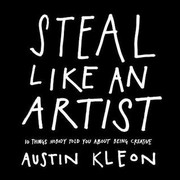
Steal like an artist by 11161966|Austin Kleon book cover

πŸ“˜ Steal like an artist

When asked to talk to students at Broome Community College in upstate New York in the spring of 2011, Austin Kleon wrote a simple list often things he wished he'd heard when he was their age: 'Steal like an artist; Don't wait until you know who you are to start making things; Write the book you want to read; Use your hands; Side projects are important; Do good work and put it where people can see it; Geography is no longer our master; Be nice (the world is a small town.); Be boring (it's the only way to get work done.); and, Creativity is subtraction.' After giving the speech, he posted the text and slides to his popular blog, where it quickly went viral. Now Kleon has expanded his original manifesto into an illustrated guide to the creative life for writers, artists, entrepreneurs, designers, photographers, musicians, and anyone attempting to make things - art, a career, a life - in the digital age. Brief, direct, and visually interactive, the book includes illustrative anecdotes and mini-exercise sections calling out practical actions readers can take to unleash their own creative spirits.

β˜…β˜…β˜…β˜…β˜…β˜…β˜…β˜…β˜…β˜… 4.1 (42 ratings)
Similar? ✓ Yes 0 ✗ No 0
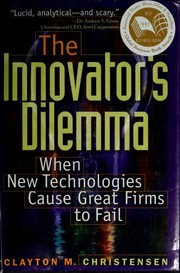
The Innovator's Dilemma by 6744863|Clayton M. Christensen book cover

πŸ“˜ The Innovator's Dilemma

In his book, The Innovator's Dilemma [3], Professor Clayton Christensen of Harvard Business School describes a theory about how large, outstanding firms can fail "by doing everything right." The Innovator's Dilemma, according to Christensen, describes companies whose successes and capabilities can actually become obstacles in the face of changing markets and technologies. ([Source][1]) This book takes the radical position that great companies can fail precisely because they do everything right. It demonstrates why outstanding companies that had their competitive antennae up, listened astutely to customers, and invested aggressively in new technologies still lost their market leadership when confronted with disruptive changes in technology and market structure. And it tells how to avoid a similar fate. Using the lessons of successes and failures of leading companies, The Innovator's Dilemma presents a set of rules for capitalizing on the phenomenon of disruptive innovation. These principles will help managers determine when it is right not to listen to customers, when to invest in developing lower-performance products that promise lower margins, and when to pursue small markets at the expense of seemingly larger and more lucrative ones. - Jacket flap. [1]: http://web.mit.edu/6.933/www/Fall2000/teradyne/clay.html

β˜…β˜…β˜…β˜…β˜…β˜…β˜…β˜…β˜…β˜… 3.9 (16 ratings)
Similar? ✓ Yes 0 ✗ No 0
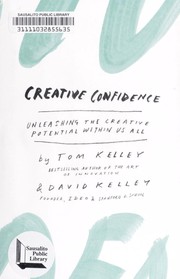
Creative Confidence by 10273241|Tom Kelley book cover

πŸ“˜ Creative Confidence
 by Tom Kelley

"IDEO founder and Stanford d.school creator David Kelley and his brother Tom Kelley, IDEO partner and the author of the bestselling The Art of Innovation, have written a powerful and compelling book on unleashing the creativity that lies within each and every one of us. Too often, companies and individuals assume that creativity and innovation are the domain of the "creative types." But two of the leading experts in innovation, design, and creativity on the planet show us that each and every one of us is creative. In an incredibly entertaining and inspiring narrative that draws on countless stories from their work at IDEO and with many of the world's top companies, David and Tom Kelley identify the principles and strategies that will allow us to tap into our creative potential in our work lives, and in our personal lives, and allow us to innovate in terms of how we approach and solve problems. It is a book that will help each of us be more productive and successful in our lives and in our careers. "--

β˜…β˜…β˜…β˜…β˜…β˜…β˜…β˜…β˜…β˜… 3.2 (5 ratings)
Similar? ✓ Yes 0 ✗ No 0
Creative Confidence by 10273241|Tom Kelley book cover

πŸ“˜ Creative Confidence
 by Tom Kelley

"IDEO founder and Stanford d.school creator David Kelley and his brother Tom Kelley, IDEO partner and the author of the bestselling The Art of Innovation, have written a powerful and compelling book on unleashing the creativity that lies within each and every one of us. Too often, companies and individuals assume that creativity and innovation are the domain of the "creative types." But two of the leading experts in innovation, design, and creativity on the planet show us that each and every one of us is creative. In an incredibly entertaining and inspiring narrative that draws on countless stories from their work at IDEO and with many of the world's top companies, David and Tom Kelley identify the principles and strategies that will allow us to tap into our creative potential in our work lives, and in our personal lives, and allow us to innovate in terms of how we approach and solve problems. It is a book that will help each of us be more productive and successful in our lives and in our careers. "--

β˜…β˜…β˜…β˜…β˜…β˜…β˜…β˜…β˜…β˜… 3.2 (5 ratings)
Similar? ✓ Yes 0 ✗ No 0
Originals: How Non-Conformists Move the World by 7584134|Adam Grant book cover

πŸ“˜ Originals: How Non-Conformists Move the World
 by Adam Grant


β˜…β˜…β˜…β˜…β˜…β˜…β˜…β˜…β˜…β˜… 5.0 (1 rating)
Similar? ✓ Yes 0 ✗ No 0
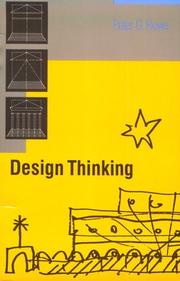
Design thinking by 8157406|Peter G. Rowe book cover

πŸ“˜ Design thinking


β˜…β˜…β˜…β˜…β˜…β˜…β˜…β˜…β˜…β˜… 4.0 (1 rating)
Similar? ✓ Yes 0 ✗ No 0
Sprint: How to Solve Big Problems and Test New Ideas in Just Five Days by 11654540|Jake Knapp book cover

πŸ“˜ Sprint: How to Solve Big Problems and Test New Ideas in Just Five Days
 by Jake Knapp


β˜…β˜…β˜…β˜…β˜…β˜…β˜…β˜…β˜…β˜… 0.0 (0 ratings)
Similar? ✓ Yes 0 ✗ No 0
Sprint: How to Solve Big Problems and Test New Ideas in Just Five Days by 11654540|Jake Knapp book cover

πŸ“˜ Sprint: How to Solve Big Problems and Test New Ideas in Just Five Days
 by Jake Knapp


β˜…β˜…β˜…β˜…β˜…β˜…β˜…β˜…β˜…β˜… 0.0 (0 ratings)
Similar? ✓ Yes 0 ✗ No 0
Hooked: How to Build Habit-Forming Products by 11842645|Nir Eyal book cover

πŸ“˜ Hooked: How to Build Habit-Forming Products
 by Nir Eyal


β˜…β˜…β˜…β˜…β˜…β˜…β˜…β˜…β˜…β˜… 0.0 (0 ratings)
Similar? ✓ Yes 0 ✗ No 0

Building a business in the virtual world by 11220389|C. F. Earl book cover

πŸ“˜ Building a business in the virtual world
 by C. F. Earl

Teaches the importance of building a business online, focusing on websites, social media, and e-mail.

β˜…β˜…β˜…β˜…β˜…β˜…β˜…β˜…β˜…β˜… 0.0 (0 ratings)
Similar? ✓ Yes 0 ✗ No 0
Making Ideas Happen by 11180787|Scott Belsky book cover

πŸ“˜ Making Ideas Happen

How the world's leading innovators push their ideas to fruition, time and time again. Edison famously said that genius is 1 percent inspiration, 99 percent perspiration. Ideas for new businesses, solutions to the world's problems, and artistic breakthroughs are common, but great execution is rare.According to Scott Belsky, the capacity to make ideas happen can be strengthened by anyone willing to build their organizational habits and harness the forces of community. That's why he founded Behance, a company that helps creative people and teams across industries develop these skills.Belsky has spent six years studying the habits of especially productive creative people and teams-the ones who make their ideas happen time and time again. After interviewing hundreds of successful creatives, he has compiled their most powerful-and often counterintuitive-practices, such as:Generate ideas in moderation and act without convictionReduce all projects to just three primary componentsEncourage fighting within your teamSeek competition and share ideas liberallyIn an increasingly flexible and entrepreneurial environment, creative minds have the opportunity (and responsibility) to solve and change industries-but they can only do that if they overcome the obstacles. While many of us obsess about discovering great new ideas, Belsky shows why it's better to develop the capacity to make ideas happen-a capacity that endures over time.

β˜…β˜…β˜…β˜…β˜…β˜…β˜…β˜…β˜…β˜… 0.0 (0 ratings)
Similar? ✓ Yes 0 ✗ No 0
The market planning guide by 6551710|David H. Bangs book cover

πŸ“˜ The market planning guide


β˜…β˜…β˜…β˜…β˜…β˜…β˜…β˜…β˜…β˜… 0.0 (0 ratings)
Similar? ✓ Yes 0 ✗ No 0
The innovator's DNA by 7810372|Jeff Dyer book cover

πŸ“˜ The innovator's DNA
 by Jeff Dyer

"Some people are just natural innovators, right? With no apparent effort, they discover ideas for new products, services, and entire businesses. It may look like innovators are born, not made. But according to Jeffrey Dyer and Hal Gregersen, anyone can become more innovative. How? Master the discovery skills that distinguish innovative entrepreneurs and executives from ordinary managers. In The Innovator's DNA, the authors identify five capabilities demonstrated by the best innovators: ΚΊ Associating: drawing connections between questions, problems, or ideas from unrelated fields ΚΊ Questioning: posing queries that challenge common wisdom ΚΊ Observing: scrutinizing the behavior of customers, suppliers, and competitors to identify new ways of doing things ΚΊ Experimenting: constructing interactive experiences and provoking unorthodox responses to see what insights emerge ΚΊ Networking: meeting people with different ideas and perspectives The authors explain how to generate ideas with these skills, collaborate with "delivery-driven" colleagues to implement ideas, and build innovation skills throughout your organization to sharpen its competitive edge. They also provide a self-assessment for rating your own innovator's DNA. Practical and provocative, this book is an essential resource for all teams seeking to strengthen their innovative prowess"-- "How can I innovate? How do I spot people who are more likely to generate disruptive business ideas for my organization? How can I help my team be more innovative? If you've ever asked yourself these questions, then you know there is no silver bullet for learning how to be more innovative. Indeed, conventional wisdom says that some people naturally and habitually have that "spark" and other people just don't. Picking up where The Innovator's Solution leaves off, authors Jeff Dyer and Hal Gregersen offer a different view, and instead argue that all people can learn how to be more innovative. In The Innovator's DNA, the authors now show that you can train yourself -- and others -- to think and act more like an innovator, even like those high profile innovators such as Scott Cook, Mike Lazardis, Meg Whitman, and AG Lafley. In partnership with Clayton Christensen, Dyer and Gregersen launched an in-depth study of "innovative entrepreneurs" -- that is, founders and CEOs of companies based on a unique value proposition relative to incumbents -- and compared them to other successful (but not innovative) CEOs and executives. Through in-depth interviews, 360 and survey data, Dyer, Gergersen, and Christensen identified a set of five "discovery skills" ( associational thinking, questioning, observing, experimenting, and idea networking) that distinguish innovative entrepreneurs from typical executives. This book explains each of the discovery skills, how to develop them, and how to use them in combination to generate new ideas. It shows how to rate, and then build upon, your own "Innovator's DNA", using the same diagnostics used in their study of successful innovators"--

β˜…β˜…β˜…β˜…β˜…β˜…β˜…β˜…β˜…β˜… 0.0 (0 ratings)
Similar? ✓ Yes 0 ✗ No 0
Change by Design by 6987728|Tim Brown book cover

πŸ“˜ Change by Design
 by Tim Brown


β˜…β˜…β˜…β˜…β˜…β˜…β˜…β˜…β˜…β˜… 0.0 (0 ratings)
Similar? ✓ Yes 0 ✗ No 0
Raising money by 13503636|Douglas A. Gray book cover

πŸ“˜ Raising money


β˜…β˜…β˜…β˜…β˜…β˜…β˜…β˜…β˜…β˜… 0.0 (0 ratings)
Similar? ✓ Yes 0 ✗ No 0
Some Other Similar Books

Design Thinking: Understanding How Designers Think and Work by Nigel Cross
Creative Confidence: Unleashing the Creative Potential Within Us All by Tom Kelley and David Kelley

Have a similar book in mind? Let others know!

Please login to submit books!