Books like Fewer by Ben J. Wattenberg


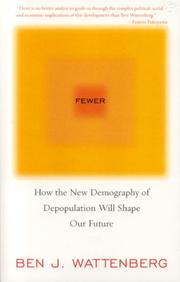
"In countries throughout the world - both modern and less developed -- birthrates and fertility rates are now falling at an astonishing rates. Depopulation is already proceeding in Italy, Germany, and Spain; Russia is losing a million people each year; Japan will begin losing population within a few years. Among the modern nations, only the United States is an exception to the trend." "In Fewer, Ben J. Wattenberg brings his expertise in world and domestic demographics to bear on this momentous but largely unrecognized shift, analyzing its major implications for geopolitics, the environment, the world economy, and the health of regions and nations. The United States, for example, may find itself with weaker allies who have ever-greater proportions of Muslim voters. Europe may not be able to maintain its economic strength without vast numbers of immigrant workers - workers they have resisted allowing into their countries." "What Mr. Wattenberg has to say about the impact of declining world population will underline its profound impact on the lives of people everywhere - from the dominance of the elderly and their demands on the resources of their governments, to the enormous potential of China and India, to the relatively privileged position of the United States vis-a-vis the major world powers. In an age already beset by a transformation in world politics, Fewer will help explain current trends as well as sketch the shape of our future."--BOOK JACKET
First publish date: 2004
Subjects: Population, Fertility, Human, Human Fertility, Demography
Authors: Ben J. Wattenberg
0.0 (0 community ratings)

Fewer by Ben J. Wattenberg

How are these books recommended?

The books recommended for Fewer by Ben J. Wattenberg are shaped by reader interaction. Votes on how closely books relate, user ratings, and community comments all help refine these recommendations and highlight books readers genuinely find similar in theme, ideas, and overall reading experience.


Have you read any of these books?
Your votes, ratings, and comments help improve recommendations and make it easier for other readers to discover books they’ll enjoy.

Books similar to Fewer (9 similar books)
Atomic Habits by 11797737|James Clear book cover

πŸ“˜ Atomic Habits

No matter your goals, Atomic Habits offers a proven framework for improving every day. James Clear, one of the world's leading experts on habit formation, reveals practical strategies that will teach you exactly how to form good habits, break bad ones, and master the tiny behaviors that lead to remarkable results.

β˜…β˜…β˜…β˜…β˜…β˜…β˜…β˜…β˜…β˜… 4.0 (1046 ratings)
Similar? ✓ Yes 0 ✗ No 0
The Subtle Art of Not Giving a F*ck by 7260500|Mark Manson book cover

πŸ“˜ The Subtle Art of Not Giving a F*ck

In this book, blogger and former internet entrepreneur Mark Manson explains in simple, no expletives barred terms how to achieve happiness by caring more about fewer things and not caring at all about more. He explains how the metrics we use to define ourselves may be the very things holding us back. By redefining our metrics, questioning ourselves and doubting everything, we may be able to find that we're better off than we think, and thereby become happier people.

β˜…β˜…β˜…β˜…β˜…β˜…β˜…β˜…β˜…β˜… 4.1 (645 ratings)
Similar? ✓ Yes 0 ✗ No 0
The Life-Changing Magic of Tidying Up by 11623704|Marie Kondo book cover

πŸ“˜ The Life-Changing Magic of Tidying Up

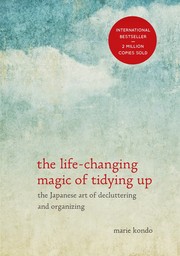
Japanese cleaning consultant Marie Kondo takes tidying to a whole new level, promising that if you properly simplify and organize your house once, you'll never have to do it again. Most methods advocate a room-by-room approach, which doom you to pick away at your piles of stuff forever. The KonMari Method, with its revolutionary category-by-category system, leads to lasting results. In fact, none of Kondo's clients have lapsed (and she still has a three-month wait list). With detailed guidance for determining which items in your house "spark joy" (and which don't), this international best-seller featuring Tokyo's newest lifestyle phenomenon will help you clear your clutter and enjoy the unique magic of a tidy home - and the calm, motivated mindset it can inspire.

β˜…β˜…β˜…β˜…β˜…β˜…β˜…β˜…β˜…β˜… 3.6 (57 ratings)
Similar? ✓ Yes 0 ✗ No 0
Digital Minimalism by 7145896|Cal Newport book cover

πŸ“˜ Digital Minimalism

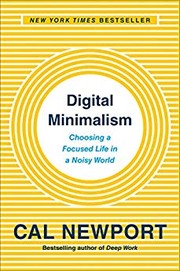
The key to living well in a high tech world is to spend much less time using technology. In recent years, our culture's relationship with personal technology has transformed from something exciting into something darker. Innovations like smartphones and social media are useful, but many of us are increasingly troubled by how much control these tools seem to exert over our daily experiences – including how we spend our free time and how we feel about ourselves. In Digital Minimalism, Newport proposes a bold solution: a minimalist approach to technology use in which you radically reduce the time you spend online, focusing on a small set of carefully-selected activities while happily ignoring the rest.

β˜…β˜…β˜…β˜…β˜…β˜…β˜…β˜…β˜…β˜… 3.4 (14 ratings)
Similar? ✓ Yes 0 ✗ No 0
The birth dearth by 8803365|Ben J. Wattenberg book cover

πŸ“˜ The birth dearth

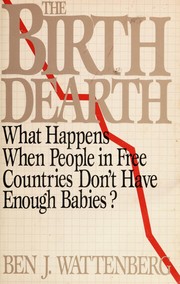
The Birth Dearth is a 1987 non-fiction book by Ben J. Wattenberg, a political scientist and author. The book argues that the declining birth rate in developed countries is a serious problem that could have far-reaching consequences for the economy, society, and culture. Wattenberg begins by examining the historical trends in birth rates. He notes that the birth rate in the United States has been declining since the early 1970s, and that this trend is not unique to the United States. He also notes that the birth rate is declining in other developed countries, such as Japan, Germany, and France. Wattenberg then argues that the declining birth rate is a problem because it will lead to a smaller workforce and a larger elderly population. He also argues that the declining birth rate will make it more difficult to sustain economic growth and social programs. Wattenberg concludes by proposing a number of solutions to the birth dearth. He suggests that governments should provide financial incentives for couples to have children, and that they should make it easier for women to combine work and family. The Birth Dearth was a controversial book when it was published. Some critics argued that Wattenberg was exaggerating the problem, while others argued that he was proposing unrealistic solutions. However, the book has been influential in shaping the debate about the declining birth rate.

β˜…β˜…β˜…β˜…β˜…β˜…β˜…β˜…β˜…β˜… 4.8 (10 ratings)
Similar? ✓ Yes 0 ✗ No 0
The birth dearth by 8803365|Ben J. Wattenberg book cover

πŸ“˜ The birth dearth

The Birth Dearth is a 1987 non-fiction book by Ben J. Wattenberg, a political scientist and author. The book argues that the declining birth rate in developed countries is a serious problem that could have far-reaching consequences for the economy, society, and culture. Wattenberg begins by examining the historical trends in birth rates. He notes that the birth rate in the United States has been declining since the early 1970s, and that this trend is not unique to the United States. He also notes that the birth rate is declining in other developed countries, such as Japan, Germany, and France. Wattenberg then argues that the declining birth rate is a problem because it will lead to a smaller workforce and a larger elderly population. He also argues that the declining birth rate will make it more difficult to sustain economic growth and social programs. Wattenberg concludes by proposing a number of solutions to the birth dearth. He suggests that governments should provide financial incentives for couples to have children, and that they should make it easier for women to combine work and family. The Birth Dearth was a controversial book when it was published. Some critics argued that Wattenberg was exaggerating the problem, while others argued that he was proposing unrealistic solutions. However, the book has been influential in shaping the debate about the declining birth rate.

β˜…β˜…β˜…β˜…β˜…β˜…β˜…β˜…β˜…β˜… 4.8 (10 ratings)
Similar? ✓ Yes 0 ✗ No 0
The power of less by 11188809|Leo Babauta book cover

πŸ“˜ The power of less

"The Power of Less" is a blueprint for reducing the clutter, noise, and unnecessary work that fills a modern day. Babauta's lessons enable readers to do less, be more effective, get more done, and simplify their lives.

β˜…β˜…β˜…β˜…β˜…β˜…β˜…β˜…β˜…β˜… 3.2 (4 ratings)
Similar? ✓ Yes 0 ✗ No 0
The Art of Possibility by 9225362|Rosamund Stone Zander book cover

πŸ“˜ The Art of Possibility

Presenting twelve breakthrough practices for bringing creativity into all human endeavors, this book is the dynamic product of an extraordinary partnership. It combines Benjamin Zander's experience as conductor of the Boston Philharmonic and his talent as a teacher and communicator with psychotherapist Rosamund Stone Zander's genius for designing innovative paradigms for personal and professional fulfillment. The authors' harmoniously interwoven perspectives provide a deep sense of the powerful role that the notion of possibility can play in every aspect of life. Through uplifting stories, parables, and personal anecdotes, the authors invite readers to become passionate communicators, leaders, and performers whose lives radiate possibility into the world.

β˜…β˜…β˜…β˜…β˜…β˜…β˜…β˜…β˜…β˜… 0.0 (0 ratings)
Similar? ✓ Yes 0 ✗ No 0
The demography of the 1970's: the birth dearth and what it means by 8803365|Ben J. Wattenberg book cover

πŸ“˜ The demography of the 1970's: the birth dearth and what it means


β˜…β˜…β˜…β˜…β˜…β˜…β˜…β˜…β˜…β˜… 0.0 (0 ratings)
Similar? ✓ Yes 0 ✗ No 0

Some Other Similar Books

Essentialism: The Disciplined Pursuit of Less by Greg McKeown
Deep Work: Rules for Focused Success in a Distracted World by Cal Newport
Minimalism: Live a Meaningful Life by Joshua Fields Millburn & Ryan Nicodemus
Simplify: Ten Practices to Unclutter Your Soul by Bill Hybels

Have a similar book in mind? Let others know!

Please login to submit books!