Books like Uncanny Valley by Anna Wiener


First publish date: 2020
Subjects: Social conditions, New York Times reviewed, Employees, New York Times bestseller, Sex discrimination in employment
Authors: Anna Wiener
3.4 (5 community ratings)

Uncanny Valley by Anna Wiener

How are these books recommended?

The books recommended for Uncanny Valley by Anna Wiener are shaped by reader interaction. Votes on how closely books relate, user ratings, and community comments all help refine these recommendations and highlight books readers genuinely find similar in theme, ideas, and overall reading experience.


Have you read any of these books?
Your votes, ratings, and comments help improve recommendations and make it easier for other readers to discover books they’ll enjoy.

Books similar to Uncanny Valley (13 similar books)
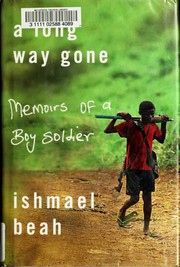
A Long Way Gone by 6965223|Ishmael Beah book cover

πŸ“˜ A Long Way Gone

A Long Way Gone: Memoirs of a Boy Soldier (2007) is a memoir written by Ishmael Beah, an author from Sierra Leone. The book is a firsthand account of Beah's time as a child soldier during the civil war in Sierra Leone (1990s). Beah was 12 years old when he fled his village after it was attacked by rebels, and he wandered the war-filled country until brainwashed by an army unit that forced him to use guns and drugs. By 13, he had perpetrated and witnessed numerous acts of violence. Three years later, UNICEF rescued him from the unit and put him into a rehabilitation program that helped him find his uncle, who would eventually adopt him. After his return to civilian life he began traveling the United States recounting his story. A Long Way Gone was nominated for a Quill Award in the Best Debut Author category for 2007. Time magazine's Lev Grossman named it one of the Top 10 Nonfiction Books of 2007, ranking it at No. 3, and praising it as "painfully sharp", and its ability to take "readers behind the dead eyes of the child-soldier in a way no other writer has." A Long Way Gone was listed as one of the top ten books for young adults by the American Library Association in 2008.

β˜…β˜…β˜…β˜…β˜…β˜…β˜…β˜…β˜…β˜… 4.1 (34 ratings)
Similar? ✓ Yes 0 ✗ No 0
The Age of Surveillance Capitalism by 857852|Shoshana Zuboff book cover

πŸ“˜ The Age of Surveillance Capitalism

"Shoshana Zuboff, named "the true prophet of the information age" by the Financial Times, has always been ahead of her time. Her seminal book In the Age of the Smart Machine foresaw the consequences of a then-unfolding era of computer technology. Now, three decades later she asks why the once-celebrated miracle of digital is turning into a nightmare. Zuboff tackles the social, political, business, personal, and technological meaning of "surveillance capitalism" as an unprecedented new market form. It is not simply about tracking us and selling ads, it is the business model for an ominous new marketplace that aims at nothing less than predicting and modifying our everyday behavior--where we go, what we do, what we say, how we feel, who we're with. The consequences of surveillance capitalism for us as individuals and as a society vividly come to life in The Age of Surveillance Capitalism's pathbreaking analysis of power. The threat has shifted from a totalitarian "big brother" state to a universal global architecture of automatic sensors and smart capabilities: A "big other" that imposes a fundamentally new form of power and unprecedented concentrations of knowledge in private companies--free from democratic oversight and control"-- "In this masterwork of original thinking and research, Shoshana Zuboff provides startling insights into the phenomenon that she has named surveillance capitalism. The stakes could not be higher: a global architecture of behavior modification threatens human nature in the twenty-first century just as industrial capitalism disfigured the natural world in the twentieth. Zuboff vividly brings to life the consequences as surveillance capitalism advances from Silicon Valley into every economic sector. Vast wealth and power are accumulated in ominous new "behavioral futures markets," where predictions about our behavior are bought and sold, and the production of goods and services is subordinated to a new "means of behavioral modification." The threat has shifted from a totalitarian Big Brother state to a ubiquitous digital architecture: a "Big Other" operating in the interests of surveillance capital. Here is the crucible of an unprecedented form of power marked by extreme concentrations of knowledge and free from democratic oversight. Zuboff's comprehensive and moving analysis lays bare the threats to twenty-first century society: a controlled "hive" of total connection that seduces with promises of total certainty for maximum profit-at the expense of democracy, freedom, and our human future. With little resistance from law or society, surveillance capitalism is on the verge of dominating the social order and shaping the digital future--if we let it."--Dust jacket.

β˜…β˜…β˜…β˜…β˜…β˜…β˜…β˜…β˜…β˜… 3.9 (11 ratings)
Similar? ✓ Yes 0 ✗ No 0
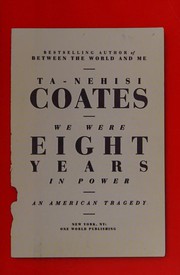
We Were Eight Years in Power by 7695610|Ta-Nehisi Coates book cover

πŸ“˜ We Were Eight Years in Power

In these "urgently relevant essays," the National Book Award-winning author of Between the World and Me "reflects on race, Barack Obama's presidency and its jarring aftermath"*--including the election of Donald Trump

β˜…β˜…β˜…β˜…β˜…β˜…β˜…β˜…β˜…β˜… 4.3 (6 ratings)
Similar? ✓ Yes 0 ✗ No 0
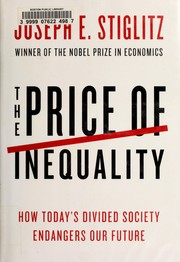
The price of inequality by 7311516|Joseph E. Stiglitz book cover

πŸ“˜ The price of inequality


β˜…β˜…β˜…β˜…β˜…β˜…β˜…β˜…β˜…β˜… 4.7 (3 ratings)
Similar? ✓ Yes 0 ✗ No 0
Half the sky by 10105417|Nicholas D. Kristof book cover

πŸ“˜ Half the sky

From two of our most fiercely moral voices, a passionate call to arms against our era's most pervasive human rights violation: the oppression of women and girls in the developing world.With Pulitzer Prize winners Nicholas D. Kristof and Sheryl WuDunn as our guides, we undertake an odyssey through Africa and Asia to meet the extraordinary women struggling there, among them a Cambodian teenager sold into sex slavery and an Ethiopian woman who suffered devastating injuries in childbirth. Drawing on the breadth of their combined reporting experience, Kristof and WuDunn depict our world with anger, sadness, clarity, and, ultimately, hope.They show how a little help can transform the lives of women and girls abroad. That Cambodian girl eventually escaped from her brothel and, with assistance from an aid group, built a thriving retail business that supports her family. The Ethiopian woman had her injuries repaired and in time became a surgeon. A Zimbabwean mother of five, counseled to return to school, earned her doctorate and became an expert on AIDS.Through these stories, Kristof and WuDunn help us see that the key to economic progress lies in unleashing women's potential. They make clear how so many people have helped to do just that, and how we can each do our part. Throughout much of the world, the greatest unexploited economic resource is the female half of the population. Countries such as China have prospered precisely because they emancipated women and brought them into the formal economy. Unleashing that process globally is not only the right thing to do; it's also the best strategy for fighting poverty.Deeply felt, pragmatic, and inspirational, Half the Sky is essential reading for every global citizen. - From the Hardcover edition.

β˜…β˜…β˜…β˜…β˜…β˜…β˜…β˜…β˜…β˜… 4.7 (3 ratings)
Similar? ✓ Yes 0 ✗ No 0
The Forgotten Man by 6649454|Amity Shlaes book cover

πŸ“˜ The Forgotten Man

It's difficult today to imagine how America survived the Great Depression. Only through the stories of the common people who struggled during that era can we really understand how the nation endured. These are the people at the heart of Amity Shlaes's insightful and inspiring history of one of the most crucial events of the twentieth century.In The Forgotten Man, Amity Shlaes, one of the nation's most respected economic commentators, offers a striking reinterpretation of the Great Depression. Rejecting the old emphasis on the New Deal, she turns to the neglected and moving stories of individual Americans, and shows how through brave leadership they helped establish the steadfast character we developed as a nation. Some of those figures were well known, at least in their dayβ€”Andrew Mellon, the Greenspan of the era; Sam Insull of Chicago, hounded as a scapegoat. But there were also unknowns: the Schechters, a family of butchers in Brooklyn who dealt a stunning blow to the New Deal; Bill W., who founded Alcoholics Anonymous in the name of showing that small communities could help themselves; and Father Divine, a black charismatic who steered his thousands of followers through the Depression by preaching a Gospel of Plenty.Shlaes also traces the mounting agony of the New Dealers themselves as they discovered their errors. She shows how both Presidents Hoover and Roosevelt failed to understand the prosperity of the 1920s and heaped massive burdens on the country that more than offset the benefit of New Deal programs. The real question about the Depression, she argues, is not whether Roosevelt ended it with World War II. It is why the Depression lasted so long. From 1929 to 1940, federal intervention helped to make the Depression greatβ€”in part by forgetting the men and women who sought to help one another.Authoritative, original, and utterly engrossing, The Forgotten Man offers an entirely new look at one of the most important periods in our history. Only when we know this history can we understand the strength of American character today.

β˜…β˜…β˜…β˜…β˜…β˜…β˜…β˜…β˜…β˜… 5.0 (1 rating)
Similar? ✓ Yes 0 ✗ No 0
Impostor Syndrome by 11891249|Kathy Wang book cover

πŸ“˜ Impostor Syndrome
 by Kathy Wang

The Russians plant an agent in a Facebook-like company; she rises to become the chief operating officer. One day a low-level tech notices unusually high outbound traffic from a server in Dublin, and adventure ensues.

β˜…β˜…β˜…β˜…β˜…β˜…β˜…β˜…β˜…β˜… 2.0 (1 rating)
Similar? ✓ Yes 0 ✗ No 0
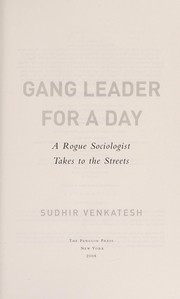
Gang leader for a day by 7044729|Sudhir Alladi Venkatesh book cover

πŸ“˜ Gang leader for a day

First introduced in Freakonomics, here is the full story of Sudhir Venkatesh, the sociology grad student who infiltrated one of Chicago's most notorious gangs The story of the young sociologist who studied a Chicago crack-dealing gang from the inside captured the world's attention when it was first described in Freakonomics. Gang Leader for a Day is the fascinating full story of how Sudhir Venkatesh managed to gain entrance into the gang, what he learned, and how his method revolutionized the academic establishment. When Venkatesh walked into an abandoned building in one of Chicago's most notorious housing projects, he was looking for people to take a multiple-choice survey on urban poverty. A first-year grad student hoping to impress his professors with his boldness, he never imagined that as a result of the assignment he would befriend a gang leader named JT and spend the better part of a decade inside the projects under JT's protection, documenting what he saw there. Over the next seven years, Venkatesh got to know the neighborhood dealers, crackheads, squatters, prostitutes, pimps, activists, cops, organizers, and officials. From his privileged position of unprecedented access, he observed JT and the rest of the gang as they operated their crack-selling business, conducted PR within their community, and rose up or fell within the ranks of the gang's complex organizational structure. In Hollywood-speak, Gang Leader for a Day is The Wire meets Harvard University. It's a brazen, page turning, and fundamentally honest view into the morally ambiguous, highly intricate, often corrupt struggle to survive in what is tantamount to an urban war zone. It is also the story of a complicated friendship between Sudhir and JT-two young and ambitious men a universe apart.

β˜…β˜…β˜…β˜…β˜…β˜…β˜…β˜…β˜…β˜… 0.0 (0 ratings)
Similar? ✓ Yes 0 ✗ No 0
Detroit by 5608100|Charlie LeDuff book cover

πŸ“˜ Detroit

An exposΓ© of Detroit, icon of America's lost prosperity, from Pulitzer Prize-winning journalist Charlie LeDuff. Back in his broken hometown, LeDuff searches through the ruins for clues to its fate, his family's, and his own. Once the richest city in America, Detroit is now the nation's poorest. It is an eerie and angry place of deserted factories and abandoned homes and forgotten people. LeDuff sets out to uncover what destroyed his city, and shares an unbelievable story of a hard town in a rough time filled with some of the strangest and strongest people our country has to offer.

β˜…β˜…β˜…β˜…β˜…β˜…β˜…β˜…β˜…β˜… 0.0 (0 ratings)
Similar? ✓ Yes 0 ✗ No 0
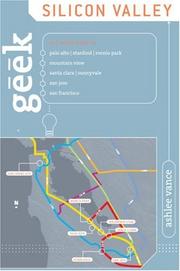
Geek Silicon Valley by 7835911|Ashlee Vance book cover

πŸ“˜ Geek Silicon Valley


β˜…β˜…β˜…β˜…β˜…β˜…β˜…β˜…β˜…β˜… 0.0 (0 ratings)
Similar? ✓ Yes 0 ✗ No 0
Hell and Other Destinations by 3775295|Madeleine Korbel Albright book cover

πŸ“˜ Hell and Other Destinations


β˜…β˜…β˜…β˜…β˜…β˜…β˜…β˜…β˜…β˜… 0.0 (0 ratings)
Similar? ✓ Yes 0 ✗ No 0
All That She Carried by 7049916|Tiya Miles book cover

πŸ“˜ All That She Carried
 by Tiya Miles


β˜…β˜…β˜…β˜…β˜…β˜…β˜…β˜…β˜…β˜… 0.0 (0 ratings)
Similar? ✓ Yes 0 ✗ No 0

Some Other Similar Books

The Compromised: The Stakes and Limits of Digital Life by Carl Miller
Electric City: The Rise of Tech and the Fall of Privacy by Adam Rogers
Brotopia: Breaking Up the Boys' Club of Silicon Valley by Emily Chang
Automating Inequality: How High-Tech Tools Profile, Police, and Punish the Poor by Virginia Eubanks
Tools and Fears: The Politics of Fear and the Future of Tech by Shoshana Zuboff
Talk to Me: How Voice Computing Will Transform the Way We Live, Work, and Think by James Vlahos
The Age of AI: And Our Human Future by Henry Kissinger & Eric Schmidt
The Rise of the Robots: Technology and the Threat of Mass Unemployment by Martin Ford

Have a similar book in mind? Let others know!

Please login to submit books!