Books like Philosophical Explanations by Robert Nozick
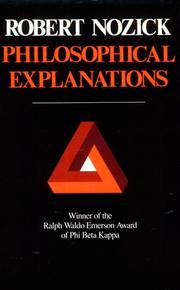

In this highly original work, Robert Nozick develops new views on philosophy's central topics and weaves them into a unified philosophical perspective. It is many years since a major work in English has ranged so widely over philosophy's fundamental concerns: the identity of the self, knowledge and skepticism, free will, the question of why there is something rather than nothing, the foundations of ethics, the meaning of life. Writing in a distinctive and personal philosophical voice, Mr. Nozick presents a new mode of philosophizing. In place of the usual semi-coercive philosophical goals of proof, of forcing people to accept conclusions, this book seeks philosophical explanations and understanding, and thereby stays truer to the original motivations for being interested in philosophy. -- Description from http://www.amazon.com (April 11, 2012).
First publish date: 1981
Authors: Robert Nozick
★ ★ ★ ★ ★ 0.0 (0 community ratings)

Philosophical Explanations by Robert Nozick

How are these books recommended?

The books recommended for Philosophical Explanations by Robert Nozick are shaped by reader interaction. Votes on how closely books relate, user ratings, and community comments all help refine these recommendations and highlight books readers genuinely find similar in theme, ideas, and overall reading experience.


Have you read any of these books?
Your votes, ratings, and comments help improve recommendations and make it easier for other readers to discover books they’ll enjoy.

Books similar to Philosophical Explanations (9 similar books)
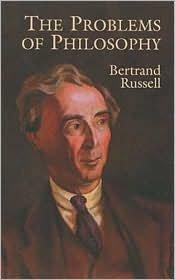
The Problems of Philosophy by 1410756|Bertrand Russell book cover

πŸ“˜ The Problems of Philosophy

A concise exploration of Bertrand Russell’s key philosophical questions, focusing primarily on epistemology while briefly addressing metaphysics and other contemporary issues.

β˜…β˜…β˜…β˜…β˜…β˜…β˜…β˜…β˜…β˜… 3.4 (5 ratings)
Similar? ✓ Yes 0 ✗ No 0
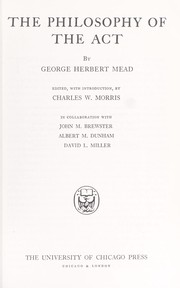
The philosophy of the act by 8256606|George Herbert Mead book cover

πŸ“˜ The philosophy of the act

George Herbert Mead's "Philosophy of the Act" explores the social nature of mind and self, arguing that human behavior and consciousness emerge from social interaction and communication, particularly through language, play, and games. Here's a more detailed overview: Social Emergence of Mind and Self: Mead believed that the mind and the self are not innate but arise from the social process of communication and interaction. The Act as a Unit of Analysis: Mead analyzed the act as a fundamental unit of behavior, breaking it down into stages like impulse, perception, manipulation, and consummation. The Role of Language and Symbols: Mead emphasized the importance of language and symbolic interaction in the development of the mind and self, arguing that humans learn to think and act through shared meanings and symbols. The "I" and the "Me": Mead introduced the concepts of the "I" (the active, spontaneous self) and the "me" (the social self, reflecting the attitudes of others) as key components of the self. Role-Taking and the Generalized Other: Mead argued that individuals develop a sense of self by taking on the roles of others and internalizing the perspectives of the "generalized other" (society as a whole). The Importance of Social Interaction: Mead's work highlights the importance of social interaction and communication in shaping human behavior, thought, and consciousness.

β˜…β˜…β˜…β˜…β˜…β˜…β˜…β˜…β˜…β˜… 5.0 (1 rating)
Similar? ✓ Yes 0 ✗ No 0
Language, truth and logic by 1894781|A. J. Ayer book cover

πŸ“˜ Language, truth and logic
 by A. J. Ayer

Mr. Ayer sets up specific tests by which you can easily evaluate statements of ideas. You will also learn how to distinguish ideas that cannot be verified by experience--those expressing religious, moral, or aesthetic experience, those expounding theological or metaphysical doctrine, and those dealing with a priori truth. The basic thesis of this work is that philosophy should not squander its energies upon the unknowable, but should perform its proper function in criticism and analysis.

β˜…β˜…β˜…β˜…β˜…β˜…β˜…β˜…β˜…β˜… 0.0 (0 ratings)
Similar? ✓ Yes 0 ✗ No 0
Advancement of learning, and The new Atlantis by 6707741|Francis Bacon book cover

πŸ“˜ Advancement of learning, and The new Atlantis


β˜…β˜…β˜…β˜…β˜…β˜…β˜…β˜…β˜…β˜… 0.0 (0 ratings)
Similar? ✓ Yes 0 ✗ No 0
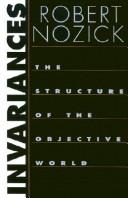
Invariances by 9707513|Robert Nozick book cover

πŸ“˜ Invariances


β˜…β˜…β˜…β˜…β˜…β˜…β˜…β˜…β˜…β˜… 0.0 (0 ratings)
Similar? ✓ Yes 0 ✗ No 0
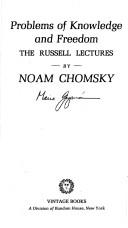
Problems of knowledge and freedom by 7476011|Noam Chomsky book cover

πŸ“˜ Problems of knowledge and freedom


β˜…β˜…β˜…β˜…β˜…β˜…β˜…β˜…β˜…β˜… 0.0 (0 ratings)
Similar? ✓ Yes 0 ✗ No 0
Experience and nature by 6209631|John Dewey book cover

πŸ“˜ Experience and nature
 by John Dewey


β˜…β˜…β˜…β˜…β˜…β˜…β˜…β˜…β˜…β˜… 0.0 (0 ratings)
Similar? ✓ Yes 0 ✗ No 0
Qu'est-ce qu'une chose? by 8298231|Martin Heidegger book cover

πŸ“˜ Qu'est-ce qu'une chose?


β˜…β˜…β˜…β˜…β˜…β˜…β˜…β˜…β˜…β˜… 0.0 (0 ratings)
Similar? ✓ Yes 0 ✗ No 0
The Structure of Scientific Revolutions by 9607127|Thomas S. Kuhn book cover

πŸ“˜ The Structure of Scientific Revolutions

The Structure of Scientific Revolutions by Thomas S. Kuhn.

β˜…β˜…β˜…β˜…β˜…β˜…β˜…β˜…β˜…β˜… 0.0 (0 ratings)
Similar? ✓ Yes 0 ✗ No 0

Some Other Similar Books

An Inquiry into Meaning and Truth by William P. Alston
Languages of Art by Nelson Goodman
The Problems of Philosophy by Ludwig Wittgenstein
The Logical Investigations by Ludwig Wittgenstein
Mind and World by J. David Velleman
Freedom and Resentment by P.F. Strawson

Have a similar book in mind? Let others know!

Please login to submit books!