Books like Robert Oppenheimer by Ray Monk


An exploration of the enigma of Robert Oppenheimer's life and personality and his contributions to the revolution in twentieth-century physics.
First publish date: 2013
Authors: Ray Monk
★ ★ ★ ★ ★ 5.0 (1 community ratings)

Robert Oppenheimer by Ray Monk

How are these books recommended?

The books recommended for Robert Oppenheimer by Ray Monk are shaped by reader interaction. Votes on how closely books relate, user ratings, and community comments all help refine these recommendations and highlight books readers genuinely find similar in theme, ideas, and overall reading experience.


Have you read any of these books?
Your votes, ratings, and comments help improve recommendations and make it easier for other readers to discover books they’ll enjoy.

Books similar to Robert Oppenheimer (7 similar books)

The last man who knew everything by 3764395|David N. Schwartz book cover

πŸ“˜ The last man who knew everything

A meticulously researched biography of Enrico Fermi, tracing his pioneering work on the first nuclear chain reaction, his roles in the Fascist Party and Manhattan Project, and his complex personal life.

β˜…β˜…β˜…β˜…β˜…β˜…β˜…β˜…β˜…β˜… 4.0 (1 rating)
Similar? ✓ Yes 0 ✗ No 0
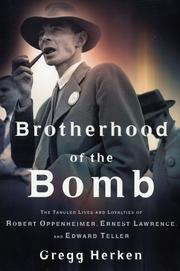
Brotherhood of the Bomb by 12047477|Gregg Herken book cover

πŸ“˜ Brotherhood of the Bomb

"If science is the story of the twentieth century, no drama is more compelling than that of "the Bomb" and its creators. But the tale of human conflict that connects the three scientists most responsible for the nuclear age - Robert Oppenheimer, Ernest Lawrence, and Edward Teller - was until now known only in broad outline.". "Ten years in the research and writing, Gregg Herken's account is based on private papers, interviews with Manhattan Project survivors, and recently released documents and coded intercepts obtained from FBI and KGB archives and other sources around the world. One of Brotherhood of the Bomb's surprises is the complex game of spy versus counterspy that surrounded the bomb's building and later dominated the Cold War. Yet, armies of U.S. security agents were unable to prevent the bomb's secrets from being passed to the Russians (sometimes by their American helpers). At the book's center is the question of loyalty - to science, to country, to family - and the wrenching choices that had to be made when such allegiances came into conflict."--BOOK JACKET.

β˜…β˜…β˜…β˜…β˜…β˜…β˜…β˜…β˜…β˜… 0.0 (0 ratings)
Similar? ✓ Yes 0 ✗ No 0
The complete idiot's guide to understanding Einstein by 6833782|Gary Moring book cover

πŸ“˜ The complete idiot's guide to understanding Einstein


β˜…β˜…β˜…β˜…β˜…β˜…β˜…β˜…β˜…β˜… 0.0 (0 ratings)
Similar? ✓ Yes 0 ✗ No 0
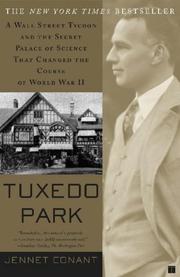
Tuxedo Park by 7053129|Jennet Conant book cover

πŸ“˜ Tuxedo Park

"In the fall of 1940, as German bombers flew over London and with America not yet at war, a small team of British scientists on orders from Winston Churchill carried out a daring transatlantic mission. The British unveiled their most valuable military secret in a clandestine meeting with American nuclear physicists at the Tuxedo Park mansion of a mysterious Wall Street tycoon, Alfred Lee Loomis. Powerful, handsome, and enormously wealthy, Loomis had for years led a double life, spending his days brokering huge deals and his weekends working with the world's leading scientists in his deluxe private laboratory that was hidden in a massive stone castle.". "In this account of a hitherto unexplored but crucial story of the war, Jennet Conant traces one of the world's most extraordinary careers and scientific enterprises. She describes Loomis' phenomenal rise to become one of the Wall Street legends of the go-go twenties. He rode out the Depression years in high style, and indulged in the hobbies of the fabulously rich.". "At the height of his influence on Wall Street, Loomis abruptly retired and devoted himself purely to science. He turned his Tuxedo Park laboratory into the meeting place for the most visionary minds of the twentieth century: Albert Einstein, Werner Heisenberg, James Franck, Niels Bohr, and Enrico Fermi. With England threatened by invasion, he joined Vannevar Bush, Karl Compton, and the author's grandfather, Harvard president James B. Conant, in mobilizing civilian scientists to defeat Nazi Germany, and personally bankrolled pioneering research into the radar detection systems that ultimately changed the course of World War II.". "Together with his friend Ernest Lawrence, the Nobel Prize-winning atom smasher, Loomis established a top-secret wartime laboratory at MIT and recruited the most famous names in physics. Through his close ties to his cousin Henry Stimson, who was secretary of war, Loomis was able to push FDR to spend hundreds of millions of dollars to create the advanced radar systems that defeated the German Air Force and deadly U-boats, and then to build the first atomic bomb. One of the greatest scientific generals of World War II, Loomis' legacy exists not only in the development of radar but also in his critical role in speeding the day of victory."--BOOK JACKET.

β˜…β˜…β˜…β˜…β˜…β˜…β˜…β˜…β˜…β˜… 0.0 (0 ratings)
Similar? ✓ Yes 0 ✗ No 0
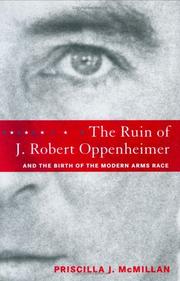
The Ruin of J. Robert Oppenheimer by 6950650|Priscilla McMillan book cover

πŸ“˜ The Ruin of J. Robert Oppenheimer


β˜…β˜…β˜…β˜…β˜…β˜…β˜…β˜…β˜…β˜… 0.0 (0 ratings)
Similar? ✓ Yes 0 ✗ No 0
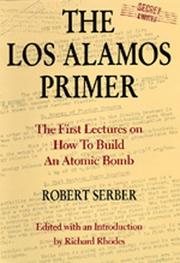
The Los Alamos primer by 8337996|R. Serber book cover

πŸ“˜ The Los Alamos primer
 by R. Serber

The Los Alamos Primer: The First Official Lecture Notes of the Manhattan Project's Founding Fathers

β˜…β˜…β˜…β˜…β˜…β˜…β˜…β˜…β˜…β˜… 0.0 (0 ratings)
Similar? ✓ Yes 0 ✗ No 0
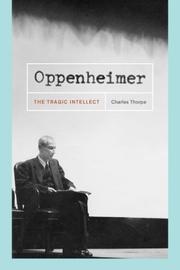
Oppenheimer by 6856902|Charles Thorpe book cover

πŸ“˜ Oppenheimer

At a time when the Manhattan Project was synonymous with large-scale science, physicist J. Robert Oppenheimer (1904–67) represented the new sociocultural power of the American intellectual. Catapulted to fame as director of the Los Alamos atomic weapons laboratory, Oppenheimer occupied a key position in the compact between science and the state that developed out of World War II. By tracing the makingβ€”and unmakingβ€”of Oppenheimer’s wartime and postwar scientific identity, Charles Thorpe illustrates the struggles over the role of the scientist in relation to nuclear weapons, the state, and culture.A stylish intellectual biography, Oppenheimer maps out changes in the roles of scientists and intellectuals in twentieth-century America, ultimately revealing transformations in Oppenheimer’s persona that coincided with changing attitudes toward science in society."This is an outstandingly well-researched book, a pleasure to read and distinguished by the high quality of its observations and judgments. It will be of special interest to scholars of modern history, but non-specialist readers will enjoy the clarity that Thorpe brings to common misunderstandings about his subject."β€”Graham Farmelo, Times Higher Education Supplement"A fascinating new perspective....Thorpe’s book provides the best perspective yet for understanding Oppenheimer’s Los Alamos years, which were critical, after all, not only to his life but, for better or worse, the history of mankind."β€”Catherine Westfall, Nature

β˜…β˜…β˜…β˜…β˜…β˜…β˜…β˜…β˜…β˜… 0.0 (0 ratings)
Similar? ✓ Yes 0 ✗ No 0

Have a similar book in mind? Let others know!

Please login to submit books!