Books like The Future of Capitalism by Paul Collier


First publish date: 2018
Genre: Politics & Government/Public Policy
Authors: Paul Collier
★ ★ ★ ★ ★ 3.0 (2 community ratings)

The Future of Capitalism by Paul Collier

How are these books recommended?

The books recommended for The Future of Capitalism by Paul Collier are shaped by reader interaction. Votes on how closely books relate, user ratings, and community comments all help refine these recommendations and highlight books readers genuinely find similar in theme, ideas, and overall reading experience.


Have you read any of these books?
Your votes, ratings, and comments help improve recommendations and make it easier for other readers to discover books they’ll enjoy.

Books similar to The Future of Capitalism (9 similar books)

The Age of Surveillance Capitalism by 857852|Shoshana Zuboff book cover

πŸ“˜ The Age of Surveillance Capitalism

Shoshana Zuboff explains how digital data is turned into a new market formβ€”surveillance capitalismβ€”where corporations predict and shape behavior for profit, reshaping power, privacy, and democracy in the digital age.

β˜…β˜…β˜…β˜…β˜…β˜…β˜…β˜…β˜…β˜… 3.9 (11 ratings)
Similar? ✓ Yes 0 ✗ No 0
The Great Transformation by 10487479|Karl Polanyi book cover

πŸ“˜ The Great Transformation

Karlβ€―Polanyi’s landmark analysis of the Industrial Revolution’s economic and social impact, exposing how market self‑regulation can lead to harmful social consequences, and reviewing its relevance in today’s globalized world.

β˜…β˜…β˜…β˜…β˜…β˜…β˜…β˜…β˜…β˜… 4.0 (5 ratings)
Similar? ✓ Yes 0 ✗ No 0
The End of Alchemy by 8739182|Mervyn King book cover

πŸ“˜ The End of Alchemy


β˜…β˜…β˜…β˜…β˜…β˜…β˜…β˜…β˜…β˜… 2.0 (1 rating)
Similar? ✓ Yes 0 ✗ No 0
Doughnut economics by 4518191|Kate Raworth book cover

πŸ“˜ Doughnut economics

Raworth sets out seven key ways to fundamentally reframe our understanding of what economics is and does. Along the way, she points out how we can break our addiction to growth; redesign money, finance, and business to be in service to people; and create economies that are regenerative and distributive by design. Named after the now-iconic doughnut? image that Raworth first drew to depict a sweet spot of human prosperity (an image that appealed to the Occupy Movement, the United Nations, eco-activists, and business leaders alike), Doughnut Economics offers a radically new compass for guiding global development, government policy, and corporate strategy, and sets new standards for what economic success looks like.

β˜…β˜…β˜…β˜…β˜…β˜…β˜…β˜…β˜…β˜… 5.0 (1 rating)
Similar? ✓ Yes 0 ✗ No 0
Nobody by 7948075|Marc Lamont Hill book cover

πŸ“˜ Nobody


β˜…β˜…β˜…β˜…β˜…β˜…β˜…β˜…β˜…β˜… 4.0 (1 rating)
Similar? ✓ Yes 0 ✗ No 0
Countdown by 8370179|Alan Weisman book cover

πŸ“˜ Countdown

Alan Weisman’s Countdown asks how many humans Earth can sustain, blending field research with ecological science to chart a path toward a balanced, prosperous future for people and nature.

β˜…β˜…β˜…β˜…β˜…β˜…β˜…β˜…β˜…β˜… 5.0 (1 rating)
Similar? ✓ Yes 0 ✗ No 0
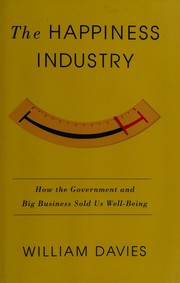
The happiness industry by 11885789|William Davies book cover

πŸ“˜ The happiness industry

"In winter 2014, a Tibetan monk lectured the world leaders gathered at Davos on the importance of Happiness. The recent DSM-5, the manual of all diagnosable mental illnesses, for the first time included shyness and grief as treatable diseases. Happiness has become the biggest idea of our age, a new religion dedicated to well-being. In this brilliant dissection of our times, political economist William Davies shows how this philosophy, first pronounced by Jeremy Bentham in the 1780s, has dominated the political debates that have delivered neoliberalism. From a history of business strategies of how to get the best out of employees, to the increased level of surveillance measuring every aspect of our lives; from why experts prefer to measure the chemical in the brain than ask you how you are feeling, to why Freakonomics tells us less about the way people behave than expected, The Happiness Industry is an essential guide to the marketization of modern life. Davies shows that the science of happiness is less a science than an extension of hyper-capitalism"-- "When Jeremy Bentham proposed that government should run 'for the greatest benefit of the greatest number,' he posed two problems: what is happiness and how can we measure it? With the rise of positive psychology, freakonomics, behavioural economics, endless TED talks, the happiness manifesto, the Happiness Index, the tyranny of customer service, the emergence of the quantified self movement, we have become a culture obsessed with measuring our supposed satisfaction. In anecdotes that include the Buddhist monk who lectured the business leaders of the world at Davos, why the Nike Fuel band makes us more worried about our fitness, how parts of our city are being rebuilt in response to scientific studies of oxytocin levels in our brain, and what a survey from Radisson hotels--that proves that 62% of us believe that well-being is a luxury worth more than work or a good relationship--really tells us about the way we measure ourselves, and continually find ourselves wanting"--

β˜…β˜…β˜…β˜…β˜…β˜…β˜…β˜…β˜…β˜… 4.0 (1 rating)
Similar? ✓ Yes 0 ✗ No 0
The myth of the rational voter by 7061174|Bryan Caplan book cover

πŸ“˜ The myth of the rational voter

"Caplan argues that voters continually elect politicians who either share their biases or else pretend to, resulting in bad policies winning again and again by popular demand. Calling into question our most basic assumptions about American politics, Caplan contends that democracy fails precisely because it does what voters want. Through an analysis of American's voting behavior and opinions on a range of economic issues, he makes the case that noneconomists suffer from four prevailing biases: they underestimate the wisdom of the market mechanism, distrust foreigners, undervalue the benefits of conserving labor, and pessimistically believe the economy is going from bad to worse. Caplan lays out several ways to make democratic government work better."--Provided by publisher.

β˜…β˜…β˜…β˜…β˜…β˜…β˜…β˜…β˜…β˜… 0.0 (0 ratings)
Similar? ✓ Yes 0 ✗ No 0
The road to somewhere by 530033|David Goodhart book cover

πŸ“˜ The road to somewhere

Goodhart examines how economic and cultural openness in the West has benefited some but left others behind, sparking a populist backlash that reshapes political divides and redefines national identity.

β˜…β˜…β˜…β˜…β˜…β˜…β˜…β˜…β˜…β˜… 0.0 (0 ratings)
Similar? ✓ Yes 0 ✗ No 0

Some Other Similar Books

Capital in the Twenty-First Century by Thomas Piketty
The Commons: The New Revolution by Peter Barnes
The Power of Creative Destruction by Philippe Aghion and Peter Howitt
The Rise of the Robots by Martin Ford

Have a similar book in mind? Let others know!

Please login to submit books!