📘
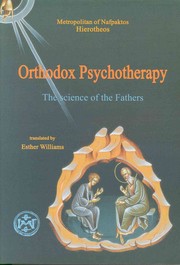
Orthodox Psychotherapy
The book “Orthodox Psychotherapy” (The Science of the Fathers) sets out the teaching of the holy Fathers of the Church on curing the soul.
It has been increasingly established in recent years that Orthodoxy is a therapeutic science. In order for a person to find the health of his soul and really to know God and himself, he must first of all find the place of his heart. “Finding and curing the heart is essentially finding salvation.”
At the beginning of the book, in the chapter “Orthodoxy as a Therapeutic Science”, it is pointed out that Orthodox theology is above all a therapeutic method and treatment for the soul. The Church does not exist in order to serve people’s social needs, but to guide them to the healing of their souls. There is an account of the method for achieving purity of heart, in other words, healing, and it is noted that no cure is possible without God’s mercy and man’s effort.
In the second chapter, “The Orthodox Therapist” there is an analysis of the prerequisites for priest-therapists and their basic qualities. The three degrees of priesthood (deacon, priest, bishop) are very closely connected with the three basic degrees of the spiritual life (purification, illumination and deification). Special emphasis is given to the fact that a fundamental condition for the soul’s healing is the existence of a physician who can heal, in other words, a spiritual father. The difference between remission of sins and the cure of the soul is also underlined. There is a discussion of the value of spiritual priesthood and what it can offer to human society.
By studying the third chapter the reader can ascertain what the Fathers of the Church mean by the terms “nous”, “heart” and “soul”, and what the relationship and difference is between them. The sickness and dying of the soul, the darkening of the nous, and the sickness and dying of the heart are looked at in detail, and it is established that the nous is what defines man’s spiritual condition, and that it is identified with the soul and the heart.
There is an examination of the ways in which the healing of the nous is achieved, then the results of the cure are set out. The Church with its teaching, worship, ascetic practice and sacraments frees the nous and makes it a temple of the Holy Spirit. It is essential for us to realise that man’s cure consists in discovering the energy of the nous and distinguishing it from the energy of reason, because the work of reason is different from the work of the nous. The holy Fathers speak of the unifying of the nous, in other words, the union of nous and heart which is accomplished by the return of the nous to the heart, and they emphasise that, when someone discovers his heart, he literally becomes a person. The distinction between the bodily and spiritual heart is discussed. There is an account of the interpretation given by the Fathers of the terms “warmth”, “contrition of heart”, “pain in the heart” and “leap of the heart”, and of the value of tears in the spiritual life.
Particular attention is given to thoughts and reason. The development of sin starts with thoughts, and our spiritual life or spiritual death depends on our confronting them. There is an analysis of what thoughts are, and what causes provoke them; the consequences of prolonged thoughts, and how a person can be cured of evil and demonic thoughts. Making a god of reason and impassioned thoughts create turmoil in man’s entire spiritual organism. Intense struggle, spiritual watchfulness and constant repentance are required to free someone from the tyranny of thoughts. It is mainly by prayer, but also by obedience to an Orthodox spiritual father, that a person is released from thoughts.
The fourth chapter, “Orthodox Pathology” presents the teaching of the holy Fathers about the passions, which are an unnatural life, and are created by sins which lurk for a long time within us. It describes the causes and development of passions. There is an account
★★★★★★★★★★ 0.0 (0 ratings)
Similar?
✓ Yes
0
✗ No
0