Books like Why Don't Penguins' Feet Freeze? by New Scientist
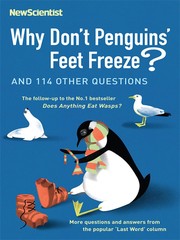

Why Don't Penguins' Feet Freeze? compiles the most engaging responses from New Scientist’s ‘Last Word’ column, celebrating the magazine’s most popular science section. The book offers readers entertaining and enlightening explanations for a wide range of seemingly simple, everyday questions. With fresh answers never before published in book form combined with early favourites from the column’s history, this compilation showcases the blend of humor and rigorous science that has made the column a fan favourite.
First publish date: 2006
Genre: Science/Biology
Authors: New Scientist
3.3 (4 community ratings)

Why Don't Penguins' Feet Freeze? by New Scientist

How are these books recommended?

The books recommended for Why Don't Penguins' Feet Freeze? by New Scientist are shaped by reader interaction. Votes on how closely books relate, user ratings, and community comments all help refine these recommendations and highlight books readers genuinely find similar in theme, ideas, and overall reading experience.


Have you read any of these books?
Your votes, ratings, and comments help improve recommendations and make it easier for other readers to discover books they’ll enjoy.

Books similar to Why Don't Penguins' Feet Freeze? (9 similar books)

A short history of nearly everything by 6500568|Bill Bryson book cover

📘 A short history of nearly everything

Bill Bryson turns the universe into a conversational guide, tracing science from the Big Bang through evolution, geology, chemistry, astronomy, and particle physics with humor and clarity.

4.2 (90 ratings)
Similar? ✓ Yes 0 ✗ No 0
The Immortal Life of Henrietta Lacks by 11086925|Rebecca Skloot book cover

📘 The Immortal Life of Henrietta Lacks

The Immortal Life of Henrietta Lacks follows the story of Henrietta Lacks, a poor black tobacco farmer whose cancer cells were taken in 1951 without her consent and later became the first immortal human cell line, HeLa, driving major scientific breakthroughs while raising questions of ethics, race, and medical exploitation.

4.2 (41 ratings)
Similar? ✓ Yes 0 ✗ No 0
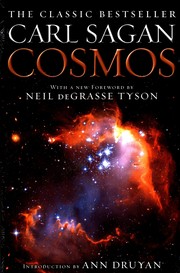
Cosmos by 8799977|Carl Sagan book cover

📘 Cosmos
 by Carl Sagan

Carl Sagan’s Cosmos traces the history of science and the universe’s evolution, from ancient philosophers to modern discoveries, and explores the quest to understand life beyond Earth.

4.6 (12 ratings)
Similar? ✓ Yes 0 ✗ No 0
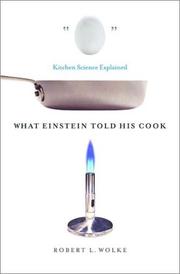
What Einstein Told His Cook by 8855387|Robert L. Wolke book cover

📘 What Einstein Told His Cook


3.5 (2 ratings)
Similar? ✓ Yes 0 ✗ No 0
Paradox by 9722577|Jim Al-Khalili book cover

📘 Paradox


4.0 (1 rating)
Similar? ✓ Yes 0 ✗ No 0
What Einstein Told His Barber by 6995125|Robert Wolke book cover

📘 What Einstein Told His Barber

What makes ice cubes cloudy? How do shark attacks make airplanes safer? Can a person traveling in a car at the speed of sound still hear the radio? Moreover, would they want to...?Do you often find yourself pondering life's little conundrums? Have you ever wondered why the ocean is blue? Or why birds don't get electrocuted when perching on high-voltage power lines? Robert L. Wolke, professor emeritus of chemistry at the University of Pittsburgh and acclaimed author of What Einstein Didn't Know, understands the need to...well, understand. Now he provides more amusing explanations of such everyday phenomena as gravity (If you're in a falling elevator, will jumping at the last instant save your life?) and acoustics (Why does a whip make such a loud cracking noise?), along with amazing facts, belly-up-to-the-bar bets, and mind-blowing reality bites all with his trademark wit and wisdom.If you shoot a bullet into the air, can it kill somebody when it comes down? You can find out about all this and more in an astonishing compendium of the proverbial mind-boggling mysteries of the physical world we inhabit.Arranged in a question-and-answer format and grouped by subject for browsing ease, WHAT EINSTEIN TOLD HIS BARBER is for anyone who ever pondered such things as why colors fade in sunlight, what happens to the rubber from worn-out tires, what makes red-hot objects glow red, and other scientific curiosities. Perfect for fans of Newton's Apple, Jeopardy!, and The Discovery Channel, WHAT EINSTEIN TOLD HIS BARBER also includes a glossary of important scientific buzz words and a comprehensive index. -->From the Trade Paperback edition.

3.0 (1 rating)
Similar? ✓ Yes 0 ✗ No 0
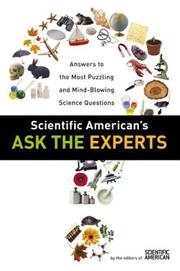
Scientific American's Ask the Experts by 6921607|Editors Of Scientific American book cover

📘 Scientific American's Ask the Experts

Ask the Experts: Puzzling Science Questions Answered

0.0 (0 ratings)
Similar? ✓ Yes 0 ✗ No 0
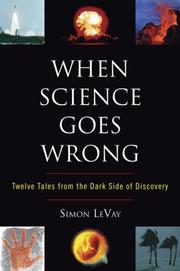
When Science Goes Wrong by 8802959|Simon LeVay book cover

📘 When Science Goes Wrong

Brilliant scientific successes have helped shape our world, and are always celebrated. However, for every victory, there are no doubt numerous little-known blunders. Neuroscientist Simon LeVay brings together a collection of fascinating, yet shocking, stories of failure from recent scientific history in When Science Goes Wrong. From the fields of forensics and microbiology to nuclear physics and meteorology, in When Science Goes Wrong LeVay shares twelve true essays illustrating a variety of ways in which the scientific process can go awry. Failures, disasters and other negative outcomes of science can result not only from bad luck, but from causes including failure to follow appropriate procedures and heed warnings, ethical breaches, quick pressure to obtain results, and even fraud. Often, as LeVay notes, the greatest opportunity for notable mishaps occurs when science serves human ends. LeVay shares these examples: To counteract the onslaught of Parkinson's disease, a patient undergoes cutting-edge brain surgery using fetal transplants, and is later found to have hair and cartilage growing inside his brain. In 1999, NASA's Mars Climate Orbiter spacecraft is lost due to an error in calculation, only months after the agency adopts a policy of "Faster, Better, Cheaper." Britain's Bracknell weather forecasting team predicts two possible outcomes for a potentially violent system, but is pressured into releasing a ‘milder' forecast. The BBC's top weatherman reports there is "no hurricane", while later the storm hits, devastating southeast England. Ignoring signals of an imminent eruption, scientists decide to lead a party to hike into the crater of a dormant volcano in Columbia, causing injury and death. When Science Goes Wrong provides a compelling glimpse into human ambition in scientific pursuit.

0.0 (0 ratings)
Similar? ✓ Yes 0 ✗ No 0
The hidden life of trees by 11759163|Peter Wohlleben book cover

📘 The hidden life of trees

Are trees social beings? Forester and author Peter Wohlleben makes the case that, yes, the forest is a social network. He draws on groundbreaking scientific discoveries to describe how trees are like human families: tree parents live together with their children, communicate with them, support them as they grow, share nutrients with those who are sick or struggling, and even warn each other of impending dangers. Wohlleben also shares his deep love of woods and forests, explaining the amazing processes of life, death, and regeneration he has observed in his woodland.

0.0 (0 ratings)
Similar? ✓ Yes 0 ✗ No 0

Some Other Similar Books

The Science of Everyday Life by David Macaulay
Quiet: The Power of Introverts in a World That Can't Stop Talking by Susan Cain
The Gene: An Intimate History by Siddhartha Mukherjee
Sapiens: A Brief History of Humankind by Yuval Noah Harari
The Body: A Guide for Occupants by Bill Bryson
Why Are The Beads of Dew Still Clinging to the Grass by William F. Wooten

Have a similar book in mind? Let others know!

Please login to submit books!