Books like Amusing Ourselves to Death by Neil Postman


Amusing Ourselves to Death examines how the demands of entertainment reshape politics, journalism, education, and religion, turning complex societal institutions into spectacles. Postman argues that this shift erodes critical discourse and public deliberation. He proposes a strategy for regaining control over media, suggesting reforms that align broadcasting with civic values and educational goals. The book serves as both a warning and a blueprint for using media constructively. In doing so, Postman blends media theory, sociology, and practical policy recommendations to illuminate the profound influence of television and other mass media on cultural and political life.
First publish date: 1985
Genre: Education & Language/Education
Authors: Neil Postman
★ ★ ★ ★ ★ 4.1 (24 community ratings)

Amusing Ourselves to Death by Neil Postman

How are these books recommended?

The books recommended for Amusing Ourselves to Death by Neil Postman are shaped by reader interaction. Votes on how closely books relate, user ratings, and community comments all help refine these recommendations and highlight books readers genuinely find similar in theme, ideas, and overall reading experience.


Have you read any of these books?
Your votes, ratings, and comments help improve recommendations and make it easier for other readers to discover books they’ll enjoy.

Books similar to Amusing Ourselves to Death (23 similar books)

The Age of Surveillance Capitalism by 857852|Shoshana Zuboff book cover

📘 The Age of Surveillance Capitalism

Shoshana Zuboff explains how digital data is turned into a new market form—surveillance capitalism—where corporations predict and shape behavior for profit, reshaping power, privacy, and democracy in the digital age.

★★★★★★★★★★ 3.9 (11 ratings)
Similar? ✓ Yes 0 ✗ No 0
Industrial Society and Its Future by 7439476|Theodore Kaczynski book cover

📘 Industrial Society and Its Future

Industrial Society and Its Future is a manifesto written by Theodore Kaczynski under the pseudonym FC, addressing his opposition to modern society and technology.

★★★★★★★★★★ 4.0 (9 ratings)
Similar? ✓ Yes 0 ✗ No 0
Technopoly by 6536474|Neil Postman book cover

📘 Technopoly

Neil Postman warns of the growing dominance of technology—its impact on politics, intellect, religion, history, privacy, and truth—in his critical examination of the late twentieth‑century “Technopoly.”

★★★★★★★★★★ 3.7 (6 ratings)
Similar? ✓ Yes 0 ✗ No 0
The Information Diet by 12597201|Clay A. Johnson book cover

📘 The Information Diet

A practical handbook for today’s information‑churned consumers, teaching how to manage, filter, and effectively use digital data in the age of the internet and the information superhighway.

★★★★★★★★★★ 3.5 (4 ratings)
Similar? ✓ Yes 0 ✗ No 0
Teaching as a subversive activity by 6536474|Neil Postman book cover

📘 Teaching as a subversive activity

Postman critiques antiquated teaching practices and offers bold, practical reforms to align education with contemporary realities.

★★★★★★★★★★ 2.7 (3 ratings)
Similar? ✓ Yes 0 ✗ No 0
The Assault on Reason by 6951010|Al Gore book cover

📘 The Assault on Reason
 by Al Gore

An analysis of the decline of public reason in American politics and society, focusing on the role of religious fundamentalism and the erosion of democratic values.

★★★★★★★★★★ 3.7 (3 ratings)
Similar? ✓ Yes 0 ✗ No 0
The news by 7549151|Alain De Botton book cover

📘 The news

Alain de Botton examines how everyday news shapes our priorities and emotions, using twenty‑five archetypal stories to show why we react to disasters, celebrity gossip, politics, and distant conflicts the way we do.

★★★★★★★★★★ 3.7 (3 ratings)
Similar? ✓ Yes 0 ✗ No 0
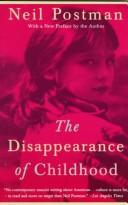
The disappearance of childhood by 6536474|Neil Postman book cover

📘 The disappearance of childhood

Neil Postman contends that television’s pervasive presence in homes exposes children prematurely to adult ideas, undermining their capacity for abstract thought and eroding the very notion of childhood.

★★★★★★★★★★ 3.5 (2 ratings)
Similar? ✓ Yes 0 ✗ No 0
Automation and alienation by 6531756|Jon M. Shepard book cover

📘 Automation and alienation


★★★★★★★★★★ 4.0 (1 rating)
Similar? ✓ Yes 0 ✗ No 0
Conscientious objections by 6536474|Neil Postman book cover

📘 Conscientious objections


★★★★★★★★★★ 2.0 (1 rating)
Similar? ✓ Yes 0 ✗ No 0
Twilight of the Machines by 6129393|John Zerzan book cover

📘 Twilight of the Machines

Anarchist Politics

★★★★★★★★★★ 3.0 (1 rating)
Similar? ✓ Yes 0 ✗ No 0
Building a Bridge to the 18th Century by 6536474|Neil Postman book cover

📘 Building a Bridge to the 18th Century


★★★★★★★★★★ 5.0 (1 rating)
Similar? ✓ Yes 0 ✗ No 0
Dreadful Splendor by 8852383|B. R. Myers book cover

📘 Dreadful Splendor


★★★★★★★★★★ 5.0 (1 rating)
Similar? ✓ Yes 0 ✗ No 0
Magic and loss by 11861480|Virginia Heffernan book cover

📘 Magic and loss

Virginia Heffernan explores how the Internet transforms everyday experiences, revealing both its magical potential and the losses it brings to physical, emotional life.

★★★★★★★★★★ 4.0 (1 rating)
Similar? ✓ Yes 0 ✗ No 0
Our Culture, What's Left of It by 7079716|Theodore Dalrymple book cover

📘 Our Culture, What's Left of It


★★★★★★★★★★ 0.0 (0 ratings)
Similar? ✓ Yes 0 ✗ No 0
The neophiliacs by 7718041|Christopher Booker book cover

📘 The neophiliacs


★★★★★★★★★★ 0.0 (0 ratings)
Similar? ✓ Yes 0 ✗ No 0
The soft revolution by 6536474|Neil Postman book cover

📘 The soft revolution


★★★★★★★★★★ 0.0 (0 ratings)
Similar? ✓ Yes 0 ✗ No 0
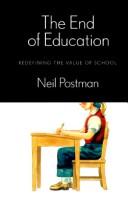
The end of education by 6536474|Neil Postman book cover

📘 The end of education

In this brilliantly challenging response to the education crisis, Neil Postman returns to the subject that established his reputation as one of our most insightful social critics. Starting from his belief that schooling is now too often a trivial pursuit, a mechanical exercise, he argues with stunning clarity that we have lost sight of the inherent value and substance of learning, and sets out to restore it for our time. Postman begins by portraying the American education of an earlier part of this century, when we knew what schools were for - to create a coherent, stable, unified culture out of a people of diverse traditions, languages, and religions. Shifting his focus to contemporary education, Postman outlines the markedly different narratives, or "gods," that underlie our present conception of school, and shows how poorly they serve us. The new gods are economic utility (education only as a means to a good-paying job), consumership (the belief that you are what you accumulate), technology (a reliance on mechanical solutions, not critical judgment), and separatism ("multicultural" instincts that split groups off from a unifying cultural pluralism). In describing how education may reasonably and creatively respond to - or redefine - these problems of modernity, the author presents useful narratives to help schools recover a sense of purpose, tolerance, and respect for learning. These include the Spaceship Earth (preserving the earth as a unifying theme), the Fallen Angel (learning driven not by absolute answers but by an understanding that our knowledge is imperfect), the American Experiment (emphasizing the successes and the failures of our evolving nation), the Law of Diversity (exposure to all cultures in their strengths and their weaknesses), and Word Weavers (the fundamental importance of language in forging our common humanity). Postman's The End of Education heralds a new beginning. It seeks to provide solutions while provoking debate. Postman offers a redefinition of the end of education - the essential first step before we rethink and freshly determine the means.

★★★★★★★★★★ 0.0 (0 ratings)
Similar? ✓ Yes 0 ✗ No 0
Orwell's revenge by 6848006|Peter W. Huber book cover

📘 Orwell's revenge


★★★★★★★★★★ 0.0 (0 ratings)
Similar? ✓ Yes 0 ✗ No 0
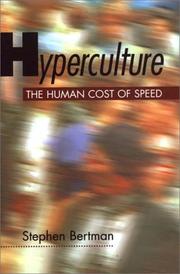
Hyperculture by 8314187|Stephen Bertman book cover

📘 Hyperculture

The rampant illnesses of our society - including the disintegration of the family, the degradation of the environment, unlimited commercialism, and unrelenting stress - are familiar to us all. For the first time, Stephen Bertman attempts to explain these disparate, overwhelmingly negative phenomena with a single, unifying principle: that the accelerated pace of American society is eroding the essence of our most fundamental values. We live, according to Bertman, in a society ruled by the "power of now," a power that gives us instant gratification even as it demands our instantaneous obedience. As a result, we have adapted our lives and values to match the speed-of-light electronic technologies that surround us. But, in so doing, we have paid a high price in spirit and mind. Hyperculture dares to suggest that the cure for our condition lies not in an "information superhighway" or "third wave information revolution," but in the radical and painful process of decelerating our lives enough to reclaim them.

★★★★★★★★★★ 0.0 (0 ratings)
Similar? ✓ Yes 0 ✗ No 0
Industrial Society and Its Future by 1183340|El Camino book cover

📘 Industrial Society and Its Future
 by El Camino


★★★★★★★★★★ 0.0 (0 ratings)
Similar? ✓ Yes 0 ✗ No 0
The I. F. Stone's weekly reader by 13794344|I. F. Stone book cover

📘 The I. F. Stone's weekly reader

The first issue of the paper appeared on January 17, 1953 in Washington, D. C. during the height of the "McCarthy era" and became a bi-weekly in 1968, closing down in December 1971.

★★★★★★★★★★ 0.0 (0 ratings)
Similar? ✓ Yes 0 ✗ No 0

Some Other Similar Books

Technopoly: The Surrender of Culture to Technology by Neil Postman
The Shallows: What the Internet Is Doing to Our Brains by Nicholas Carr
Reclaiming Conversation: The Power of Talk in a Digital Age by Sherry Turkle
The Culture of Confinement: Crime and Punishment in America by Martha C. Nussbaum
Alone Together: Why We Expect More from Technology and Less from Each Other by Sherry Turkle
The Distraction Addiction: Changing Conoursions for an Internet Addiction by Alex Soojung-Kim Pang
Cybercivilization by Gregory Ulmer
Digital Minimalism: Choosing a Focused Life in a Noisy World by Cal Newport
The Present Future: Six Tough Questions for the Church by Reinhard Bonnke

Have a similar book in mind? Let others know!

Please login to submit books!