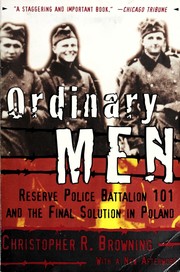
Ordinary Men
Browning’s book reveals how ordinary middle‑aged Germans of Reserve Police Battalion 101 became silent mass murderers during the Holocaust.
Is this book similar?
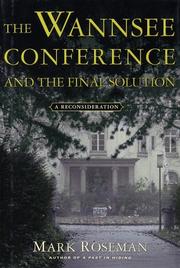
Books like this one
The historical roots of policies that led to the deaths of millions are traced in this thoughtful examination of the Nazis' businesslike planning of genocide at the notorious 1942 conference. But the path to Wannsee may have been less direct than is commonly thought, argues Roseman (History/Univ. of Southampton; A Past in Hiding, 2001). Although Adolf Hitler's violent anti-Semitic outpourings in Mein Kampf (1924) might suggest that the Nazi destruction of European Jewry was the culmination of a methodically blueprinted plan conceived long before the start of WWII, Roseman dismisses the book’s talk of Jewish “extermination” as overheated rhetoric. Initially, he points out, Hitler encouraged Jewish emigration through terror and viciously discriminatory legal measures; later, the Führer discussed a possible Jewish colony in Africa. After the war began, the Nazis pursued a program of deporting German, Polish, and Soviet Jews that turned increasingly murderous and gradually widened under the pressures of total war into a policy of mass murder. By January 20, 1942, when police chief Reinhard Heydrich and his colleagues from a variety of Nazi agencies gathered at Wannsee, the decision had already been made, either by Hitler himself or by others with his knowledge, to pursue a “final solution” to “the Jewish question.” The role of conference participants, Roseman speculates, was essentially “to listen and to nod” as Heydrich described a macabre plan to work Jews to death and kill off any survivors. Heydrich’s principal goal, Roseman asserts, was to establish the primacy of his secret police over the Reich's Jewish policies and to ensure the complicity of other bureaucrats. Heydrich got much of what he wanted; after the meeting he commenced implementing the horrific policy outlined at Wannsee, confident that other Nazis would give his agency a free hand. “Wannsee itself was not the moment of decision,” Roseman concludes, but it “cleared the way for genocide.” A chilling keyhole glimpse of Nazi evil’s bureaucratic banality.
Discover your next read
Compare books other readers have recommended. Vote to help improve these suggestions.
Looking for more books like The Wannsee Conference and the Final Solution by Mark Roseman? This list brings together suggested alternatives and feedback from SimilarBooks readers. Ratings reflect what readers think of each individual book, while the Yes and No votes show whether visitors consider it a good match for this title. Compare the recommendations below and suggest another book to help fellow readers discover their next read.
Browning’s book reveals how ordinary middle‑aged Germans of Reserve Police Battalion 101 became silent mass murderers during the Holocaust.
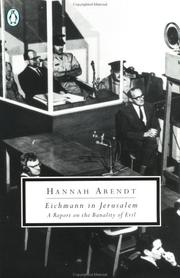
Hannah Arendt’s political analysis of Adolf Eichmann’s 1961–1962 Jerusalem trial, exploring the nature of evil, antisemitism, and Holocaust crime...

Schindler's List is a fictional account of German industrialist Oskar Schindler who saved 1,300 Jews from the Holocaust.
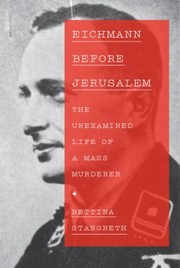

"Schindler is best known for saving over a thousand Jews by putting them on the famed "Schindler's List" and then transferring them to his factor...

World War, 1939-1945, Holocaust, Jewish (1939-1945), Genocide, War criminals, Berlin (Germany)
Community ratings describe each book independently. Similarity votes measure whether readers consider a recommendation a good match for this particular title; results can change as more visitors share feedback.
Suggest another book below, or vote Yes or No on any existing recommendation.
Share your suggestion →Readers make discovery better
Share a recommendation and help other readers discover their next great read.