Books like Dying in the City of the Blues by Keith Wailoo
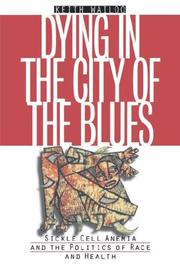

"Set in Memphis, home of one of the nation's first sickle cell clinics, Dying in the City of the Blues reveals how the recognition, treatment, social understanding, and symbolism of the disease evolved in the twentieth century, shaped by the politics of race, region, health care, and biomedicine. Using medical journals, patients' accounts, black newspapers, blues lyrics, and many other sources, Keith Wailoo follows the disease and its sufferers from the early days of obscurity before sickle cell's "discovery" by Western medicine; through its rise to clinical, scientific, and social prominence in the 1950s; to its politicization in the 1970s and 1980s. Looking forward, he considers the consequences of managed care on the politics of disease in the twenty-first century.". "Dying in the City of the Blues offers valuable new insight into the African American experience, the impact of race relations and ideologies on health care, and the politics of science, medicine, and disease."--BOOK JACKET.
First publish date: December 2, 2000
Authors: Keith Wailoo
★ ★ ★ ★ ★ 0.0 (0 community ratings)

Dying in the City of the Blues by Keith Wailoo

How are these books recommended?

The books recommended for Dying in the City of the Blues by Keith Wailoo are shaped by reader interaction. Votes on how closely books relate, user ratings, and community comments all help refine these recommendations and highlight books readers genuinely find similar in theme, ideas, and overall reading experience.


Have you read any of these books?
Your votes, ratings, and comments help improve recommendations and make it easier for other readers to discover books they’ll enjoy.

Books similar to Dying in the City of the Blues (7 similar books)
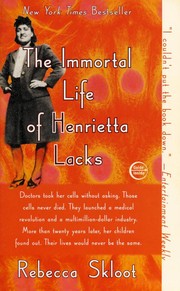
The Immortal Life of Henrietta Lacks by 11086925|Rebecca Skloot book cover

πŸ“˜ The Immortal Life of Henrietta Lacks

The Immortal Life of Henrietta Lacks follows the story of Henrietta Lacks, a poor black tobacco farmer whose cancer cells were taken in 1951 without her consent and later became the first immortal human cell line, HeLa, driving major scientific breakthroughs while raising questions of ethics, race, and medical exploitation.

β˜…β˜…β˜…β˜…β˜…β˜…β˜…β˜…β˜…β˜… 4.2 (41 ratings)
Similar? ✓ Yes 0 ✗ No 0
Roll of Thunder, Hear My Cry by 7101850|Mildred D. Taylor book cover

πŸ“˜ Roll of Thunder, Hear My Cry

A powerful story of a Black family's battle for dignity, family, and land in Depression‑era Mississippi, seen through the eyes of eight‑year‑old Cassie Logan.

β˜…β˜…β˜…β˜…β˜…β˜…β˜…β˜…β˜…β˜… 4.1 (29 ratings)
Similar? ✓ Yes 0 ✗ No 0
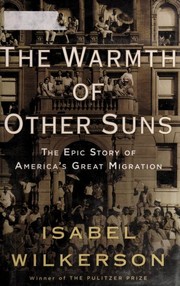
The Warmth of Other Suns by 7877632|Isabel Wilkerson book cover

πŸ“˜ The Warmth of Other Suns

The Warmth of Other Suns is a non‑fiction study of the Great Migration, tracing the journey of nearly six million African Americans from the South to northern and western cities between 1915 and 1970.

β˜…β˜…β˜…β˜…β˜…β˜…β˜…β˜…β˜…β˜… 4.4 (9 ratings)
Similar? ✓ Yes 0 ✗ No 0
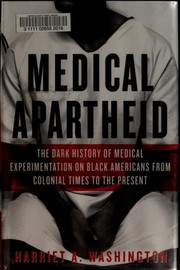
Medical apartheid by 4722915|Harriet A. Washington book cover

πŸ“˜ Medical apartheid

Harriet A. Washington’s groundbreaking history exposes how African Americans have been systematically used as unwitting subjects in medical research from slavery to today, revealing the roots of mistrust and health disparities.

β˜…β˜…β˜…β˜…β˜…β˜…β˜…β˜…β˜…β˜… 4.5 (2 ratings)
Similar? ✓ Yes 0 ✗ No 0
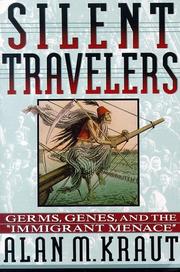
Silent travelers by 10200666|Alan M. Kraut book cover

πŸ“˜ Silent travelers

Epidemics and immigrants have suffered a lethal association in the public mind, from the Irish in New York wrongly blamed for the cholera epidemic of 1832 and Chinese in San Francisco vilified for causing the bubonic plague in 1900, to Haitians in Miami stigmatized as AIDS carriers in the 1980s. Silent Travelers vividly describes these and many other episodes of medicalized prejudice and analyzes their impact on public health policy and beyond. The book shows clearly how the equation of disease with outsiders and illness with genetic inferiority broadly affected not only immigration policy and health care but even the workplace and schools. The first synthesis of immigration history and the history of medicine, Silent Travelers is also a deeply human story, enriched by the voices of immigrants themselves. Irish, Italian, Jewish, Latino, Chinese, and Cambodian newcomers among others grapple in these pages with the mysteries of modern medicine and American prejudice. Anecdotes about famous and little-known figures in the annals of public health abound, from immigrant physicians such as Maurice Fishberg and Antonio Stella who struggled to mediate between the cherished Old World beliefs and practices of their patients and their own state-of-the-art medical science, to "Typhoid Mary" and the inspiring example of Mother Cabrini. Alan M. Kraut tells of the newcomers founding of hospitals to care for their own the "Halls of Great Peace" (actually little more than hovels where lepers could go to die) set up by Chinese immigrants; the establishment of St. Vincent's Hospital in New York as an institution sensitive to the needs of Catholic patients; and the creation of a tuberculosis sanitarium in Denver by Eastern European Jewish tradespeople who managed to scrape together $1.20 in contributions at their first meeting. Tapping into a rich array of sources - from turn-of-the-century government records to an advice book aimed at Italians financed by the DAR, from the photographs of Jacob Riis to the records of insurance companies and visiting nurse services, as well as poems, songs, stories, and letters of patients - this book evokes an intimate sense of the poignancy of the immigrant odyssey. Amid growing concern over using AIDS to exclude immigrants and ongoing debates about multi-culturalism, this look at how earlier generations struggled with such problems is especially valuable.

β˜…β˜…β˜…β˜…β˜…β˜…β˜…β˜…β˜…β˜… 4.0 (1 rating)
Similar? ✓ Yes 0 ✗ No 0
Just medicine by 11954227|Dayna Bowen Matthew book cover

πŸ“˜ Just medicine

"Over 84,000 black and brown lives are needlessly lost each year due to health disparities, the unfair, unjust, and avoidable differences between the quality and quantity of health care provided to Americans who are members of racial and ethnic minorities and care provided to whites. Health disparities have remained stubbornly entrenched in the American health care system--and in Just Medicine, Dayna Bowen Matthew finds that they principally arise from unconscious racial and ethnic biases held by physicians, institutional providers, and their patients. Implicit bias is the single most important determinant of health and health care disparities. Because we have missed this fact, the money we spend on training providers to become culturally competent, expanding wellness education programs and community health centers, and even expanding access to health insurance will have only a modest effect on reducing health disparities. We will continue to utterly fail in the effort to eradicate health disparities unless we enact strong, evidence-based legal remedies that accurately address implicit and unintentional forms of discrimination, to replace the weak, tepid, and largely irrelevant legal remedies currently available. Our continued failure to fashion an effective response that purges the effects of implicit bias from American health care, Matthew argues, is unjust and morally untenable. In this book, she unites medical, neuroscience, psychology, and sociology research on implicit bias and health disparities with her own expertise in civil rights and constitutional law. Just Medicine offers us a new, effective, and innovative plan to regulate implicit biases and eliminate the inequalities they cause, and to save the lives they endanger."--

β˜…β˜…β˜…β˜…β˜…β˜…β˜…β˜…β˜…β˜… 0.0 (0 ratings)
Similar? ✓ Yes 0 ✗ No 0
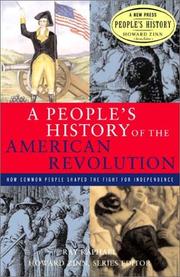
A people's history of the American Revolution by 11501602|Ray Raphael book cover

πŸ“˜ A people's history of the American Revolution

Raphael explains the central purpose of his "people's history" thusly: "By uncovering the stories of farmers, artisans, and laborers, we discern how plain folk helped create a revolution strong enough to evict the British Empire from the thirteen colonies. And by digging deeper still, we learn how people with no political standing -- women, Native Americans, African Americans -- altered the shape of a war conceived by others." After carefully reconstructing the histories of all these groups, he concludes: "The story of our nation's founding, told so often from the perspective of the 'founding fathers,' will never ring true unless it can take some account of the Massachusetts farmers who closed the courts, the poor men and boys who fought the battles, the women who followed the troops, the loyalists who viewed themselves as rebels, the pacifists who refused to sign oaths of allegiance, the Native Americans who struggled for their own independence, the southern slaves who fled to the British, the northern slaves who negotiated their freedom by joining the Continental Army". Raphael's account rings true: these people made the American Revolution. - Marcus Rediker, University of Pittsburgh.

β˜…β˜…β˜…β˜…β˜…β˜…β˜…β˜…β˜…β˜… 0.0 (0 ratings)
Similar? ✓ Yes 0 ✗ No 0

Some Other Similar Books

Medical Bondage: Race, Gender, and the Origins of American Gynecology by Dea Boster
Fatal Medicine by Paul S. S. Lee
Health Justice Now by Vineet Chopra and Carolyn M. Clancy
Medicalizing Blackness by Lara R. Markowitz

Have a similar book in mind? Let others know!

Please login to submit books!