
Leninism under Lenin
In this comprehensive and dynamic Deutscher Prize winning work, Liebman rises about the dogmatism and sterility that plague most appraisals of Le...
Is this book similar?
Books like this one
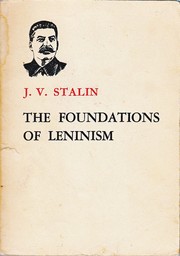
The book describes the theory and the tactics of Leninism. Not the basis of Marxism on which it relies, but the new developments of Leninism. Stalin denies that Leninism is a purely Russian phenomenon or just the application of Marxism to Russian conditions, instead explains how Leninism is the response of the proletarian movement to imperialism, which hadn't yet developed in Marx's and Engels's time. While he notes Lenin's fight against the revisionists of the II. International, he also denies that Lenin only revived revolutionary Marxism. He emphasizes Leninism as a step forward, an advancement of Marxism. In the first chapter — "Historical Roots of Leninism" — he summarizes the contradictions of imperialism and explains how the Leninist movement could form in Russia despite it not being a classical imperialist country. This is because Russia was the centre of all kinds of oppression: the Russian people were exploited both by capitalism and by their tsar, while Russia itself, allied with the western imperialists, conquered and oppressed other regions. The western imperialists also had a great interest in Russian ressources, so they would intervene in any fight against these conditions. This is why the Russian Revolution could only be an anti-imperialist revolution. In the second chapter, Stalin explains the methods of Leninism and how they are different from those of the II. International. These methods are: unity of theory and practice, as opposed to only theoretical dogmas of the II. International; winning the trust of the proletariat with actions, not with slogans; preparing the masses and the party for a proletarian revolution; self-criticism inside the party. He continues with Marx's and Lenin's refutal of some dogmas of the II. International, adding some practical examples from the experience of the Russian Revolution. Also, he provides some examples to the statement that the II. International and Kautsky were treacherous and opportunist. The author proceeds to explain the Leninist theory. First, he denies that Leninists don't care about theory, only about practice. While he agrees that theory is worthless without practice, he states that practice is also blind without theory. He quotes Lenin on the statement that a revolutionary movement can't exist without revolutionary theory and that only a party led by the most advanced theory can have the role of a vanguard fighter. The second sector of the chapter on theory criticizes the theory of spontaneity, which is against an organized party leading the working class. The third chapter then explains the opposite, Lenin's theory of proletarian revolution. Stalin analyses the question of where the revolution can start: not in the countries with most developed industry, not where there are the most proletarians, not where there is more democracy, but where imperialism is the weakest. So it is also possible for the revolution to happen in countries which don't have a very developed industry. He denies that the communist revolution has to happen some time after the bourgeois revolution, instead explaining that the bourgeois revolution can transform into a proletarian one. He explains that Lenin was not opposed to a "permanent revolution" because of its continuity, but because its supporters underestimated the role of the peasantry, a significant force for completely liquidating the remains of feudalism. Also, the "permanentists" distorted Marx's theory of permanent revolution, making it practically useless. Then, he explains why it is possible for the revolution to be victorious in one country and what conditions are necessary for that. The fourth chapter is about the dictatorship of the proletariat. Stalin emphasizes that it is not enough to just seize the power, that it is also necessary to solidify it afterwards. Because the bourgeoisie, even if it was overthrown, still has great advantages over the proletariat, which it will use against the new system, like money, better
Discover your next read
Compare books other readers have recommended. Vote to help improve these suggestions.
Looking for more books like The Foundations of Leninism by Joseph Stalin? This list brings together suggested alternatives and feedback from SimilarBooks readers. Ratings reflect what readers think of each individual book, while the Yes and No votes show whether visitors consider it a good match for this title. Compare the recommendations below and suggest another book to help fellow readers discover their next read.
In this comprehensive and dynamic Deutscher Prize winning work, Liebman rises about the dogmatism and sterility that plague most appraisals of Le...
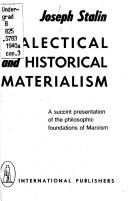
**Dialectical and Historical Materialism** (Russian: О диалектическом и историческом материализме), by Joseph Stalin, is a central text within th...


Communism, Kommunisticheskai︠a︡ partii︠a︡ Sovetskogo Soi︠u︡za
Community ratings describe each book independently. Similarity votes measure whether readers consider a recommendation a good match for this particular title; results can change as more visitors share feedback.
Suggest another book below, or vote Yes or No on any existing recommendation.
Share your suggestion →Readers make discovery better
Share a recommendation and help other readers discover their next great read.