Books like A theory of justice by John Rawls
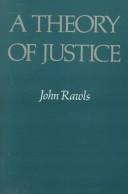

In A Theory of Justice, John Rawls presents a comprehensive framework for justice, arguing that free and rational individuals would agree on certain principles if they were unaware of their own social position, wealth, or abilities.\n\nRawls introduces the "veil of ignorance" to eliminate personal bias, leading to fair decisions about rights, duties, and distributive arrangements. He critically examines common objections, especially utilitarianism, and applies his theory to constitutional liberties, distributive justice, and the limits of political duty. The book also tackles civil disobedience, conscientious objection, and explores how his concepts of justice intertwine with moral development and the idea of society as a union of social unions.\n\nSince its original publication in 1971, the work has remained central to contemporary political philosophy, taught worldwide and translated into twenty-four languages. This revised edition reflects significant updates Rawls considered important, particularly concerning liberty and primary social goods.
First publish date: 1971
Genre: Politics & Government/Political Theory
Authors: John Rawls
★ ★ ★ ★ ★ 4.7 (6 community ratings)

A theory of justice by John Rawls

How are these books recommended?

The books recommended for A theory of justice by John Rawls are shaped by reader interaction. Votes on how closely books relate, user ratings, and community comments all help refine these recommendations and highlight books readers genuinely find similar in theme, ideas, and overall reading experience.


Have you read any of these books?
Your votes, ratings, and comments help improve recommendations and make it easier for other readers to discover books they’ll enjoy.

Books similar to A theory of justice (7 similar books)
Justice by 6500747|Michael J. Sandel book cover

πŸ“˜ Justice

Michael Sandel’s book examines justice through contemporary controversiesβ€”affirmative action, same‑sex marriage, abortion, and the moral limits of marketsβ€”offering a reflective and lyrical analysis of fairness in modern society.

β˜…β˜…β˜…β˜…β˜…β˜…β˜…β˜…β˜…β˜… 4.0 (10 ratings)
Similar? ✓ Yes 0 ✗ No 0
Anarchy, State, and Utopia by 9707513|Robert Nozick book cover

πŸ“˜ Anarchy, State, and Utopia

Robert Nozick’s 1974 classic argues for a minimal state limited to protecting citizens from force, theft, fraud, and enforcing contracts, contending that any expansion beyond this harms individual rights.

β˜…β˜…β˜…β˜…β˜…β˜…β˜…β˜…β˜…β˜… 4.0 (6 ratings)
Similar? ✓ Yes 0 ✗ No 0
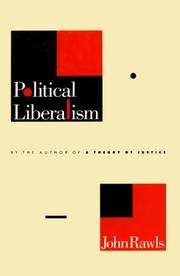
Political liberalism by 7044106|John Rawls book cover

πŸ“˜ Political liberalism
 by John Rawls

In Political Liberalism John Rawls continues and revises the idea of justice as fairness he presented in A Theory of Justice, but changes its philosophical interpretation in a fundamental way. His earlier work assumed what Rawls calls a "well-ordered society," one that is stable, relatively homogenous in its basic moral beliefs, and in which there is broad agreement about what constitutes the good life. Yet in modern democratic society a plurality of incompatible and irreconcilable doctrines - religious, philosophical, and moral - coexist within the framework of democratic institutions. Indeed, free institutions themselves encourage this plurality of doctrines as the normal outgrowth of freedom over time. Recognizing this as a permanent condition of democracy, Rawls therefore asks, how can a stable and just society of free and equal citizens live in concord when deeply divided by these reasonable, but incompatible, doctrines? His answer is based on a redefinition of a "well-ordered society." It is no longer a society united in its basic moral beliefs but in its political conception of justice, and this justice is the focus of an overlapping consensus of reasonable comprehensive doctrines. Justice as fairness is now presented as an example of such a political conception; that it can be the focus of an overlapping consensus means that it can be endorsed by the main religious, philosophical, and moral doctrines that endure over time in a well-ordered society. Such a consensus, Rawls believes, represents the most likely basis of society unity available in a constitutional democratic regime. Were it achieved, it would extend and complete the movement of thought that began three centuries ago with the gradual if reluctant acceptance of the principle of toleration. This process would end with the full acceptance and understanding of modern liberties.

β˜…β˜…β˜…β˜…β˜…β˜…β˜…β˜…β˜…β˜… 2.0 (1 rating)
Similar? ✓ Yes 0 ✗ No 0
The idea of justice by 7279350|Amartya Sen book cover

πŸ“˜ The idea of justice

Presents an analysis of what justice is, the transcendental theory of justice and its drawbacks, and a persuasive argument for a comparative perspective on justice that can guide us in the choice between alternatives.

β˜…β˜…β˜…β˜…β˜…β˜…β˜…β˜…β˜…β˜… 0.0 (0 ratings)
Similar? ✓ Yes 0 ✗ No 0
Whose justice? Which rationality? by 6248380|Alasdair C. MacIntyre book cover

πŸ“˜ Whose justice? Which rationality?

Is there any cause or war worth risking one's life for? How can we determine which actions are vices and which virtues? MacIntyre, professor of philosophy at Vanderbilt University, unravels these and other such questions by linking the concept of justice to what he calls practical rationality. He rejects the grab-what-you-can, utilitarian yardstick adopted by moral relativists. Instead, he argues that four wholly different, incompatible ideas of justice put forth by Aristotle, Augustine, Aquinas and Hume have helped shape our modern individualistic world. In his unorthodox view, each person seeks the good through an ongoing dialogue with one of these traditions or within Jewish, non-Western or other historical traditions. This weighty sequel to After Virtue (1981) is certain to stir debate.

β˜…β˜…β˜…β˜…β˜…β˜…β˜…β˜…β˜…β˜… 0.0 (0 ratings)
Similar? ✓ Yes 0 ✗ No 0
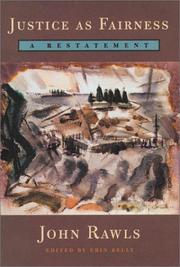
Justice as Fairness by 7044106|John Rawls book cover

πŸ“˜ Justice as Fairness
 by John Rawls

This book originated as lectures for a course on political philosophy that Rawls taught regularly at Harvard in the 1980s. In time the lectures became a restatement of his theory of justice as fairness, revised in light of his more recent papers and his treatise Political Liberalism (1993). Rawls offers a broad overview of his main lines of thought and also explores specific issues never before addressed in any of his writings. He is well aware that since the publication of A Theory of Justice in 1971, American society has moved farther away from the idea of justice as fairness. Yet his ideas retain their power and relevance to debates in a pluralistic society about the meaning and theoretical viability of liberalism. This book demonstrates that moral clarity can be achieved even when a collective commitment to justice is uncertain

β˜…β˜…β˜…β˜…β˜…β˜…β˜…β˜…β˜…β˜… 0.0 (0 ratings)
Similar? ✓ Yes 0 ✗ No 0
Liberalism and the Limits of Justice by 6500747|Michael J. Sandel book cover

πŸ“˜ Liberalism and the Limits of Justice

See work: https://openlibrary.org/works/OL1810924W

β˜…β˜…β˜…β˜…β˜…β˜…β˜…β˜…β˜…β˜… 0.0 (0 ratings)
Similar? ✓ Yes 0 ✗ No 0

Some Other Similar Books

Justice as Fairness: A Restatement by John Rawls
The Foundations of Justice: Volume 1 by Amartya Sen
Communitarianism and Its Critics by Michael Sandel
The Theory of Justice: An Examination by Ian Shapiro
Liberty, Equality, Fraternity: Exploring the Foundations of Liberal Ideals by Gopal Balakrishnan
Equality and Liberty by Brian Barry
The Concept of Justice by David W. Masingill

Have a similar book in mind? Let others know!

Please login to submit books!