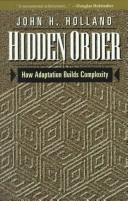
Books like Hidden Order by John H. Holland

First publish date: 1996
Authors: John H. Holland
★ ★ ★ ★ ★ 4.0 (1 community ratings)

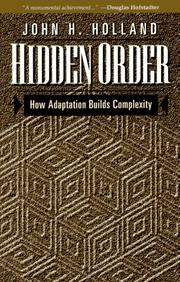
Hidden Order by John H. Holland

How are these books recommended?

The books recommended for Hidden Order by John H. Holland are shaped by reader interaction. Votes on how closely books relate, user ratings, and community comments all help refine these recommendations and highlight books readers genuinely find similar in theme, ideas, and overall reading experience.


Have you read any of these books?
Your votes, ratings, and comments help improve recommendations and make it easier for other readers to discover books they’ll enjoy.

Books similar to Hidden Order (3 similar books)
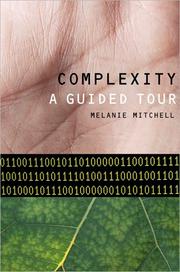
Complexity: A Guided Tour by 8776148|Melanie Mitchell book cover

πŸ“˜ Complexity: A Guided Tour


β˜…β˜…β˜…β˜…β˜…β˜…β˜…β˜…β˜…β˜… 4.3 (3 ratings)
Similar? ✓ Yes 0 ✗ No 0
Hidden order by 8259403|Holland, John H. book cover

πŸ“˜ Hidden order

John H. Holland’s 1985 classic synthesizes complex adaptive systems, proposing general principles and a versatile computer model, while outlining paths to deepen theoretical understanding and address real‑world challenges.

β˜…β˜…β˜…β˜…β˜…β˜…β˜…β˜…β˜…β˜… 0.0 (0 ratings)
Similar? ✓ Yes 0 ✗ No 0
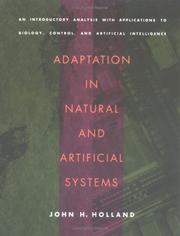
Adaptation in natural and artificial systems by 8259403|Holland, John H. book cover

πŸ“˜ Adaptation in natural and artificial systems

Genetic algorithms are playing an increasingly important role in studies of complex adaptive systems, ranging from adaptive agents in economic theory to the use of machine learning techniques in the design of complex devices such as aircraft turbines and integrated circuits. Adaptation in Natural and Artificial Systems is the book that initiated this field of study, presenting the theoretical foundations and exploring applications. In its most familiar form, adaptation is a biological process, whereby organisms evolve by rearranging genetic material to survive in environments confronting them. In this now classic work, Holland presents a mathematical model that allows for the nonlinearity of such complex interactions. He demonstrates the model's universality by applying it to economics, physiological psychology, game theory, and artificial intelligence and then outlines the way in which this approach modifies the traditional views of mathematical genetics. Initially applying his concepts to simply defined artificial systems with limited numbers of parameters, Holland goes on to explore their use in the study of a wide range of complex, naturally occuring processes, concentrating on systems having multiple factors that interact in nonlinear ways. Along the way he accounts for major effects of coadaptation and coevolution: the emergence of building blocks, or schemata, that are recombined and passed on to succeeding generations to provide, innovations and improvements. -- Publisher description.

β˜…β˜…β˜…β˜…β˜…β˜…β˜…β˜…β˜…β˜… 0.0 (0 ratings)
Similar? ✓ Yes 0 ✗ No 0

Some Other Similar Books

Adaptive Agents and Multi-Agent Systems by Kate Devlin
The Self-Organizing Universe: Scientific & Human Implications by Ben W. McNeill
Sync: How Order Emerges from Chaos in the Universe, Nature, and Daily Life by Steven Strogatz
Emergence: The Connected Lives of Ants, Brains, Cities, and Software by Steven Johnson
Order Out of Chaos: Man's New Dialogue with Nature by Ilya Prigogine and Isabelle Stengers
Complex Adaptive Systems: An Introduction to Computational Models of Social Life by John H. Miller and Scott E. Page
The Recursive Universe: Cosmic Complexity and the Limits of Scientific Knowledge by William Poundstone
Hidden Order: How Adaptation Builds Complexity by Walter J. Freeman
Order and Chaos in Dynamical Systems by J. M. T. Thompson and H. B. Stewart

Have a similar book in mind? Let others know!

Please login to submit books!