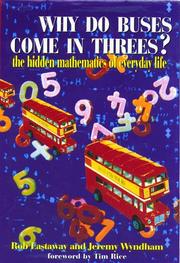
Why do buses come in threes?
Eastaway invites readers to discover how simple arithmetic patterns and geometry reveal hidden order in everyday life, from the way buses queue t...
Is this book similar?
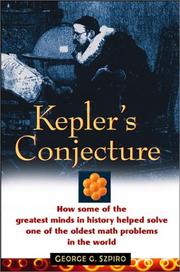
Books like this one
The fascinating story of a problem that perplexed mathematicians for nearly 400 years In 1611, Johannes Kepler proposed that the best way to pack spheres as densely as possible was to pile them up in the same way that grocers stack oranges or tomatoes. This proposition, known as Kepler's Conjecture, seemed obvious to everyone except mathematicians, who seldom take anyone's word for anything. In the tradition of Fermat's Enigma, George Szpiro shows how the problem engaged and stymied many men of genius over the centuries--Sir Walter Raleigh, astronomer Tycho Brahe, Sir Isaac Newton, mathematicians C. F. Gauss and David Hilbert, and R. Buckminster Fuller, to name a few--until Thomas Hales of the University of Michigan submitted what seems to be a definitive proof in 1998. George G. Szpiro (Jerusalem, Israel) is a mathematician turned journalist. He is currently the Israel correspondent for the Swiss daily Neue Zurcher Zeitung.
Discover your next read
Compare books other readers have recommended. Vote to help improve these suggestions.
Looking for more books like Kepler's Conjecture by George G. Szpiro? This list brings together suggested alternatives and feedback from SimilarBooks readers. Ratings reflect what readers think of each individual book, while the Yes and No votes show whether visitors consider it a good match for this title. Compare the recommendations below and suggest another book to help fellow readers discover their next read.
Eastaway invites readers to discover how simple arithmetic patterns and geometry reveal hidden order in everyday life, from the way buses queue t...
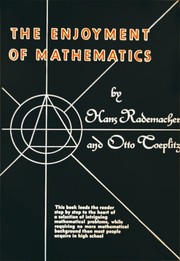
Popular works, Mathematics, Nonfiction, Reference, Essays
Community ratings describe each book independently. Similarity votes measure whether readers consider a recommendation a good match for this particular title; results can change as more visitors share feedback.
Suggest another book below, or vote Yes or No on any existing recommendation.
Share your suggestion →Readers make discovery better
Share a recommendation and help other readers discover their next great read.