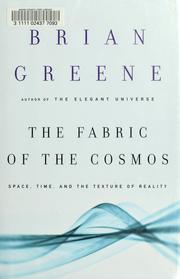
The fabric of the cosmos
A thrilling exploration of the cosmos, brilliantly explained by a popular science master.
Is this book similar?

Books like this one
Dark matter is a fundamental component of the standard cosmological model, but in spite of four decades of increasingly sensitive searches, no-one has yet detected a single dark matter particle in the laboratory. An alternative cosmological paradigm exists: MOND (MOdified Newtonian Dynamics). Observations explained in the standard model by postulating dark matter are explained in MOND by proposing a modification of Newton’s laws of motion. Both MOND and the standard model have had successes and failures – but only MOND has repeatedly predicted observational facts in advance of their discovery. In this volume, David Merritt outlines why such predictions are considered by many philosophers of science to be the ‘gold standard’ when it comes to judging a theory’s validity. In a world where the standard model receives most attention, the author applies criteria from the philosophy of science to assess, in a systematic way, the viability of this alternative cosmological paradigm. “This book gives a very careful analysis of the relation of theory to observational confirmation in astrophysics and cosmology, using as a case study the succession of MOND models proposed by Milgrom. Using Lakatos’s approach, which is contrasted with Popper’s proposals, the book focuses with exemplary clarity on the question of to what extent theories can be taken to be validated by observational tests. This is a great contribution to the philosophy of cosmology, which will also make the reader appreciate the strength of Milgrom’s theory in terms of having, in advance, made predictions which were subsequently confirmed.” GEORGE F. R. ELLIS, University of Cape Town “Merritt’s take on dark matter is as thorough as it is illuminating. It is rare to find arguments so rigorous on both the scientific and philosophical sides, while still being eminently readable... The book is extremely well structured … I think that everyone who has a research interest in astrophysics and cosmology will benefit from reading this book. And I think that physics would much benefit from a similar analysis of inflation and other hypotheses for the early universe, quantum gravity, theories of everything and grand unification, and quantum foundations.'' Sabine Hossenfelder, Frankfurt Institute for Advanced Studies SABINE HOSSENFELDER, Frankfurt Institute for Advanced Studies “David Merritt, in an excellent well-written discussion, considers MOND, an alternative to dark matter, in terms of the ideas of Karl Popper and Imre Lakatos. In assessing a scientific theory, Popper emphasized falsification over verification, but in practice a theory may grow in content through a ‘research program.’ This growth is judged to be progressive if it successfully predicts new phenomena not related to those the theory was designed to explain. Merritt traces the MOND research program through various stages, pointing out numerous progressive successes. The point is that MOND is essentially predictive; the standard theory, dark matter, is essentially reactive.” ROBERT H. SANDERS, University of Groningen
Discover your next read
Compare books other readers have recommended. Vote to help improve these suggestions.
Looking for more books like A Philosophical Approach to MOND by David Merritt? This list brings together suggested alternatives and feedback from SimilarBooks readers. Ratings reflect what readers think of each individual book, while the Yes and No votes show whether visitors consider it a good match for this title. Compare the recommendations below and suggest another book to help fellow readers discover their next read.
A thrilling exploration of the cosmos, brilliantly explained by a popular science master.

In **Dark Matter and the Dinosaurs**, Lisa Randall links the K–T extinction event to a comet dislodged by a dark–matter disk in our galaxy, explo...
physics

A comprehensive textbook on astronomy, helping you understand science and the universe around us.
The Structure of Scientific Revolutions by Thomas S. Kuhn.
Astronomy, Cosmology, philosophy of science, history of astronomy, dark matter
Community ratings describe each book independently. Similarity votes measure whether readers consider a recommendation a good match for this particular title; results can change as more visitors share feedback.
Suggest another book below, or vote Yes or No on any existing recommendation.
Share your suggestion →Readers make discovery better
Share a recommendation and help other readers discover their next great read.