Books like The Eleven Pictures of Time by C. K. Raju
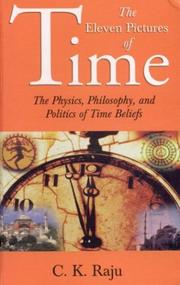

A book on how church politics transformed religious beliefs about time which then got into modern science. See the backcover at http://ckraju.net/11picsoftime/11picsoftime/Back-Cover.html
First publish date: October 9, 2003
Authors: C. K. Raju
★ ★ ★ ★ ★ 0.0 (0 community ratings)

The Eleven Pictures of Time by C. K. Raju

How are these books recommended?

The books recommended for The Eleven Pictures of Time by C. K. Raju are shaped by reader interaction. Votes on how closely books relate, user ratings, and community comments all help refine these recommendations and highlight books readers genuinely find similar in theme, ideas, and overall reading experience.


Have you read any of these books?
Your votes, ratings, and comments help improve recommendations and make it easier for other readers to discover books they’ll enjoy.

Books similar to The Eleven Pictures of Time (10 similar books)

A Brief History of Time by 6965847|Stephen Hawking book cover

πŸ“˜ A Brief History of Time

Stephenβ€―Hawking explains the fundamental physics of the universeβ€”space, time, cosmology, black holes, and the Big Bangβ€”in clear, accessible language.

β˜…β˜…β˜…β˜…β˜…β˜…β˜…β˜…β˜…β˜… 4.2 (203 ratings)
Similar? ✓ Yes 0 ✗ No 0
Time and Again by 6953443|Jack Finney book cover

πŸ“˜ Time and Again

Jack Finney’s classic time‑travel tale follows commercial artist Siβ€―Morley, recruited by the U.S. Army to imagine himself in 1882 New York, where he encounters love and paradoxes while navigating a secret project that rewrites history.

β˜…β˜…β˜…β˜…β˜…β˜…β˜…β˜…β˜…β˜… 3.7 (3 ratings)
Similar? ✓ Yes 0 ✗ No 0
Time wars by 8359842|Jeremy Rifkin book cover

πŸ“˜ Time wars


β˜…β˜…β˜…β˜…β˜…β˜…β˜…β˜…β˜…β˜… 5.0 (1 rating)
Similar? ✓ Yes 0 ✗ No 0
A future for presentism by 6959106|Craig Bourne book cover

πŸ“˜ A future for presentism


β˜…β˜…β˜…β˜…β˜…β˜…β˜…β˜…β˜…β˜… 4.0 (1 rating)
Similar? ✓ Yes 0 ✗ No 0
Time, creation and the continuum by 7392113|Richard Sorabji book cover

πŸ“˜ Time, creation and the continuum

Richard Sorabji here takes time as his central theme, exploring fundamental questions about its nature: Is it real or an aspect of consciousness? Did it begin along with the universe? Can anything escape from it? Does it come in atomic chunks? In addressing these and myriad other issues, Sorabji engages in an illuminating discussion of early thought about time, ranging from Plato and Aristotle to Islamic, Christian, and Jewish medieval thinkers. Sorabji argues that the thought of these often neglected philosophers about the subject is, in many cases, more complete than that of their more recent counterparts.

β˜…β˜…β˜…β˜…β˜…β˜…β˜…β˜…β˜…β˜… 0.0 (0 ratings)
Similar? ✓ Yes 0 ✗ No 0
The direction of time by 7464594|Hans Reichenbach book cover

πŸ“˜ The direction of time


β˜…β˜…β˜…β˜…β˜…β˜…β˜…β˜…β˜…β˜… 0.0 (0 ratings)
Similar? ✓ Yes 0 ✗ No 0
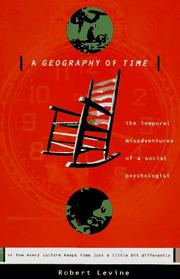
A geography of time by 8164659|Levine, Robert book cover

πŸ“˜ A geography of time

In this engaging and spirited book, eminent social psychologist Robert Levine asks us to explore a dimension of our experience that we take for granted - our perception of time. When we travel to a different country, or even a different city in the United States, we assume that a certain amount of cultural adjustment will be required, whether it's getting used to new food or negotiating a foreign language, adapting to a different standard of living or another currency. In fact, what contributes most to our sense of disorientation is having to adapt to another culture's sense of time. Levine, who has devoted his career to studying time and the pace of life, takes us on an enchanting tour of time through the ages and around the world. As he recounts his unique experiences with humor and deep insight, we travel with him to Brazil, where to be three hours late is perfectly acceptable, and to Japan, where he finds a sense of the long-term that is unheard of in the West. We visit communities in the United States and find that population size affects the pace of life - and even the pace of walking. We travel back in time to ancient Greece to examine early clocks and sundials, then move forward through the centuries to the beginnings of "clock time" during the Industrial Revolution. Levine raises some fascinating questions. How do we use our time? Are we being ruled by the clock? What is this doing to our cities? To our relationships? To our own bodies and psyches? Are there decisions we have made without conscious choice? Alternative tempos we might prefer? Perhaps, Levine argues, our goal should be to try to live in a "multitemporal" society, one in which we learn to move back and forth among nature time, event time, and clock time.

β˜…β˜…β˜…β˜…β˜…β˜…β˜…β˜…β˜…β˜… 0.0 (0 ratings)
Similar? ✓ Yes 0 ✗ No 0
The Physical Basis of the Direction of Time by 6380390|H. D. Zeh book cover

πŸ“˜ The Physical Basis of the Direction of Time
 by H. D. Zeh

An examination of the physical origin of time’s direction, focusing on radiation, thermodynamics, quantum indeterminism and spacetime structure, and proposing a common root in the universe’s time‑independent wave function.

β˜…β˜…β˜…β˜…β˜…β˜…β˜…β˜…β˜…β˜… 0.0 (0 ratings)
Similar? ✓ Yes 0 ✗ No 0
Time Maps by 6691160|Eviatar Zerubavel book cover

πŸ“˜ Time Maps

"Who were the first people to inhabit North America? Does the West Bank belong to the Arabs or the Jews? Why are racists so obsessed with origins? Is a seventh cousin still a cousin? Why do some societies name their children after dead ancestors?" "As Eviatar Zerubavel demonstrates in Time Maps, we cannot answer questions such as these without a deeper understanding of how we envision the past. In a pioneering attempt to map the structure of our collective memory, Zerubavel considers the cognitive patterns we use to organize the past in our minds and the mental strategies that help us string together unrelated events into coherent and meaningful narratives, as well as the social grammar of battles over conflicting interpretations of history. Drawing on fascinating examples that range from Hiroshima to the Holocaust, from Columbus to Lucy, and from ancient Egypt to the former Yugoslavia, Zerubavel shows how we construct historical origins; how we tie discontinuous events together into stories; how we link families and entire nations through genealogies; and how we separate distinct historical periods from one another through watersheds, such as the invention of fire or the fall of the Berlin Wall." "Most people think the Roman Empire ended in 476, even though it lasted another 977 years in Byzantium. Challenging such conventional wisdom, Time Maps will be must reading for anyone interested in how the history of our world takes shape."--Jacket.

β˜…β˜…β˜…β˜…β˜…β˜…β˜…β˜…β˜…β˜… 0.0 (0 ratings)
Similar? ✓ Yes 0 ✗ No 0
The discovery of time by 6597468|Stephen Edelston Toulmin book cover

πŸ“˜ The discovery of time


β˜…β˜…β˜…β˜…β˜…β˜…β˜…β˜…β˜…β˜… 0.0 (0 ratings)
Similar? ✓ Yes 0 ✗ No 0

Some Other Similar Books

The Philosophy of Time: A Critical Introduction by Robert C. Koons
Time and Reality by Timothy O'Connor
The End of Time: The Next Revolution in Physics by Julian Barbour
The Nature of Time by Stanley J. Goldfarb
Time and Space: A Modern Introduction by Lawrence Sklar
Kant and the Philosophy of Time by Henry E. Allison
Time and Causality: A Critical Overview by Hartry H. Field
The Puzzle of Time: Why It Matters by James Hartle
The Philosophy of Time by Gregory R. Cox
The Order of Time by Carlo Rovelli
Time Travel: A History by James Gleick
The Future of Time: Nature and Culture by SeΓ‘n D. Kelly
Time and the Novel by William-view
The Physics of Time by Karen Crowther
Time in History by Maya Jasanoff
The Story of Time by Kristin R. Dieffenbach

Have a similar book in mind? Let others know!

Please login to submit books!