
Introduction to logic
A concise introductory textbook that outlines the fundamentals of logic and critical reasoning for students and scholars.
Is this book similar?
Books like this one
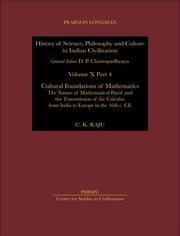
**From the backpage** (http://ckraju.net/IndianCalculus/back_page.htm) The volumes of the Project of History of Science, Philosophy and Culture in Indian Civilization aim to discover the central aspects of India’s heritage and present them in an interrelated manner. In spite of their unitary look, these volumes recognize the difference between the areas of material civilization and those of ideational culture. The Project is not being executed by a single group of thinkers, methodologically uniform or ideologically identical in their commitments. Rather, contributions are made by different scholars of diverse ideological persuasions and methodological approaches. The Project is marked by what may be called ‘methodological pluralism’. In spite of its primarily historical character, this project, both in its conceptualization and execution, has been shaped by scholars drawn from different disciplines. It is the first time that an endeavour of such unique and comprehensive character has been undertaken to study critically a major world civilization. This volume examines in depth the implications of Indian history and philosophy for contemporary mathematics and science. The conclusions challenge current formal mathematics and its basis in the Western dogma that deduction is infallible (or that it is less fallible than induction). The development of the calculus in India, over a thousand years, is exhaustively documented in the volume, along with novel insights, and is related to the key sources of wealth—monsoon-dependent agriculture and navigation required for overseas trade—and the corresponding requirement of timekeeping. Rejecting the usual double standard of evidence used to construct Eurocentric history, a single, new standard of evidence for transmissions is proposed. Using this, it is pointed out that Jesuits in Cochin, following the Toledo model of translation, had long-term opportunity to transmit Indian calculus texts to Europe. The European navigational problem of determining latitude, longitude, and loxodromes, and the 1582 Gregorian calendar-reform, provided ample motivation. The mathematics in these earlier Indian texts suddenly starts appearing in European works from the mid 16th c. onwards, providing compelling circumstantial evidence. While the calculus in India had valid pramāna, this differed from Western notions of proof, and the Indian (algorismus) notion of number differed from the European (abacus) notion. Hence, like their earlier difficulties with the algorismus, Europeans had difficulties in understanding the calculus, which, like computer technology, enhanced the ability to calculate, albeit in a way regarded as epistemologically insecure. Present-day difficulties in learning mathematics are related, via “phylogeny is ontogeny”, to these historical difficulties in assimilating imported mathematics. An appendix takes up further contemporary implications of the new philosophy of mathematics for the extension of the calculus needed to handle the infinities arising in the study of shock waves and the renormalization problem of quantum field theory.
Discover your next read
Compare books other readers have recommended. Vote to help improve these suggestions.
Looking for more books like Cultural Foundations of Mathematics by C. K. Raju? This list brings together suggested alternatives and feedback from SimilarBooks readers. Ratings reflect what readers think of each individual book, while the Yes and No votes show whether visitors consider it a good match for this title. Compare the recommendations below and suggest another book to help fellow readers discover their next read.
A concise introductory textbook that outlines the fundamentals of logic and critical reasoning for students and scholars.
Logic, History and Philosophy of Mathematics, History of Calculus, New Philosophy of Mathematics
Community ratings describe each book independently. Similarity votes measure whether readers consider a recommendation a good match for this particular title; results can change as more visitors share feedback.
Suggest another book below, or vote Yes or No on any existing recommendation.
Share your suggestion →Readers make discovery better
Share a recommendation and help other readers discover their next great read.